Height decides, not age. A high-back booster from 100 cm, a backless booster from 125 cm, the belt alone from 135 cm: three figures settle the question, and none of them arrives on a birthday. Measure your child, enter the numbers, read the category.
The rest of this page explains where those thresholds come from, what they do not cover, and why the commonest mistake is moving up a category too early.
Which car seat does my child need?
Three measurements, one approved category. Height and weight decide; age only governs two precise rules.
Your child
Measure standing, heels against the wall, no shoes. Height is the main criterion of regulation R129.
Weight stays a ceiling even under R129: every seat carries a maximum weight on its approval label.
Age decides nothing except two things: the 15 months of rear facing, and the 3 years below which no Belgian exemption applies.
Today
Used to catch a premature move to the next category. The AWSR warns against changing too quickly in its July 2026 brochure.
Rear positions are the safest, and the centre position the safest of the three when it is a full position with a three-point belt.
Result
Group 1, harness or impact shield
The harness holds the child, not the car belt. Stay in this category as long as the seat maximum weight is not reached and the eye line stays below the top of the backrest.
Child restraintCompulsory
Installation directionForward facing allowed, rear facing recommended
Backless boosterNot approved at this height yet (125 cm)
Next threshold2 cm → 100 cm
The seat used today belongs to a more advanced category than these measurements call for. Moving up too early is the most common mistake: go back to the category above for as long as the current seat allows it.
Three signs it is time to change seat
- The weight goes above the maximum printed on the seat.
- Group 0+: the head comes close to the top edge of the shell. Groups 1 and 2/3: the eyes reach the top of the backrest.
- Rear facing, the harness must come out at shoulder height or just below. Forward facing, at shoulder height or just above.
Regulatory thresholds used
Figures taken from the brochure "En voiture avec un enfant" published by the Walloon road safety agency AWSR, July 2026 edition, and from articles 35 and 44 of the Belgian highway code as set out by Vias institute. Consulted on 25/09/2026. Change them if a more recent version gives other figures.
Guidance, not an approval
This tool points to an approved seat category from the Belgian regulatory thresholds. It recommends no model, no brand and no product. Only the approval label on your seat, its handbook and your vehicle handbook are authoritative, including where they contradict the result above: a seat may be approved over a wider or narrower range than the default values. The compatibility list published by the seat maker settles the question of the seating position. If in doubt, ask the maker, a specialist retailer or the Walloon road safety agency. This site is neither an approval body nor a road safety service.
Which car seat for which age, at a glance?
Read the table by height. The ages are orders of magnitude, never a criterion.
| Height of the child | Approved category | Installation direction | Limit that closes the category |
|---|---|---|---|
| Birth to 87 cm | Group 0+, infant carrier | Rear facing, exclusively | 13 kg, or the head at the shell edge |
| 87 to 105 cm | Group 1, harness or impact shield | Rear facing to 15 months minimum, then either way | 18 kg, or the eyes at the top of the backrest |
| 100 to 125 cm | Group 2/3, high-back booster | Forward facing | 36 kg, or 150 cm |
| 125 to 135 cm | Backless booster possible | Forward facing | 36 kg, or 150 cm |
| 135 cm and above | Three-point seat belt | No device | Nothing, the law stops there |
These values come from the brochure En voiture avec un enfant published by the Walloon road safety agency AWSR, July 2026 edition, and from the legal framework set by articles 35 and 44 of the Belgian highway code. Some models widen their range: a group 1 seat can go to 125 cm and 36 kg, a booster to 50 kg. Only the approval label stuck on the side of your seat is authoritative.
One zone overlaps, between 100 and 105 cm, and it deserves a stop. The booster becomes legal, the harness stays preferable. As long as the seat maximum weight is not reached and the child's eyes do not clear the top of the backrest, there is no reason to change.
Why does height outrank both age and weight?
Because the car belt is drawn for a body of a certain length, and nothing else tells you where it will land.
The lap strap has to bear on the hips, below the stomach. Until roughly ten years old a child's pelvic bones are not developed enough to hold it: in an impact it rides up and compresses the abdomen. A booster does nothing except raise the child so the strap falls back where it belongs. Seat height is geometry, and geometry is measured in centimetres.
That is the reasoning behind the European R129 standard, in force since 2013, which classifies seats by height. The older R44 standard classified them by weight, and it is still in everyone's head because millions of seats sold before September 2024 carry its label. Both standards are legal side by side. They do not always say the same thing.
Where the two standards diverge
| Weight of the child | Allowed by the older R44 standard | Required by the height threshold | The gap |
|---|---|---|---|
| 9 kg | Group I, forward facing possible | Rear facing to 15 months minimum | Up to six months of early turning |
| 13 kg | Move to group I | 87 cm, reached earlier or later per child | Whichever comes first closes group 0+ |
| 15 kg | Group II, so a booster | 100 cm, sometimes not reached | The booster arrives before the belt sits right |
| 22 kg | Group III, backless booster possible | 125 cm for a backless booster | The widest gap in the grid |
| 36 kg | End of group III | 150 cm | The two standards meet again |
The table boils down to one sentence: wherever the two standards disagree, height is always the more cautious of the two. A child of 15 kg measuring 96 cm falls into R44 group II and could legally sit on a booster approved to that standard. Four centimetres are missing for the belt to run where it should.
From what height can a child move to a booster?
100 cm, with a backrest. The AWSR puts it in writing: high-back boosters only offer good protection from 100 cm.
The backrest is not a comfort accessory. It brings two things a plain cushion has not: the side protection that takes a lateral impact, and the belt guide at headrest height that runs the diagonal strap across the shoulder rather than the neck. On a child of 105 cm, the difference between the two comes down to a few centimetres of webbing.
1 child in 4
Share of children correctly restrained in a suitable seat in Wallonia; one child in ten is not restrained at all (AWSR, July 2026 brochure)
And the signal that says it is time to change is not a round number, it is an eye line. On a group 1 seat as on a group 2/3 seat, once the child's eyes reach the top edge of the backrest, the category is finished. On a group 0+ shell, it is the head coming close to the edge of the shell. Two seconds of checking, door open.
Is a backless booster allowed before 125 cm?
No. Backless boosters may only be used from 125 cm, and the tool refuses them below that.
This is where boot floors across the country are breaking the rule. The flat backless cushion, the one that lives in the car for Wednesday's school run, only becomes compliant at 125 cm. Before that it raises without protecting: no side protection, no shoulder belt guide.
Until what age is a car seat compulsory in Belgium?
Until 135 cm, and the law never mentions an age.
The Belgian highway code, as set out by Vias institute, requires a suitable restraint for every child under 18 measuring less than 135 cm. Children over 135 cm and adults under 135 cm are not covered. The rule is federal: identical in Wallonia, Brussels and Flanders.
A breach is a third-degree offence, carrying an on-the-spot fine of 191 euros, plus an administrative fee indexed every year. Many Belgian pages still quote 174 euros: that is the pre-indexation figure, and it has been copied from site to site for years.
One detail the law settles and nobody reads: it stops at 135 cm, while boosters are approved up to 150 cm. Nothing forces you to bin the booster the day the measuring stick allows it, and the AWSR explicitly advises keeping it beyond that point if the child does not object.
Léa is 98 cm and 15 kg: the booster is too early
Wavre, a Tuesday morning, nursery school drop-off. Léa is three years and two months old, 98 cm on the paediatrician's stick, 15 kg on the bathroom scales. Her parents have just bought her a high-back booster, because she went past 15 kg and they read somewhere that this was the group II threshold.
Let us run the calculation by hand, in the order the tool follows.
First test, the obligation: 98 cm, so under 135 cm, so a restraint is compulsory. Second test, group 0+: its maximum height is 87 cm, Léa is 98 cm, the carrier is behind her. Third test, group 1: ceiling at 105 cm and 18 kg, Léa fits both, she belongs there. Fourth test, the booster: it starts at 100 cm and Léa measures 98. She is 2 cm short.
The verdict fits on one line: Léa stays in her harness seat, and the booster waits two centimetres. Her 15 kg would have moved her up under the older R44 standard, her 98 cm hold her back under the height logic. Between the two readings, the second is the one that protects, because it is the only one that knows where the strap will land.
Two months later Léa will pass 100 cm and the booster will become legal. It will not thereby become advisable: as long as her eyes stay below the top of her harness seat backrest and she stays under 18 kg, the harness will do better. Those are two different questions, and mixing them up costs months of protection.
Three children in the back: what does Belgian law actually say?
It covers the case. A page written for France cannot tell you that, because French law does not know these exemptions.
The Belgian highway code allows three of them, set out by Vias institute on secumobilite.be, and all three apply only to a child of at least three, seated on the rear bench:
- The seating position has no seat belt.
- Two restraints are already fitted and a third will no longer go in.
- The child is being driven by someone other than the parents, occasionally and over a short distance.
The second exemption is the large-family one, and it is poorly understood. It does not say the third child travels loose: wearing the belt is compulsory. Nor does it say you can arrange things to suit, since it assumes two seats really are fitted.
The third carries a trap the AWSR flags and that rarely surfaces: your own child is never an occasional passenger. If you are driving, they must always be in their seat. The exemption exists for the friend brought back from football, not for yours.
Two placement rules complete the picture. Below three years, no exemption applies, ever. And a rear-facing seat never goes in front of an active frontal airbag: if the airbag cannot be deactivated, that position is out, with no exception.
Which mistakes push a child into the wrong category?
Five, and they all pull the same way: they move the child up too early.
- Reading the weight when height is what decides. The direct legacy of the R44 standard. The 15 kg of group II and the 22 kg of group III are weight thresholds, and they almost always arrive before the matching centimetres.
- Taking the age on the box for a rule. Packaging gives indicative age brackets to help with the purchase. None of them carries any regulatory weight.
- Leaving the winter coat on. The padding compresses at the moment of impact and creates slack in the harness, invisible when you buckle up. A correct harness leaves no more than one centimetre of slack and cannot be pinched between two fingers.
- Buying a 0+/1/2/3 multi-group seat to cover ten years. It covers ten years and fits each of the stages poorly, which the AWSR says without hedging.
- Believing a second-hand seat with no history is a bargain. After an impact, even a light one, a seat is replaced. A shell cracked on the inside does not show, and the seller does not always know either.
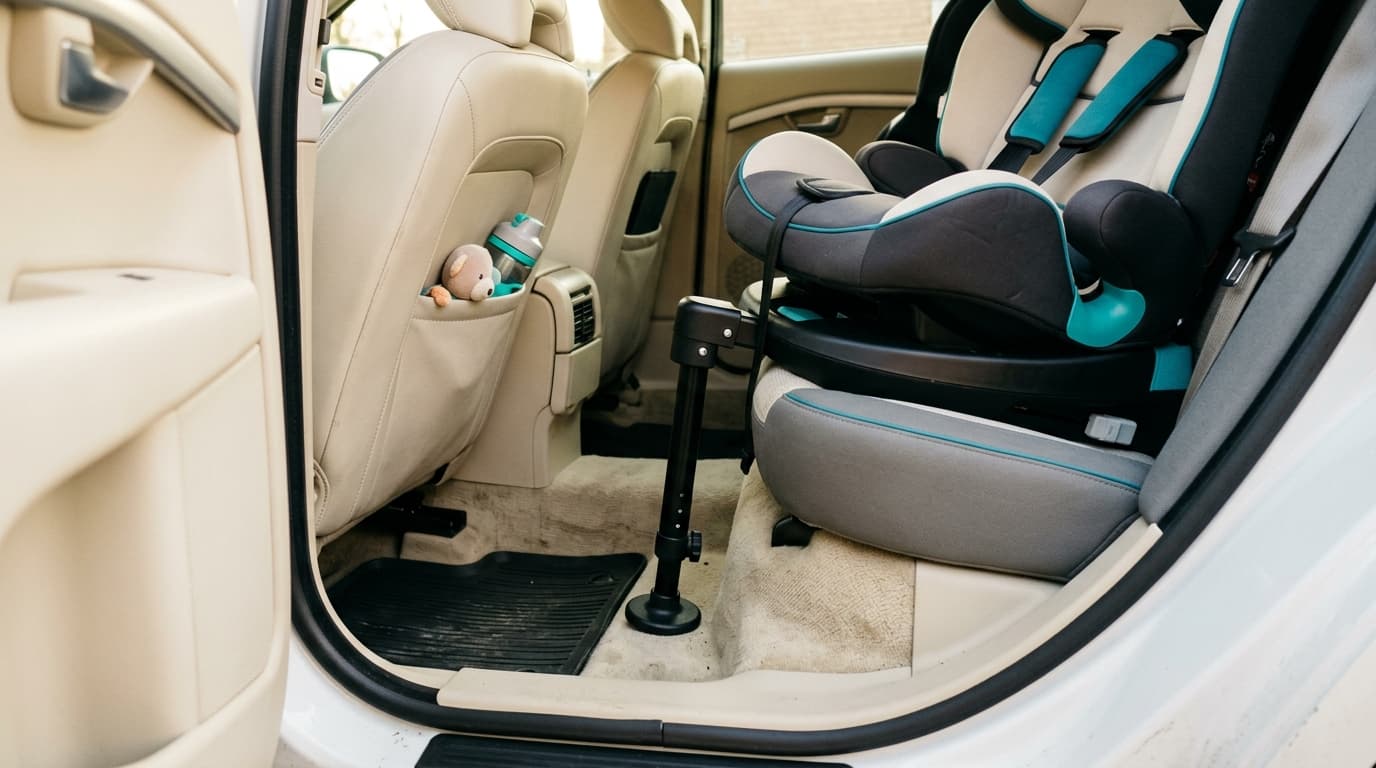
Léa will keep her harness until spring, and the booster stays in its box on the garage shelf. For what comes next, we have set out elsewhere how long to keep a rear-facing seat, why a support leg does not suit every floor, and what to check on a second-hand car seat. To count the Isofix positions you can genuinely use in your next family car, go through our comparison tool.
Comparateur Monospaces & ludospaces
Compare tous les monospaces & ludospaces côte à côte.
Comparer maintenant →
Frequently asked questions
Audrey teste des familiales depuis 2015, maman de deux enfants, basée à Wavre. Elle installe vraiment les sièges Isofix avant de juger l’habitabilité et calcule le budget sur cinq ans, carburant et entretien compris. Sa boussole : peut-on y mettre deux sièges-auto et les courses sans jouer à Tetris ?