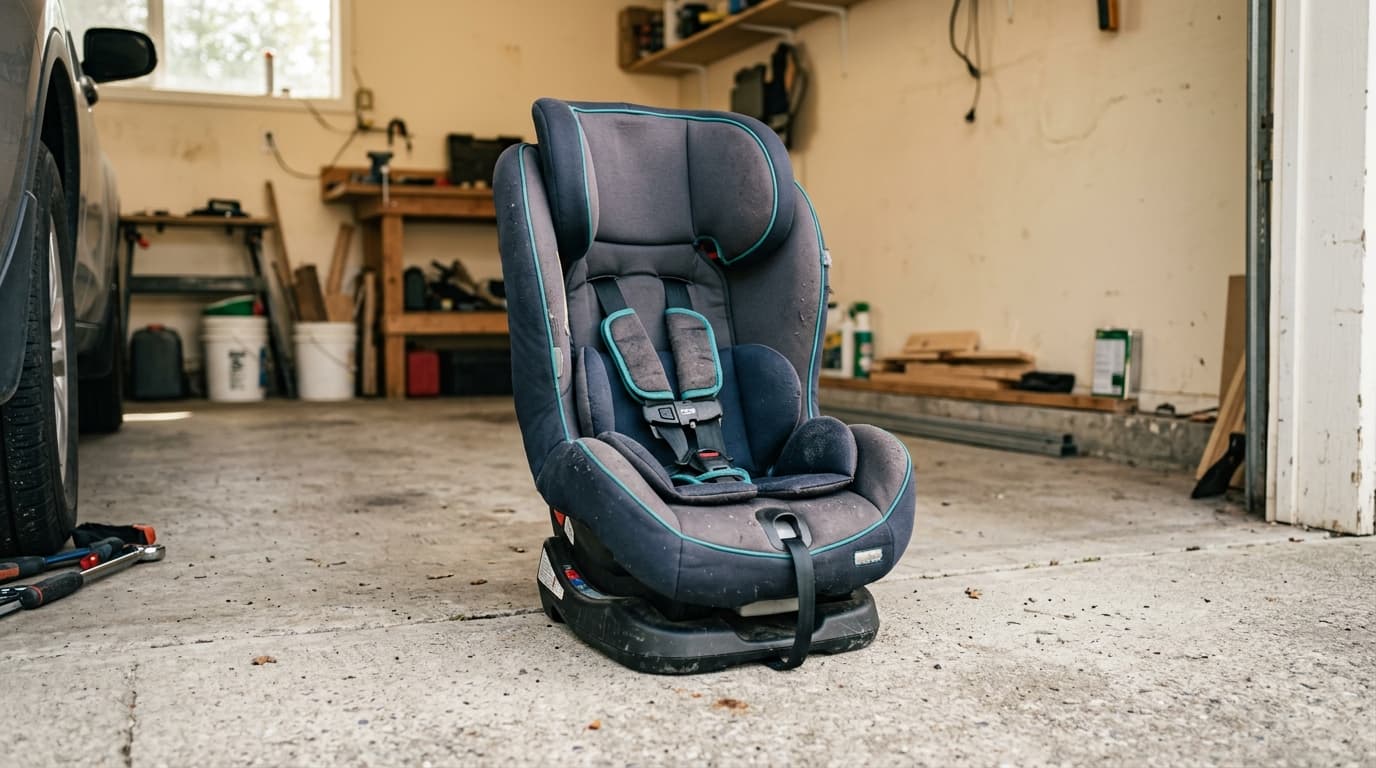
A second-hand car seat is neither banned nor automatically dangerous. It is simply shorter: part of its service life has already been used up, and nothing on the shell will tell you how much. What remains is to price the years left, in euros, before saying yes.
Can you buy a second-hand car seat?
Yes, with no legal restriction in Belgium. And nearly every safety body advises against it, for a reason that is not the one people expect.
The reason always given first is the invisible crash. A seat that has absorbed an impact, even a light one, can carry micro-cracks in its structure with nothing visible to the naked eye, and nobody can promise it will hold next time. That is true, and it is not enough: an honest seller who has never had a crash will tell you so, and you will have no way to verify it. The obstacle has a name, and it is the absence of proof, in either direction.
The second reason is more measurable, and far less often told. The TCS, the Swiss touring club, which has been crash-testing child seats for decades, put an old R44/02 approved seat through a spot check: the belt routing gave way, and seat and dummy were thrown into the front seat. Those very old approvals, granted before 1995, are banned today. But the mechanism they illustrate does not stop at an approval date.
No rule imposes an expiry date
The word "expiry" is borrowed from food packaging, and it misleads.
There is no official end-of-use date for a child car seat anywhere in European regulation, and manufacturers are under no obligation to state one, as Sécurange, an independent French child car safety reference, points out. Nobody checks anything. Nobody penalises anything.
The shell carries something else: a date stamp moulded into the plastic, often a small clock face, sometimes two figures inside a circle. It gives the year and week of production, more rarely the day and month. That is a date of birth, not a deadline. The whole question is how many years you count from it, and that is exactly where the available advice stops.
How many years does a car seat really last?
Between five and nine, depending on the type of seat, according to TCS recommendations. The reason is physical and it is worth thirty seconds.
A car seat protects through its expanded polystyrene, which deforms and absorbs the energy of an impact. That material ages. It hardens, it settles, it loses part of its cushioning ability, and none of this produces any visible sign: the shell looks exactly the same at nine years as at one. Add the structural plastic, exposed to summers at sixty degrees behind a windscreen and to winters at zero, and you have an object that ages badly while never looking any older.
The service lives recommended by the TCS are these: around 5 years for a group 0+ infant carrier, 6 years for a group I seat, 9 years for a group II/III booster. Other bodies land on neighbouring ranges, 5 to 10 years depending on the brand, with one shared common-sense rule: past eight to ten years, stop.
Let us set out the calculation nobody sets out: the recommended use remaining, by the age of the seat at the moment it is offered to you.
| Age of seat at purchase | Group 0+ carrier | Group I seat | Group II/III booster |
|---|---|---|---|
| New | 5 years | 6 years | 9 years |
| 2 years | 3 years | 4 years | 7 years |
| 3 years | 2 years | 3 years | 6 years |
| 5 years | used up | 1 year | 4 years |
| 7 years | used up | used up | 2 years |
| 10 years | used up | used up | used up |
Read it straight through: a second-hand seat is almost always sold after a first child, so at two to four years old. On an infant carrier, that means half the recommended life has gone before you have buckled the first harness.
€329.99 new, €165 the break-even at three years
The decisive figure is the one nobody ever gives: the cost per year of use. Without it, "cheaper" means nothing.
Take a seat sold in Belgium today. The Maxi-Cosi Pearl 360, group 0+/1, approved from 40 to 105 cm and usable from birth to around four years, was listed at €329.99 at Dreambaby, a Belgian nursery retailer, on 19 September 2026, in Authentic Graphite. It meets the i-Size standard with the FamilyFix 360 base, sold separately. Taking the six years the TCS recommends for a seat in this group, the new item works out at €55.00 per year of use.
€55.00
Cost of one recommended year of use for a new group I seat at €329.99 (Belgian price checked on 19 September 2026)
Now the same seat made three years ago, offered used at half price, so €165. It has three recommended years left. Cost per year of use: €55.00. Exactly the same.
This is the result that surprises everyone, me included the first time I worked it out on the corner of a table. Half the price for half the life is a wash. Buying used only becomes genuinely cheaper if the discount is deeper than the share of life already spent: below €165 for a three-year-old seat you gain something; above it, you pay more per year of use than new, and you inherit a history you know nothing about on top. On Belgian classifieds, recent branded seats rarely change hands below half the list price.
One case is the exception, and it is a common one: the seat you are given. A cousin, a neighbour, a colleague clearing out the attic. The cost per year drops to zero, the price question disappears, and only the history question is left, which is handled differently.
Car-Pass documents the car, nothing documents the seat
The Belgian asymmetry is striking once you look at it head on.
To buy a used car in Belgium, you must be given a Car-Pass, an official document tracing the mileage recorded at every workshop visit and roadworthiness test. The country built a tool to stop anyone lying to you about the history of a body shell. For the seat you buckle inside it, holding a fifteen-kilo child at a hundred and twenty kilometres an hour, nothing exists. No register, no logbook, no declaration requirement, no inspection.
The history of a child car seat rests entirely on the word of the person selling it to you.
Two blind spots follow from that, and those are verifiable. The first is the crash: a seller who had a low-speed rear-end shunt three years earlier may genuinely not think of it, or not know that it counts. The second is the product recall. Child seats are regularly recalled across Europe, and the European Commission publishes an annual review of the Safety Gate alert system, in which articles for children weigh heavily. A second-hand buyer is on no customer list: they never received the letter, and they will never know their model was recalled. Checking the exact reference against the European database before buying takes five minutes, and almost nobody does it.
What to check on a seat that has already been used
If you are going ahead anyway, and there are good reasons to, the TCS recommends running this list before any use. It is done on the spot, seat in hand, never from a photo.
- The approval label, usually orange: R129 or R44/04 acceptable, R44/03 legal but discouraged, R44/01 and R44/02 banned. No legible label, no purchase.
- The moulded date stamp, so you work out the real age rather than trusting the "bought two years ago" in the listing.
- The straps and belt guides, examined piece by piece: fraying, cuts, marked fading on one side only.
- The locks, the buckle and the adjusters: everything should click home firmly and release without force, including the harness height adjustment.
- The cover removed, to inspect the bare shell and spot cracks, whitened creases or loose parts. This is the step nobody takes and the most useful one.
- The manual, or failing that its PDF on the manufacturer's site, without which you will know neither how to fit it nor its height limits.
Hanna and Nils, both in their thirties, near Eupen in the German-speaking east of Belgium, are expecting their second child in December. Nils's cousin offered them his group I seat, bought new, never crashed as far as he knows. Date stamp read on the shell: week 34 of 2019. Seven years. Of the six years recommended for that group, nothing is left, and the price question no longer even arises. They turned it down, politely, and kept the high-back booster the same family was throwing in, that one made in 2023 and good for six more years.
Does a replacement cover change anything?
A great deal. An original cover is part of the seat's approval: its composition, its thickness and the way it behaves in a crash were tested with the shell. A universal cover bought separately was not, and it can change the way the harness holds the child down. If a second-hand seat turns up with a cover that is clearly not the manufacturer's, that is a reason to refuse in its own right, not a cosmetic detail.
And if family hands you their eldest child's seat?
That is the best possible configuration, by a distance. You know the people, you know the car, you can ask without awkwardness whether it has been crashed and get a reliable answer. The same age calculation still has to be done, with the same coldness: affection adds no years to polystyrene.
Selling yours without lying
If you are the one selling, three lines make an honest listing and they raise what your seat is worth: the exact standard read off the label, the date read off the stamp, and one sentence about impacts, including to say that there was one. Put the manual in the box. A documented seat sells better than a seat in "very good condition".
Hanna and Nils bought new for the December baby and took the 2023 booster for their eldest. Total for two seating positions: one seat at full price, one at nothing, and two date stamps read by torchlight in a garage in the East Cantons. To check how many Isofix positions your next family car really carries, use our comparison tool, our piece on the support leg and our verdict on rear-facing travel.
Comparateur SUV familiaux & 7 places
Compare tous les suv familiaux & 7 places côte à côte.
Comparer maintenant →
Frequently asked questions
Audrey teste des familiales depuis 2015, maman de deux enfants, basée à Wavre. Elle installe vraiment les sièges Isofix avant de juger l’habitabilité et calcule le budget sur cinq ans, carburant et entretien compris. Sa boussole : peut-on y mettre deux sièges-auto et les courses sans jouer à Tetris ?