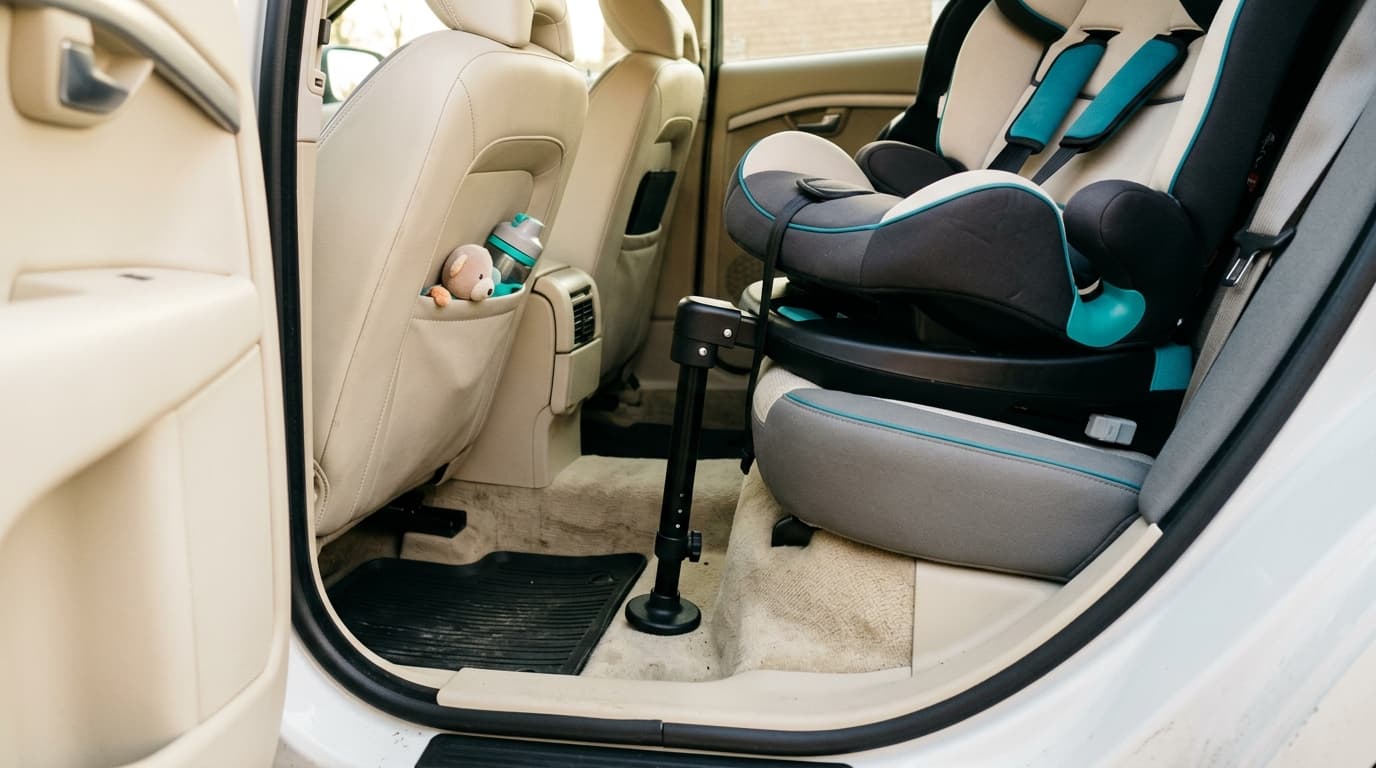
A support leg is not an option on the car seat, it is a condition set by your car. It has to stand on a solid floor. In MPVs and van-based family cars, the very ones families buy for their storage space, it often lands straight on a floor hatch. The top tether then takes over.
Support leg or top tether: which should you choose?
Whichever your car accepts. The question has no answer in the abstract, and that is exactly what product pages never say.
An i-Size seat holds the child with two Isofix connectors, plus a third point that stops it tipping forward in a frontal impact. Two solutions exist, and any given seat almost always offers just one: the support leg, a telescopic foot resting on the floor, or the top tether, a strap running from the top of the backrest to an anchor behind the seating position. Securange, a French child-safety reference that has documented these fittings for years, puts it plainly: both do the same job, and no test body ranks one above the other.
Elke and Wouter, both in their thirties, have two children aged 2 and 5 and cover 14,000 km a year in a used compact MPV, in the Kempen region near Turnhout, in the north of Belgium. They ordered a base with a support leg because it had been described to them as the safer choice. The leg never once sat flat.
| Criterion | Support leg | Top tether |
|---|---|---|
| Bearing point | the floor of the car | an anchor hook behind the seating position |
| What to check | solid floor, no bin or hatch | that the hook exists, and exactly where |
| Centre seat | often impossible, transmission tunnel | possible if the hook exists, which is rare |
| Adjustment | telescopic height, contact indicator | strap tension, colour indicator |
| Most common mistake | leg resting on a storage bin lid | strap run under a parcel shelf, or slack |
| Decided by | the car handbook | the car handbook |
| Combines with the other | almost never | almost never |
The third anchor point in one sentence
Two Isofix connectors hold the seat at the bottom. They do not stop it swinging forward.
The third point exists for that, and for nothing else. Isofix anchors have been fitted to at least two rear seats on every new passenger car sold in Europe since 2006, but the anti-rotation device arrives with the seat you buy, not with the car.
Why does a support leg not fit every floor?
Because it transfers load into the floor, and a hollow floor transfers nothing.
The telescopic foot is not decorative. In a frontal impact it takes part of the energy and channels it into the structure of the car. Standing on a plastic lid that closes a storage bin, it stands on thin air: the lid gives way, the third anchor point disappears, and the seat behaves as though it never had one.
The problem targets precisely the cars families buy. MPVs, van-based family cars, estates, and a growing number of electric models with a raised floor: the storage hatch at the feet of the second row has become a selling point, and rightly so, because it swallows sports shoes, an umbrella and two water bottles without eating into the boot. The Citroën Grand C4 SpaceTourer has two of them, with lids, at second-row level. Useful storage eleven months out of twelve, and a missing support on the day it counts.
Three ways out, one of them to be ruled out immediately. Some car makers supply a filler element designed for their vehicle: that is the only acceptable block, because it is dimensioned, documented and named in the handbook. Otherwise, fit the seat in another position, or buy a top tether seat. A plank, an upturned box, a book slipped under the foot are approved by nobody, and none of it shows on a rear bench that looks perfectly tidy.
Then comes the check that really settles it, and it takes three minutes. Securange points out that every maker publishes a vehicle compatibility list for each of its seats. That list outranks the salesperson, the online review and your intuition. The car handbook says what it allows in that exact position; the seat handbook says what the seat requires.
The top tether has traps of its own
It asks for no floor, it asks for a hook. And the hook hides.
Depending on the car, the anchor sits on the back of the seat, on the roof, on the boot floor or on the parcel shelf. It carries a standard pictogram, often tiny and often grey on grey. Running the strap to the wrong place, under a parcel shelf or over a headrest not designed for it, amounts to attaching nothing at all, and the seat will still look perfectly fitted.
Five checks to make before ordering, with the car handbook open:
- The exact location of the top tether hook for the position you want, and its pictogram.
- Whether a bin or hatch sits under the foot, in that exact position and not only in the middle.
- Whether that position appears in the compatibility list published by the seat maker.
- Whether an original filler element exists for your model.
- How the strap runs once the boot is loaded, because a suitcase resting on it leaves it slack.
One detail few families anticipate: on many family cars the centre position has no top tether anchor at all, while both outer seats do. The middle of the bench remains the best protected spot in a side impact, and it is often the one that accepts the fewest things. We have counted elsewhere the Isofix positions genuinely usable in a family car.
What does getting it wrong cost in Belgium?
€171.95, and two minutes of reading would have been enough.
In Belgium, no legal text mentions the support leg. Article 35 of the highway code requires an approved restraint for any child under 1.35 m, the on-the-spot fine is €174 per unprotected child, and Moniteur Automobile notes that the rule is federal: identical in Wallonia, Brussels and Flanders. The document that binds you on the third anchor point is therefore not the highway code but the handbook, and nobody will ever check it at the roadside.
The figure that counts, on the Belgian market. On 2 September 2026 the Maxi-Cosi FamilyFix 360 base, which works with a support leg, is listed at €171.95 at Dreambaby, a Belgian nursery specialist. The Maxi-Cosi Titan Pro2 i-Size, which fits with Isofix plus top tether and covers 76 to 150 cm, appears at €259.00 on the same site.
The two objects cover neither the same age nor the same use, and comparing them line by line would make no sense. The scenario, on the other hand, compares very well. A family that buys the support-leg base first, discovers the storage bin, then buys a top tether seat has spent €430.95 on one seating position, against €259.00 by checking first. The gap is pure waste, and it happens often.
€171.95
Cost of a support-leg base that turns out to be unusable, once the floor of the chosen position is taken up by a storage bin (Dreambaby price checked 2 September 2026)
Elke ended up opening the hatch
One Sunday in June, Wouter took the base out of the box and clicked it in behind the passenger seat. The leg went down, touched, then sank a good two centimetres as soon as he pressed on it. The bin lid flexed under his palm.
They looked for a block first. Then they opened the MPV handbook, which explicitly forbade taking support in that position. No filler kit existed for the model.
The base went back to the shop, exchanged for a top tether seat, and the hook turned out to be on the roof, behind a cover nobody had noticed in three years of driving the car.
Two minutes of handbook before ordering would have saved the round trip. Elke puts it better than I do: they had compared fifteen seats and zero floors.
Can you use a support leg and a top tether together?
Almost never on the same seat. Makers design one or the other, and the seat handbook says which. Combining two devices not intended to work together steps outside the approval, which makes nothing safer.
What if the seat is fitted with the seatbelt?
The third-point question changes shape, because the belt itself provides part of the restraint. One caveat: i-Size seats from 40 to 105 cm fit with Isofix plus an anti-rotation device, not with the belt. Belt installation stays reserved for seats approved for it, with the handbook to back it up.
Rear-facing, does the support leg change role?
It becomes more obvious without changing function. A rear-facing seat sits higher and takes more room, the leg works harder, and the space left for the front passenger shrinks. The question of which way round to fit a seat is covered in detail in our piece on rear-facing seats, and the very first seat in our comparison of infant carrier or carrycot.
Open the handbook before the catalogue. To check the number of Isofix positions and the bench width of your next family car, use our comparison tool and our take on five seats or seven.
Comparateur Monospaces & ludospaces
Compare tous les monospaces & ludospaces côte à côte.
Comparer maintenant →
Frequently asked questions
Audrey teste des familiales depuis 2015, maman de deux enfants, basée à Wavre. Elle installe vraiment les sièges Isofix avant de juger l’habitabilité et calcule le budget sur cinq ans, carburant et entretien compris. Sa boussole : peut-on y mettre deux sièges-auto et les courses sans jouer à Tetris ?