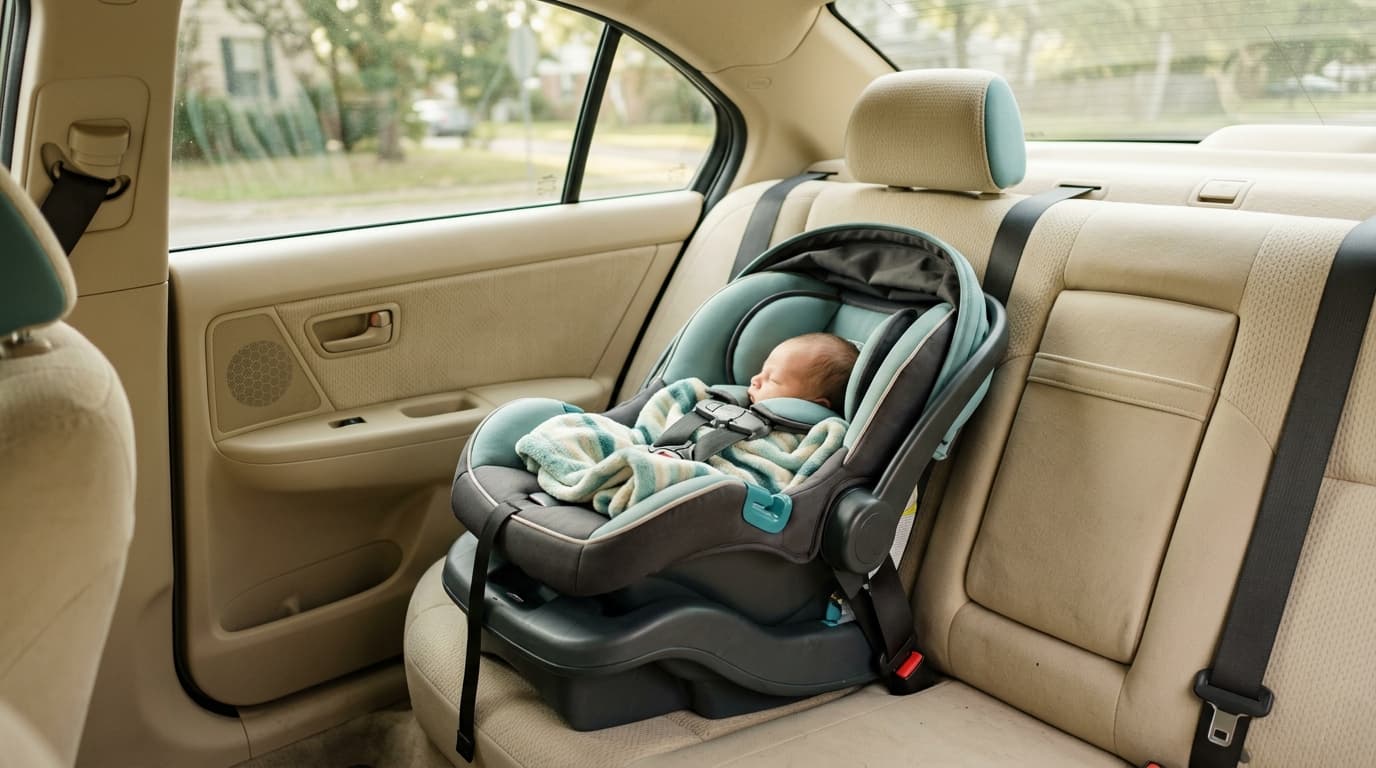
In Belgium, an i-Size approved car seat requires rear-facing travel until 15 months and 76 cm. Safety bodies, for their part, recommend going all the way to 105 cm — about four years. Between the two lies almost three years of difference, and you are the one who decides.
Rear-facing until what age, exactly?
15 months as a legal minimum. About 4 years, or 105 cm, if you follow the safety recommendation and your seat goes that far. Both answers are correct, and they do not say the same thing.
That is the whole difficulty of this question, and the reason parents get lost in it. The law sets a threshold below which you are breaking the rules; safety bodies describe the position that protects best. The first figure is an administrative floor, the second a physiological optimum. Confusing the two means believing you are "done" at fifteen months.
15 of 48 months
Share of the rear-facing protection window actually covered by the i-Size legal requirement: under a third
What does Belgian law actually say?
Two sets of rules overlap. The first is federal and applies to every child; the second comes from the approval of the seat itself.
On the highway code side, every child under 18 measuring less than 1.35 m must travel in a restraint system suited to their height and weight. The federal police point out that the driver is responsible, and the fine is an immediate €174 penalty. Nothing in there mentions the direction of travel. The rule is federal: it does not change in Wallonia, Brussels or Flanders.
On the approval side, the European R129 standard — known as i-Size — is what matters. It requires rear-facing travel until 15 months and 76 cm, both conditions having to be met. That is a clear tightening compared with the older R44 standard, which allowed turning a child forward from 9 kg, sometimes as early as nine months. R44/04 has not been manufactured since 1 September 2023 and has not been sold in shops since 1 September 2024, but a seat already bought remains perfectly legal to use. Moniteur Automobile sets out how the two texts fit together for the Belgian market.
One prohibition, though, allows no exception: a rear-facing seat is never fitted in front of an active frontal airbag.
Why do experts say four years and not fifteen months?
Because a toddler's head accounts for a share of their body mass that has nothing in common with an adult's, and their neck is not yet built to hold it back. In a frontal crash — the most common and the most violent — a forward-facing child is thrown forward, held by the harness, with the head carrying on alone.
Rear-facing, the shell absorbs and spreads the load. The result is measurable. The Swedish Transport Agency puts the risk of death or serious injury at up to five times higher for a young child travelling forward-facing rather than rear-facing. An analysis by the insurer Folksam covering fatal crashes involving children aged 0 to 6 in Sweden between 1992 and 2024 points the same way: close to half of the fatal outcomes could have been different in a rear-facing seat.
In Belgium, Test-Achats, the country's main consumer organisation, explicitly recommends going up to 105 cm, roughly four years.
Let us do the calculation nobody sets out. If the optimal protection window runs from birth to 105 cm — around forty months for a Belgian child of average growth — the legal requirement covers fifteen of them. Under a third. The remaining twenty-five to thirty months depend on no law, no roadside check and no fine: they depend entirely on what the parent decides, and incidentally on what the seat allows.
What if the child's legs are bent?
That is not a reason to turn the seat around. It is, in fact, the most widespread false good reason.
A two- or three-year-old sitting rear-facing bends their knees, crosses their legs, or rests their feet against the seat back. The position looks uncomfortable to an adult projecting their own stiffness; children settle into it without complaining — it is the position they naturally adopt on the floor. Leg fractures in rear-facing seats do happen, they are rare, and they heal. Neck injuries in forward-facing seats are rarer still, but they do not heal.
The real limit lies elsewhere, and it is written in the manual: the position of the top of the head against the top of the shell. As long as the head stays contained within the seat, protection holds. Once it goes beyond, the configuration has to change, whatever age is printed on the box.
Can your family car really keep a rear-facing seat to 105 cm?
Not always, and this is the point nursery-goods pages never address. A rear-facing seat for a four-year-old is a bulky object, and it goes into a cabin whose dimensions have not changed.
Take a concrete case. The Britax Römer Dualfix Plus is i-Size approved from 40 to 105 cm and 20 kg maximum, usable rear-facing to about four years, with forward-facing possible from 76 cm. Its spec sheet quotes 12.5 kg and overall dimensions of 74 × 44 × 55 cm. In practice, for a family, that means three things: the front seat will have less room to slide back, the centre rear position will often stay unusable for lack of Isofix anchor points, and nobody will enjoy moving it from car to car. It was listed at €268.90 at Babylux on 22 August 2026 in Space Black, and €385.90 in the Style finish. Other manufacturers offer comparable rear-facing ranges — Cybex, Joie, Maxi-Cosi, BeSafe — with their own height limits and installation methods.
Camille and Hugo, both in their early thirties, living near Arlon in the far south of Belgium, with a first child of 14 months and around 16,000 km a year between Luxembourg and the Gaume region, ran straight into this: their compact estate takes the rear-facing seat behind the passenger without trouble, but not behind the driver, who is 1.88 m tall. The answer was to move the seat to the passenger side and slide that front seat forward a few notches. This is not a comfort detail — it decides whether the four-year recommendation is workable in your car or not.
The points to check before buying, in this order:
- Can the support leg sit flat? An underfloor storage compartment in the rear footwell rules it out on some cars, and the vehicle manual says so.
- How many Isofix positions does your rear bench really carry? Two, on the vast majority of family cars; the centre position almost never has them.
- How much travel is left for the front seat once the child seat is fitted behind it? Measure it with the usual driver in their driving position, not with an empty car.
- The seat's height limit in rear-facing mode: 105 cm, 87 cm, 125 cm depending on the model. That figure decides the age at which you turn the seat, not the law.
- The weight of the seat, if you have to move it between cars regularly. Twelve kilos twice a week is something you feel.
The real-world cases: turn it, or wait
The table below separates what the law allows from what we would do in your place. The two columns often diverge, and that is normal.
| Situation | What Belgian law allows | What we would do |
|---|---|---|
| 9 months, 72 cm | Rear-facing compulsory | Rear-facing, no discussion |
| 15 months, 78 cm | Forward-facing allowed | Stay rear-facing |
| 2 and a half years, legs folded | Forward-facing allowed | Stay rear-facing: legs are not a criterion |
| 3 years, top of head level with the shell | Forward-facing allowed | Turn it, or move up to the maker's next seat |
| 3 years, seat limited to 87 cm rear-facing | Forward-facing allowed | Turn it: the seat has reached its approval limit |
| Front seat, airbag cannot be switched off | Rear-facing forbidden | Fit it in the back, no exception |
Does a swivel seat change anything for safety?
For safety, no — an i-Size approved swivel seat protects like an equivalent fixed seat. For daily life, a great deal. Rotating 90° towards the open door removes the twisting movement that wrecks parents' backs ten times a day, and above all it removes the temptation to turn the child forward-facing "to make loading easier". For a family hesitating over extended rear-facing, the swivel is often what tips the balance, not the safety argument.
And what about motion sickness?
This is the serious objection to this article, and it deserves better than a brush-off. Some children genuinely cope less well rear-facing on long journeys, without a forward visual reference. There are workarounds — more frequent breaks, a clear side window, no screens, a light meal before departure — but they do not always work. If your child is sick within twenty minutes on the road every time, the trade-off between maximum safety and bearable journeys is yours to make, and nobody should hold it against you. Our method for cleaning a family car interior deals with the other half of that problem.
Camille and Hugo settled on a seat that stays rear-facing to 105 cm, fitted behind the passenger. Their child will be turned around at about three and a half, when the top of their head reaches the top of the shell — not at fifteen months because it was permitted. To check what your next family car really takes in Isofix positions and boot space, use our comparison tool, our selection of family SUVs with the biggest boots or our 5 or 7 seats verdict.
Comparateur SUV familiaux & 7 places
Compare tous les suv familiaux & 7 places côte à côte.
Comparer maintenant →
Frequently asked questions
Audrey teste des familiales depuis 2015, maman de deux enfants, basée à Wavre. Elle installe vraiment les sièges Isofix avant de juger l’habitabilité et calcule le budget sur cinq ans, carburant et entretien compris. Sa boussole : peut-on y mettre deux sièges-auto et les courses sans jouer à Tetris ?