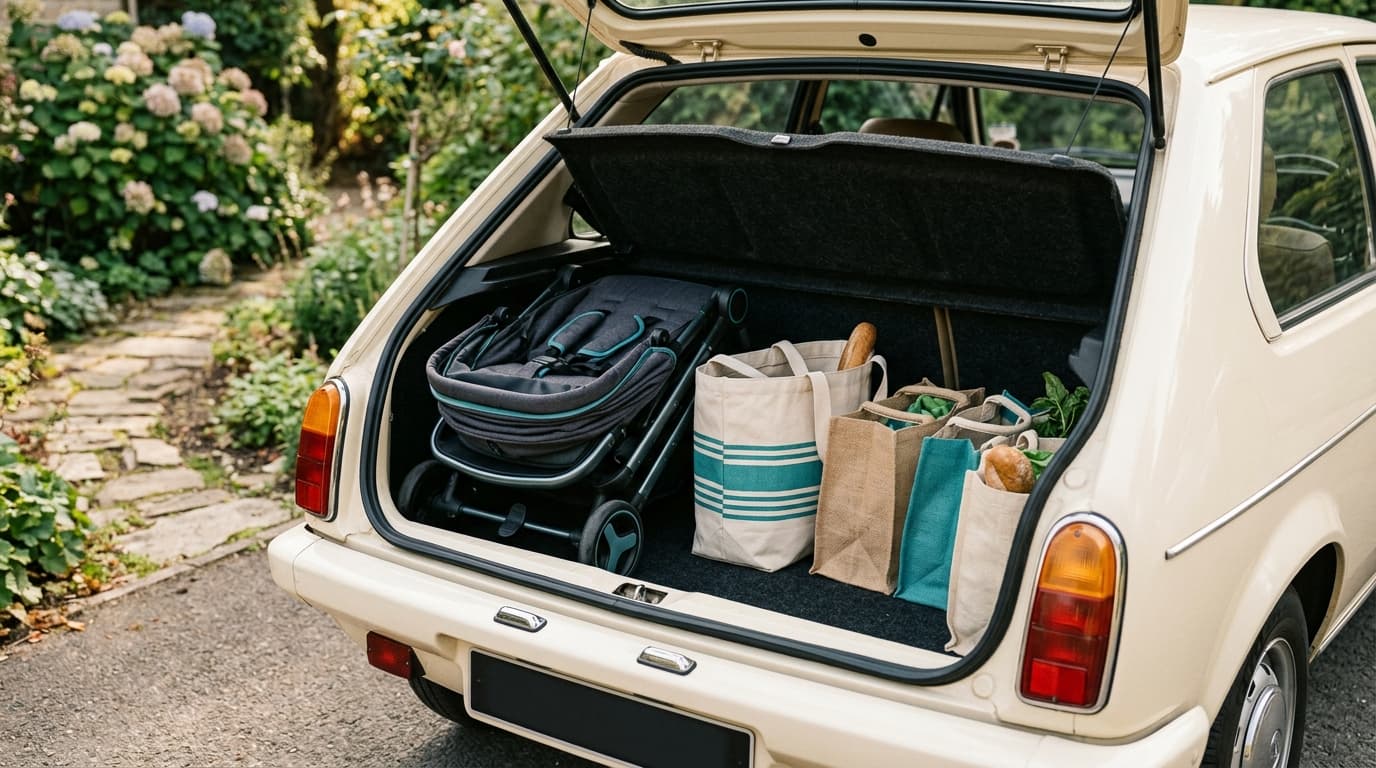
A folded pram is a rigid block of 41 to 195 litres depending on the model, and that block slides into no corner at all. The volume the manufacturer quotes, by contrast, is measured by stacking one-litre bricks wherever they will go. The two numbers are not talking about the same thing.
Hence the only method that works: three passes with a tape measure, and the pram under your arm.
A folded pram takes 41 to 195 litres
Take the folded dimensions from the maker's spec sheet, multiply them together, and you get the block your boot has to swallow. Nobody publishes that figure, so here it is, model by model.
The Babyzen YOYO3 folds to 52 × 44 × 18 cm according to Stokke customer service, which comes to 41 litres. The Bugaboo Butterfly drops to 54 × 45 × 23 cm, or 56 litres. The Cybex Balios S Lux quotes 430 × 600 × 755 mm with the seat on on its own spec sheet: 195 litres. A factor of four and a half between the first and the last, for two objects doing the same job.
The right-hand column sets them against a supermini boot that was actually measured, the Renault Clio V, which I come back to in a moment.
| Folded or closed item | Dimensions | Rigid block | Share of a Clio V boot measured at 274 L |
|---|---|---|---|
| Babyzen YOYO3 | 52 × 44 × 18 cm | 41 L | 15 % |
| IATA-size cabin suitcase | 55 × 40 × 20 cm | 44 L | 16 % |
| Bugaboo Butterfly | 54 × 45 × 23 cm | 56 L | 20 % |
| Cybex Balios S Lux, seat on | 75.5 × 60 × 43 cm | 195 L | 71 % |
| The Balios plus two cabin cases | all three together | 283 L | 103 % |
That last line is the one that settles a weekend away. A combi pushchair and two cabin bags already exceed, on paper, the boot of a supermini.
195 L
Rigid block taken up by a folded Cybex Balios S Lux with its seat on, from the manufacturer's stated dimensions
A carrycot adds thirty centimetres of length
A carrycot does not fold. It keeps its shape, it runs to around 80 cm at its longest, and it travels beside the chassis, never inside it. For the first six months, that means two items to fit rather than one. Our comparison of the infant car seat and the carrycot covers the trade-off, which turns as much on boot space as on the baby's sleep.
Why does the quoted volume predict nothing?
Because nobody audits that number. Boot volume falls outside every type-approval protocol: it is purely declared, and each brand picks the method that serves it.
The VDA standard everyone quotes works by fitting standardised blocks of 200 × 100 × 50 mm into the boot, one litre each, then counting them. In principle it is honest, since it rules out the unusable hollows that a water-fill measurement happily counts. In practice it splits into two variants nothing obliges a brand to name: VDA 210, which stops at the parcel shelf, and VDA 211, which goes up to the top of the seat backs.
The gap can be measured. Caradisiac obtained the approved bricks and did the measuring itself on two superminis: 262 bricks went into the Peugeot 208, very close to the 265 litres the brand declares, and 274 into the Renault Clio V, advertised at 340. Twenty-four per cent out. Renault replied that it measures to VDA 211, parcel shelf raised, and counts, as the whole industry does, the space freed when there is no spare wheel.
Nobody lied, strictly speaking. But the 75-litre advantage the Clio claimed over its rival shrinks to 12 litres once both cars are measured the same way, and a parent who chose on that basis chose on thin air.
Boot volumes escape type-approval. A manufacturer can pick its standard, then adapt it.
There remains the underlying problem, which even a single standard would not solve. A one-litre brick slips under the parcel shelf, wedges against a wheel arch, fills the angle behind the rear light. A folded pram does none of that. It arrives in one piece, with wheels sticking out, a handlebar that catches and a shape nobody designed for your car. The Clio's 274 litres stay true, and they stay unusable for an object 75 cm long.
The measurements manufacturers do not publish
Width, opening height, depth, sill, step. Five numbers decide the outcome, and not one appears on a spec sheet or on the vehicle registration document.
The ADAC has published the matching thresholds for a car that will take any pram on the market, bulky models included: at least 95 cm of internal width in the boot, at least 62 cm of opening height, at least 600 litres to the roof, and a loading sill no higher than 70 cm. The German motoring club adds the remark that settles the argument: these figures are not in the vehicle papers, and manufacturers often quote nothing but the volume.
Tape measure in hand, at the dealer or in your own boot, take these five measurements:
- The width between wheel arches. This is what tells you whether the pram can lie sideways when the floor is too short. On many superminis it sits around a metre, and that alone rescues a 75 cm combi.
- The tailgate opening height, not the height of the boot. A deep boot with a low opening forces you to tilt the pram to get it in, and a tilted pram hits the bumper.
- The floor depth with the parcel shelf in place. You will load with the shelf in place, not raised, because a pram visible through the rear window is a pram that gets stolen.
- The sill height. Eleven and a half kilos for the Balios S Lux, lifted four times a day, back rounded, a child on one arm. The sill wears you out faster than the volume does.
- The step between sill and floor. Some cars have a ten-centimetre drop behind the sill: the pram catches on it instead of sliding.
Will a double pram fit in an estate?
Folded, a side-by-side double often exceeds a metre in width, which puts it in direct competition with the most constrained dimension of the boot. Tandem doubles get longer rather than wider, and an estate swallows them without complaint where a supermini gives up. If a second child is already planned, that is the measurement to go and take before buying the car, not the litre count in the brochure.
Noémie and Thibaut, near Mons: 274 litres and a Balios
She is 31, he is 34, they live in a terraced house ten minutes from the Grand-Place in Mons, in the Walloon province of Hainaut, and their daughter is eight months old. The car is a 2021 Clio V, bought before the pregnancy, boot quoted at 391 litres in the brochure.
The pram was a joint gift from both families, a high-end combi chosen for the cobbles of the town centre. It rolls beautifully. It folds into a block 75 cm long that Thibaut loads diagonally, wheels against the seat back, because lengthways it refuses to go in.
On Saturdays the supermarket settles the matter for them. Pram on one side, the week's shopping on the other, and a boot that only closes if you press down. At first they blamed their own packing. The arithmetic says otherwise: 195 litres of pram inside 274 actually measured leaves 79 litres on paper, minus the angles lost around an object that interlocks with nothing. In practice, two bags.
They spent six months torn between an estate and a small MPV, toured the dealerships around the Borinage every other Saturday, compared brochures where the litre count shifted by twenty units from one leaflet to the next for the same car, and eventually gave up for lack of a figure they could trust. Then they ran the experiment the other way round: they borrowed a friend's compact buggy, a 6 kg model, and reloaded the boot. Everything went in, shopping included, with room to spare.
The premium pram was not sold. It comes out at weekends, when the boot has nothing else to carry, and it is still unbeatable on cobbles. The compact does the weekdays and the shopping. Which brings us to what the exercise cost, next to the price of a different car.
Change the car or change the pram?
The pram, in most cases, and the price gap is not close.
The Maxi-Cosi Lara², 6.4 kg, was listed at €152.99 on the brand's Belgian site on 21 September 2026. By comparison, moving from a supermini to a large-boot MPV means several thousand euros more to buy, before insurance, the Belgian registration tax and the fuel a heavier car drinks. Our ranking of the biggest family boots by budget sets out the Belgian price brackets one by one.
Three situations do justify changing the car, and none of them is about the pram.
Three child seats side by side, first: no pram will change that, it is bench width that decides. A carrycot to carry every day, second, because it does not shrink. A loading sill that is too high, third, if your back already complains: that is a body-style problem, permanent, and it gets worse as the child gets heavier.
Does a roof box solve the problem?
For holidays, yes. For daily life, no: nobody lifts an 11 kg pram onto a roof twice a day, and bars left in place cost fuel all year. More to the point, the roof and everything on it come straight out of your payload, a ceiling most families never think about and which our payload calculation breaks down box by box.
Article 45 bans loading above the head restraints
A pram stacked to the roof lining blocks the rear window, and article 45 of the Code de la route, the Belgian highway code, prohibits any load that impairs the driver's view or compromises the stability of the vehicle. The rule is federal: identical in Brussels, Wallonia and Flanders. The administrative fine regimes layered on top do differ, with cumulative ceilings set at €2,000 in Flanders and €3,500 in Wallonia; in practice those amounts target freight transport, not a badly wedged pram.
The real risk lies elsewhere. Eleven kilos left unsecured behind the rear seats, at 50 km/h, reach the head restraints with the force of a piece of furniture.
The test worth more than any table takes ten minutes: drive to the shop, ask to try the folded model in your boot, and put a bag of shopping down beside it. To compare family cars on real boot volume, Isofix positions and total budget, our comparison tool gives the figures model by model.
Comparateur Monospaces & ludospaces
Compare tous les monospaces & ludospaces côte à côte.
Comparer maintenant →
Frequently asked questions
Audrey teste des familiales depuis 2015, maman de deux enfants, basée à Wavre. Elle installe vraiment les sièges Isofix avant de juger l’habitabilité et calcule le budget sur cinq ans, carburant et entretien compris. Sa boussole : peut-on y mettre deux sièges-auto et les courses sans jouer à Tetris ?