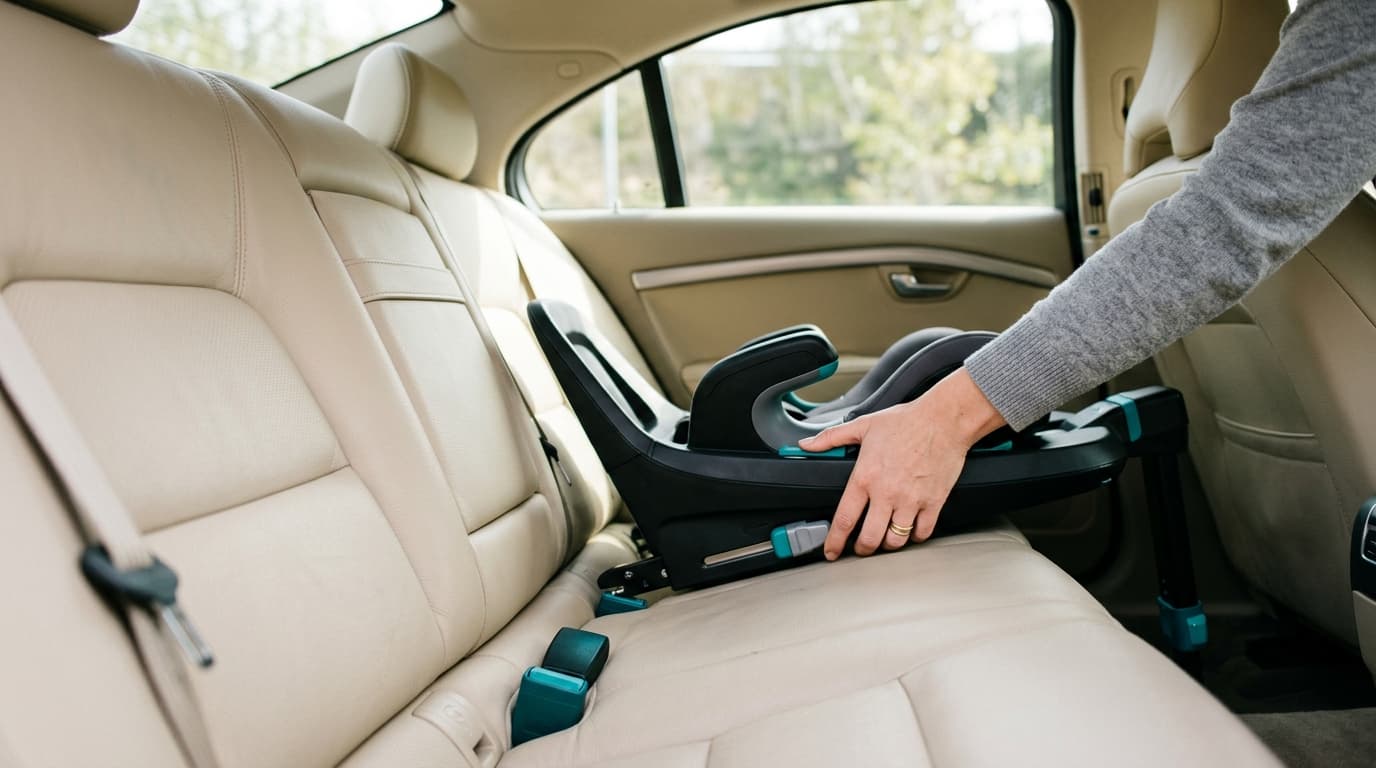
Installing an Isofix car seat takes two minutes: you find the two metal bars in the gap of the bench, click the two connectors onto them, check the green indicators, then set the third anchor point, support leg or top tether. The part that goes wrong comes afterwards, when the child is strapped in.
How do you install an Isofix car seat, step by step?
Seven movements, always in the same order. The wording in quotation marks is translated from the Britax Römer Kidfix Pro manual, but the sequence holds for nearly every seat on the market.
- Open both manuals. The car's says which seats have anchors. The seat's refers to a list of compatible vehicles, and the Swiss touring club TCS is clear: the car has to be on it.
- Find the anchor bars. Two metal bars per seat, set in the gap between cushion and backrest, 280 mm apart. If the seat comes with plastic guides, clip them on: they hold the fabric apart.
- Pull the connectors out fully. Arms left half retracted engage badly.
- Engage both sides. The arms "engage audibly" and a green indicator shows on each. Two clicks, two indicators.
- Push the seat "backwards with force, as far as possible", until it touches the backrest of the bench.
- Set the third anchor point. Support leg flat on a solid floor, or top tether strap hooked to its anchor and tightened. The choice depends on your car, as we set out in the article on the support leg.
- Pull on the seat, from both sides. If it comes away, go back to step 3.
Nothing more.
Isofix, base or belt: what equipment and how long?
The attachment method mostly changes the time needed and the number of chances to get it wrong. The times below are rough figures for someone who has already read the manual.
| Attachment | Extra purchase | Time to allow | Final check |
|---|---|---|---|
| Seat with built-in Isofix | None | 2 minutes, once | Two green indicators, third point loaded, pull test |
| Infant carrier on an Isofix base | The base, sold separately | 2 minutes for the base, a few seconds per trip | Base indicators, click of the carrier |
| Carrier or seat with the belt | None | 3 to 5 minutes, on every trip for a carrier | Belt in the coloured guides, no twist, tight |
| Booster with Isofix connectors | None | 1 minute | Isofix holds the booster, the belt holds the child |
Is it normal for an Isofix base to move?
A little sideways play generally is: the connectors grip a round bar, they are not welded to the car. European manuals give no tolerance in centimetres, and the one-inch rule quoted on forums comes from American guidance. The test here is simpler. Green indicators, third point loaded, and a seat that does not unhook when you pull: the handbook of a Kia Proceed asks for exactly that movement, push and pull. A base that tips forward points to a badly placed leg or a slack strap, not to a flaw in Isofix.
Three Belgian children in four are badly installed
Vias, the Belgian road safety institute, observes more than 1,000 children getting out of cars every three years. The latest measurement, relayed by the Meuse-Hesbaye local police in Wallonia, is blunt: 23% of children under 1.35 m are correctly installed, 50% travel in a suitable seat but badly restrained, 13% are not restrained at all and 14% sit in a seat that matches neither their height nor their weight. Meanwhile, 77% of the drivers questioned believed they had done everything correctly.
I reworked those figures by removing the children with no seat or the wrong seat. That leaves 73 children in 100 for whom the purchase was right. Of those, 50 are badly restrained, which is 68%. The press release of 9 January 2019 from AWSR, the Walloon road safety agency, based on the previous Vias measurement, gave 24% of children well installed and 49% in a compliant seat but badly restrained: the same sum gives 67%. Six years apart, one point of difference, while Isofix became the norm on seats and cars alike between the two measurements.
68%
Share of badly restrained children among those who nevertheless travel in a seat suited to their height, calculated from the latest Vias institute measurement
Switzerland measures the same thing. The survey by the accident prevention office BPA and the TCS published on 27 February 2024, on 982 children, counts one child in two badly restrained, with a seat fitting error in one case in four and an error in strapping the child in one case in three.
Isofix fixes the first family of errors. Not the second, and the list is well known:
- a loose harness, with room for more than two flat fingers at the collarbone;
- a thick coat kept under the straps, covered in our article on the winter coat in a car seat;
- on a booster, a belt run behind the back or under the arm, or rubbing the neck;
- twisted straps or a headrest left at last year's setting;
- a rear-facing seat placed in front of an active front airbag;
- a child moved up to the next seat too early, see which car seat for which age.
Can you install an Isofix seat with the seat belt?
Only if its manual provides for it. Many infant carriers fasten with the belt when the base stays in the other car, and that is approved. On a booster, the two combine by design: the connectors hold the seat still, the three-point belt restrains the child. The reason is mechanical, since Isofix anchors are designed for a combined weight of seat and child of 33 kg at most, according to the Wikipedia entry on the system.
Adding the belt "for extra strength" to a harnessed seat already fixed with Isofix, on the other hand, falls outside the approval.
What do you do in a car without Isofix?
Lotte and Mathias live in Aalst, in East Flanders. Their daughter was born in August, the carrier's Isofix base lives in their people carrier, and the grandfather, who will collect her from nursery on Thursdays, drives a 2009 hatchback. Mathias searched the gap of the bench for the bars for ten minutes. There are none. The same Wikipedia entry places the obligation in February 2013: since that date, UN Regulation 14 has required Isofix anchors and a top tether point on all new vehicles produced. Before that, it was an option.
Two routes, then. Ask the dealer whether the carmaker designed a fitting for that model, or fasten the carrier with the belt as its manual allows. They took the second, after checking that the grandfather's belt was long enough to go round the shell.
Belgian law makes no distinction. Article 35 of the Belgian highway code requires a suitable restraint for every child under 1.35 m, the fine is 174 euros, and the rule is federal: identical in Brussels, Wallonia and Flanders. It mentions neither Isofix nor the belt.
Not in the middle, not in the front, unless the handbook says so
The centre seat almost never has anchors. The Kia Proceed handbook is explicit: no anchor is provided there, and two seats are never attached to the same bar by borrowing those of the neighbouring seats.
For Lotte and Mathias, the Thursday carrier now goes in within four minutes, with the manual kept in the grandfather's glovebox. For a family, the number of Isofix positions is worth checking before buying the car: our comparison tool shows it model by model.
Comparateur Monospaces & ludospaces
Compare tous les monospaces & ludospaces côte à côte.
Comparer maintenant →
Frequently asked questions
Audrey teste des familiales depuis 2015, maman de deux enfants, basée à Wavre. Elle installe vraiment les sièges Isofix avant de juger l’habitabilité et calcule le budget sur cinq ans, carburant et entretien compris. Sa boussole : peut-on y mettre deux sièges-auto et les courses sans jouer à Tetris ?