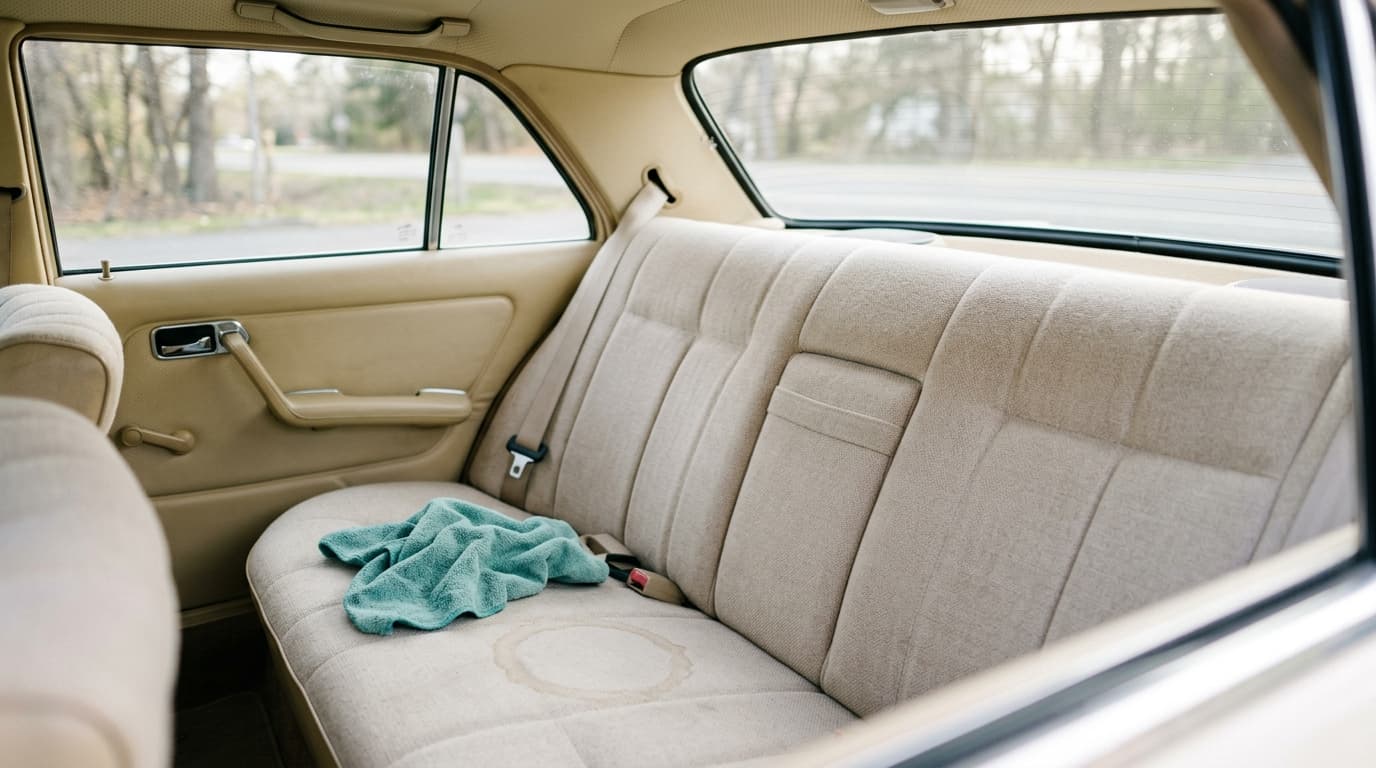
A water stain on a car seat does not come out by scrubbing the mark: it comes out by wetting a wider area, with less water, then removing that water before it dries. The ring is made during drying. The product matters less than the water you use, and Belgian tap water is hard almost everywhere in the country.
Why does a ring appear after cleaning?
Because water moves as it dries. In fabric laid over foam, it travels from the centre to the edge of the wet patch, where evaporation is fastest, and leaves behind what it was carrying: dust dissolved in the foam, leftover stain remover, limescale. The ring marks the border of the water.
Maud and Quentin live in Soignies, in the province of Hainaut in Wallonia, with two children aged 3 and 6 and an estate car with light grey upholstery. A badly closed water bottle emptied itself on the bench one Wednesday. Nothing but water. By Saturday, a brownish outline as wide as a dinner plate circled the middle seat, and the wet cloth they rubbed over it made it three fingers wider.
Their reflex was logical, and it feeds the problem.
How do you remove a water stain from a fabric car seat?
By treating the whole panel, seam to seam, and never the ring alone. Allow twenty minutes of work and a few hours of drying with the doors open.
- Vacuum the whole seat dry. Dust left on the surface becomes the next ring.
- Mist demineralised water over the entire panel, right up to the seams. The fabric should be damp, not soaked: the foam underneath must stay dry.
- Work from the edge towards the centre with a clean microfibre or a soft brush, without pressing. On an old ring, add a drop of washing-up liquid to the spray bottle.
- Extract the water straight away. Press a dry microfibre flat, turn it over, repeat. A wet and dry vacuum does better.
- Dry fast and evenly: doors open, ventilation running, indirect sun. No hairdryer held against the fabric.
- Judge the result once dry, the next day. Damp fabric always looks darker, and starting again too soon puts water back into the foam.
The seam acts as a natural border. If an outline has to remain, it will fall in the fold, where nobody sees it.
White mark or brown ring: what to do in each case?
The colour of the ring tells you where it comes from, and the treatment changes.
| What the ring looks like | Likely origin | What to do |
|---|---|---|
| White outline, rough to the touch | Limescale from tap water, or baking soda not rinsed out | Demineralised water and white vinegar half and half, whole panel, extraction |
| Brown or grey outline on light fabric | Dirt from the foam drawn up during drying | Six-step method, two light passes rather than one soaking |
| Sticky patch that gets dirty again quickly | Too much stain remover left in the fibre | Rinse with demineralised water alone, extract, add no more product |
| Ring that comes back in the same place | Foam soaked in depth | Spray extraction cleaner or a professional |
| Ring with a sour smell | Dried milk, vomit or urine | Enzyme cleaner first, see our method for vomit |
| Dark specks and a cellar smell | Mould, fabric left damp | Find where the water gets in before cleaning, see fogging and damp |
Baking soda, vinegar, steam: which ones work?
Vinegar, on limescale. Baking soda deodorises, but sprinkled on damp fabric and then badly vacuumed, it dries to a white powder and signs a brand new ring itself. Steam loosens dirt without carrying it away: without a microfibre or suction right behind it, it moves the dirt a few centimetres.
None of the three replaces extraction.
Belgian tap water leaves up to 110 mg of limescale per glass
One French degree of hardness equals 10 mg of calcium carbonate per litre, as the Belgian consumer advice body écoconso points out, placing the country's hardest water in the Brabant and Hainaut provinces. SWDE, the main Walloon water company, classes water as hard from 25 French degrees. The values gathered by CallMePower give an average of 30 degrees in Wallonia, 43.8 in Mons, 25.2 in Dinant, 17 in Antwerp, and from 14 to 40.4 in Brussels depending on the reservoir feeding the district. I did the sum for a 25 cl glass, the amount you pour on a stain without thinking: 75 mg of limescale at the Walloon average, close to 110 mg in Mons, 63 mg in Dinant, 43 mg in Antwerp, between 35 and 101 mg in Brussels. That deposit does not evaporate. It stays in the fibre, and on dark fabric it draws the familiar white outline.
75 mg
Limescale left in the fabric by a 25 cl glass of tap water at 30 French degrees, the average hardness in Wallonia
So the answer depends on the municipality more than on the region, and the exact value is on your water supplier's website. The remedy is the same everywhere: a 5-litre container of Forever demineralised water was listed at 2.29 euros at Brico, a Belgian DIY chain, on 2 October 2026, or 0.46 euros a litre.
Should you buy a spray extraction cleaner?
Not for one ring. The machine sprays water and sucks it back up at once, which removes drying in place, and with it the ring. The Kärcher SE 3 Compact states 500 W, 1.7 litres of fresh water, 2.9 litres of dirty water and 4.3 kg on its technical sheet, and the Compact Home version was listed at 189.00 euros at GAMMA, another Belgian DIY chain, on 2 October 2026, excluding the offer reserved for store card holders. I have not had it in my hands: these figures are the maker's and the shop's.
Before going that far, check in this order:
- has the ring survived two passes with demineralised water;
- does it come back in the same place once fully dry;
- are several seats affected, or only one;
- would an interior clean at a car wash, around 19 to 29 euros in Belgium, not settle it.
For a family, the sum is quick: 189.00 euros is 82 containers of demineralised water.
And on the child's car seat?
Here the manual comes before any trick. The cover is washed whole, in the machine, at the temperature the maker states, and never by patch: spot cleaning recreates exactly the ring you wanted to erase. Our cabin cleaning procedure sets out the instructions from Maxi-Cosi and Britax Römer.
For Maud and Quentin, two light passes were enough, four days apart. Total cost: 2.29 euros, with four and a half litres left in the garage. To compare family cars on their real boot, their Isofix positions and their budget, our comparison tool gives the figures model by model.
Comparateur Pas chères & occasion
Compare tous les pas chères & occasion côte à côte.
Comparer maintenant →
Frequently asked questions
Audrey teste des familiales depuis 2015, maman de deux enfants, basée à Wavre. Elle installe vraiment les sièges Isofix avant de juger l’habitabilité et calcule le budget sur cinq ans, carburant et entretien compris. Sa boussole : peut-on y mettre deux sièges-auto et les courses sans jouer à Tetris ?