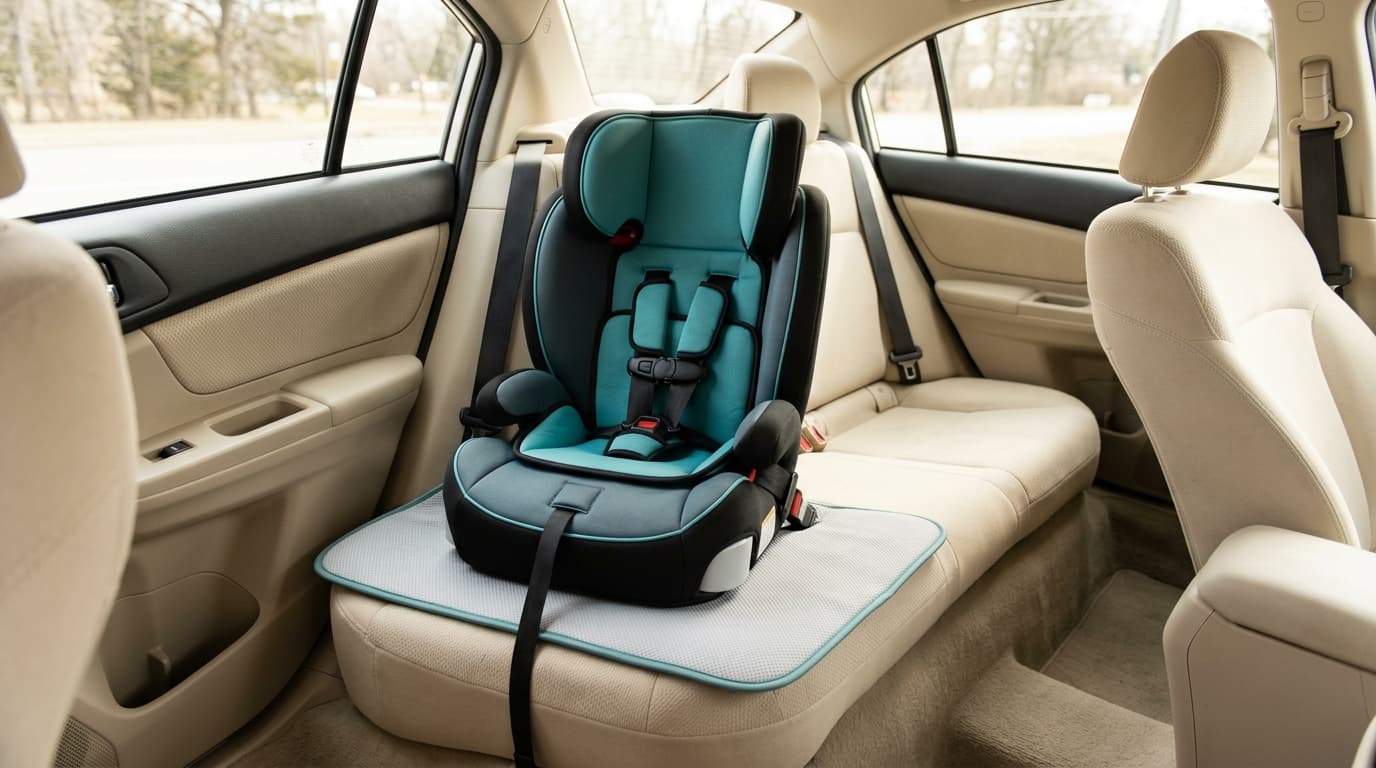
A car seat protector mat keeps the bench clean, and it can also loosen the child seat without you seeing it. The rule fits in one sentence: only fit one if the seat manual allows it, then check it with the removal test. Otherwise, a thin muslin laid flat, or nothing at all.
The dents in the bench almost always fade on their own.
Do you need a protector under a car seat?
Rarely. A properly fitted car seat does not damage the bench of a family car, and the dents it presses into the foam generally fade fairly quickly after it comes out. A protector guards against crumbs, spilt milk and the shoe soles of a child riding rear facing. It is a comfort for the car, never a safety gain for the child.
The certified technicians at Car Seats For The Littles, an American association specialising in child seat installation, do not recommend putting anything between the bench and the seat. They see too many failed installations that start exactly there. They also make a point that product listings keep quiet: a mat does not stop the dents, since the weight of the seat goes straight through it.
Charlotte and Pieter live in Herent, next to Leuven in Flemish Brabant, with two children aged 1 and 4 and a used estate car with light leather seats, bought last summer. Their first purchase after the two child seats was a padded universal bench protector, two centimetres of foam with non-slip studs, ordered online. The little one's Isofix base felt more stable than ever on it.
That was precisely the sign that should have warned them.
The seat manual decides, not the label on the mat
The orange approval label on the side of the child seat certifies a seat sitting on a bench. It says nothing about a layer of foam nobody has tested with it. A thick bench protector compresses at the moment of impact, and the seat you had tightened hard ends up with slack at the worst possible instant. Grippy undersides make things worse: they cling to the bench and make the seat feel rigid, when it is the mat holding, not the belt or the Isofix. In the United States the federal standard for child seats does not even mention these accessories, and no benchmark there governs the tests some sellers claim. Nothing on a bench protector's packaging, then, replaces the manual of the seat it will carry.
Seat manufacturers do not all say the same thing, and that is the point. Britax Römer sells its own seat protector and declares it compatible with seven named models: Hi-Liner, Swivel 2, Max-Safe Pro, Kidfix i-Size, Baby-Safe Core, Dualfix Pro M and Advansafix Pro. Seven names, not "every seat on the market". Maxi-Cosi states that its protector fits under all of the brand's seats while leaving access to the Isofix connectors. BeSafe says it has put its seat protector through crash tests. None of the three approves another brand's mat.
2.5 cm
Maximum movement tolerated at the belt path or the Isofix connectors, side to side and front to back, once the protector has been removed
Two devices call for particular care. The foot of a support leg must rest on the structural floor, never on a protector flap that spills over. And both Isofix anchors must stay visible, reachable and clear, with no fabric caught in the guides.
How do you check a protector does not loosen the seat?
With the removal test, described by the Car Seats For The Littles technicians. It takes five minutes, costs nothing, and it is the only check that answers for your seat, your mat and your bench at once.
- Read the child seat manual, installation or accessories section. If it forbids anything under the seat, stop there: the protector goes back in its box.
- Lay the protector flat, with no folds, without covering the Isofix anchors, and check that nothing sits under the foot of a support leg if there is one.
- Fit the seat exactly as the manual says, belt tensioned or Isofix connectors clicked in, top tether or support leg adjusted.
- Check the movement by hand at the belt path or the connectors, not at the top of the seat, which always moves a little. No more than 2.5 cm side to side or front to back.
- Remove the protector without loosening anything. Slide it out, or release a single Isofix connector and clip it back without touching the adjustment.
- Measure again. If the seat now moves more than 2.5 cm, or if you have to tighten it again, the protector is too thick for that seat.
For Charlotte and Pieter, step 6 was enough. Without the padded mat, the Isofix base slid clearly from side to side, well beyond the width of a thumb: the studs had faked a tightness the connectors no longer provided. The bench protector ended up in the boot, where it now protects the floor from football boots.
Which car seat protector to choose, and at what price?
The choice runs in this order, and the first criterion often rules out all the others:
- written approval from the maker of your child seat, for that exact model;
- minimal thickness, a mat that does not flatten under the pressure of a thumb;
- cut-outs that leave both Isofix anchors and the belt path fully accessible;
- an underside that does not act like a suction pad, since it is never the mat's job to hold the seat;
- a backrest flap high enough for the feet of a child riding rear facing;
- washable fabric, because spilt milk always gets through in the end.
Prices checked on 29 September 2026 on the brands' official shops, excluding delivery.
| Option | Cost | Checked detail | When to use it |
|---|---|---|---|
| Nothing, plus a vacuum cleaner | 0 euros | Dents fade on their own after removal | By default, especially on dark fabric |
| Thin muslin or towel, laid flat | 0 euros | Allowed by some manuals, never folded | Only if the manual provides for it |
| Maxi-Cosi back seat protector | 34.99 euros on maxi-cosi.be, out of stock on the day of the check | 0.45 kg, 65 % EPE foam, one strap round the headrest, room left for Isofix | Under a Maxi-Cosi seat |
| Britax Römer seat protector | 29.90 euros on the brand's official shop, French site | Front pocket, declared compatible with seven named seats | Under one of those seven seats |
| Britax Römer full seat cover | 34.90 euros on the same shop | Covers the vehicle seat completely | According to your Britax Römer seat manual |
| Padded universal bench protector or rigid shell mat | Varies | No approval from any seat maker | Avoid under a child seat |
| Towel folded several times | 0 euros | Compresses like a cushion | Never |
The figure that matters: around 30 to 35 euros for a major brand's own protector, the only kind a seat maker has taken responsibility for.
And on leather seats?
Leather shows marks more to the eye, it does not keep them longer. The dents recover; scratches come from belt buckles and shoe soles, not from the seat sitting there. Our family car interior cleaning method covers leather and fabric care, material by material.
A kick mat for the front seat back: is it risk free?
Yes, in principle. It hangs on the back of the front seat and does not touch the child seat installation.
The trap is in the pockets: a tablet or a metal bottle turns into a projectile at the first hard braking. Put only soft items in them, and if your rear-facing seat manual sets a gap to the front seat back, the mat must not reduce it.
Harness, cover, belt: accessories never to add
Between the child and the harness, nothing but what the seat maker supplied or sells as an original part. Universal harness pads, plush belt covers, another brand's newborn inserts and universal replacement covers all change where the straps sit and add a layer that compresses in a crash, exactly like a winter coat under the harness. The original cover is washable, at 30 °C on a delicate cycle for Britax Römer; it is not swapped for another.
The Belgian highway code does not mention bench protectors, but it requires every child under 135 cm to use a suitable restraint, used correctly. The rule is federal, identical in Wallonia, Brussels and Flanders, and the offence costs a 191-euro on-the-spot fine according to the Walloon road safety agency AWSR, which counts only one child in four correctly restrained in a suitable seat in Wallonia.
Charlotte and Pieter kept a thin muslin under the older child's seat, allowed by its manual, and a kick mat on each front seat. The light leather survived the autumn. To compare family cars on the Isofix positions you can actually use, their boot and their total budget, our comparison tool gives the figures model by model.
Comparateur Pas chères & occasion
Compare tous les pas chères & occasion côte à côte.
Comparer maintenant →
Frequently asked questions
Audrey teste des familiales depuis 2015, maman de deux enfants, basée à Wavre. Elle installe vraiment les sièges Isofix avant de juger l’habitabilité et calcule le budget sur cinq ans, carburant et entretien compris. Sa boussole : peut-on y mettre deux sièges-auto et les courses sans jouer à Tetris ?