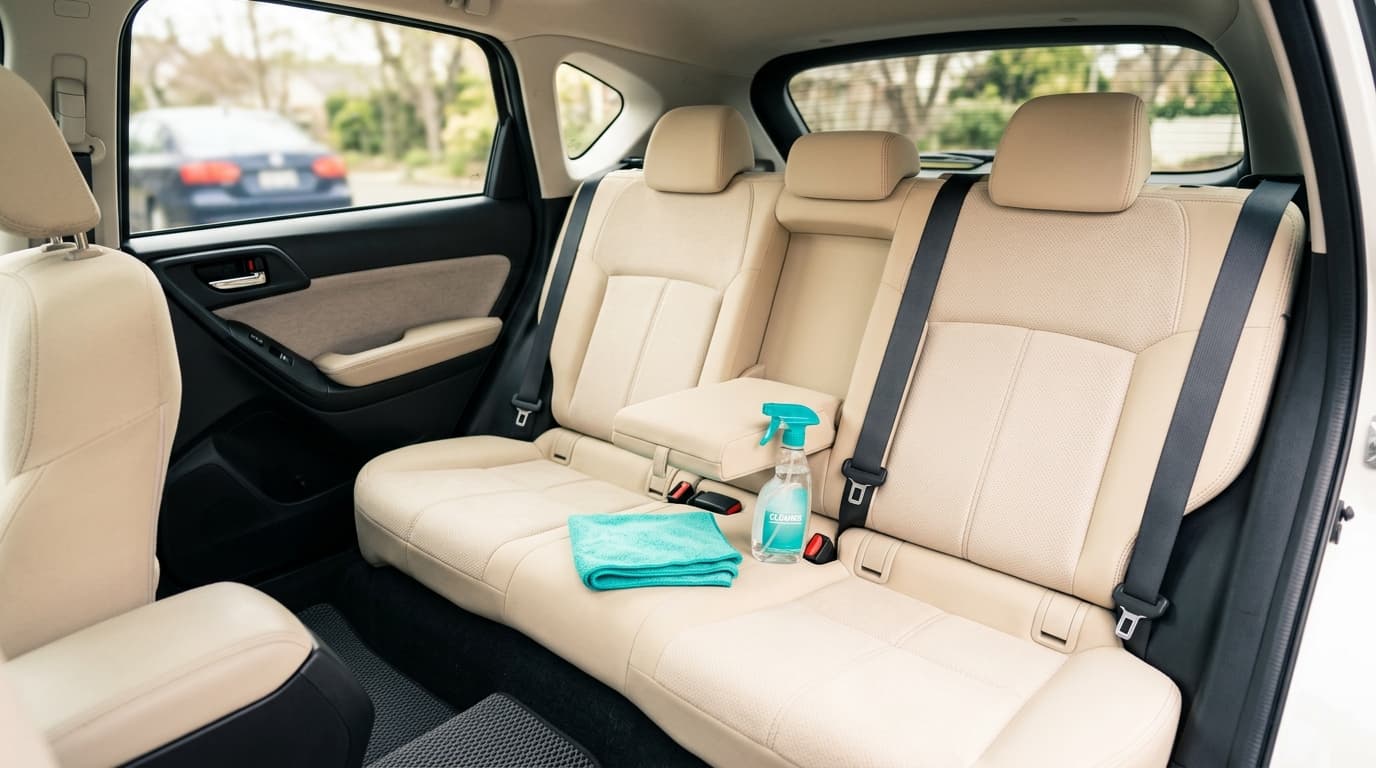
Lift the solids without rubbing, blot the free liquid under pressure, treat the stain, rinse by extraction, neutralise, dry right through. Six steps, about an hour and a quarter of work and a few hours with the doors open. The smell that returns the following Wednesday always comes from the last step, the one almost nobody does.
Where do you start when a child has just been sick in the car?
By pulling over, getting everyone out, and lifting the solids without ever rubbing. A cloth worked back and forth pushes the residue two or three millimetres into the fibre. Those millimetres are exactly what brings the smell back three days later.
Hanne and Steven live in Mechelen, between Antwerp and Brussels, and drive the E19 into the capital four times a week in a compact MPV, with two children aged 3 and 7. On a Sunday coming home from the coast, the little one was sick on the middle seat, in stationary traffic. Tissues, a wet wipe, an air freshener bought at the next service station. The smell came back on the Wednesday, then on every warm day until October.
Their mistake was not cleaning badly. It was treating one problem where there are three: a stain, made of proteins and stomach acid clinging to the fibre; a smell, coming from the seat foam rather than the fabric you can see; and, if a stomach bug is behind it, a viral contamination that outlives the stain by days.
24 journeys
Number of school runs during which a contaminated car mat stays a reservoir, at twelve days of norovirus survival and two journeys a day
The six steps, in order, and how long each one takes
The order matters as much as the products.
- Get everyone out, open all four doors and put on disposable gloves.
- Lift the solids with a stiff card or a spatula, always pushing towards the centre of the stain, never in circles.
- Blot the liquid under pressure: a thick fold of kitchen paper, ten seconds with the flat of your hand, change it, repeat. This is the only moment when you recover residue that is still loose, and it does not come round again.
- Spray a fabric stain remover, let it dwell for the time stated on the bottle, then work it with a soft brush without soaking the seat.
- Rinse by extraction: mist warm, lightly soapy water, then the same pressure with kitchen paper. Twice. Whatever is not extracted sinks back into the foam and waits for you.
- Dry right through, doors open, two to four hours depending on the season, with a household fan if you have one.
| Step | Kit | Time | Cost |
|---|---|---|---|
| Lift the solids | Disposable gloves, stiff card, sealable bag, kitchen paper | 10 min | about €2 |
| Blot the liquid | Thick folds of kitchen paper | 10 min | about €1 |
| Treat the stain | Fabric stain remover, soft brush, dwell time | 25 min | €11.81 |
| Rinse by extraction | Warm soapy water, spray bottle, microfibre cloths | 15 min | about €1 |
| Neutralise the smell | Odour eliminator, on an already clean surface | 10 min | €13.71 |
| Dry right through | Doors open, fan if available | 2 to 4 h | €0 |
| Plastics and child seat | Soapy water, diluted bleach on plastics only | 20 min | about €1 |
Both exact prices come from the same Belgian supplier, checked on 10 September 2026 at Candicar in Mettet, in the province of Namur: the Texticlean fabric stain remover in 750 ml at €11.81 including VAT, and the Absorbodor odour eliminator in 750 ml at €13.71. Total for one family: €25.52 of product, and the step that really decides the outcome costs nothing.
Why does the smell of vomit come back after three days?
Because it was never in the fabric. A bench cushion is ten to fifteen centimetres of open-cell foam under a few millimetres of textile, and warm liquid reaches the foam in under a minute.
Surface cleaning treats the visible millimetres and leaves the centimetres. Worse, it adds water. Saturated foam dries from the top down, carrying back to the surface whatever it holds, and heat accelerates the whole thing: that is why the smell reappears on the first twenty-five-degree day, in a car you thought had been sorted six weeks earlier. The footwell is worse still, with carpet bonded to an insulating underlay. Hence the rule that changes everything: extract rather than rinse, and dry for longer than feels necessary.
Should you take the mats out and remove the bench?
The mats, yes, every time, and outside. The bench, no. In an MPV or a leisure activity vehicle the second row slides on rails where liquid seeps in: run the seats fully forward and work the rails with a narrow nozzle, without taking anything off. A seat refitted slightly wrong is a far more serious problem than a smell.
Baking soda absorbs, vinegar perfumes, neither one digests
The two most widely recommended tricks here do not do what people ask of them, and many families redo the same clean three times because of it.
Bicarbonate of soda is an absorbent and a buffer: it draws off leftover moisture and raises the pH, so it genuinely dulls the smell for a few hours. It breaks down no protein. White vinegar is an acid, and vomit already is one: you simply stack two smells that each take two days to clear. Ground coffee and sparkling water mask or fizz without removing anything.
Enzymes, on the other hand, do break organic matter down for good. They demand dwell time, maintained moisture and a surface already cleared of the bulk, three things no kitchen trick supplies.
The five mistakes that bring the smell back:
- Rubbing in circles instead of pushing towards the centre, which spreads the stain and drives it in.
- Going to the product without blotting the free liquid, so treating ten times more residue than necessary.
- Soaking the fabric instead of misting it, which sends everything into the foam.
- Shutting the doors the same evening because it is raining, and letting the foam dry upwards.
- Spraying an air freshener onto a surface that was never rinsed.
Should you disinfect the car after a stomach bug, and with what?
Yes, and not with the product you would reach for. Norovirus has no lipid envelope: alcohol gels and sprays, which work precisely by attacking that envelope, are very poorly effective against it.
The information sheet from AViQ, the Walloon health agency, gives the measure that works: freshly mixed household bleach at 0.1 %, that is 1,000 ppm of active chlorine, with five to ten minutes of contact. The norovirus sheet from Sciensano, the Belgian public health institute, adds that the virus is shed in stools and vomit and keeps being shed for up to two weeks after the symptoms stop. None of this changes between Wallonia, Brussels and Flanders: same virus, same product, same contact time, only a different agency publishing the notice.
That leaves the question of where to apply it. On plastics, the seatbelt buckle, door handles and rubber mats, diluted bleach is the right tool. On seat fabric, it is not: it discolours and weakens the fibre, and the correct answer is the same as for hands, mechanical action plus soap, followed by complete drying. A virus that survives up to twelve days on carpet is not waiting to be perfumed.
Does steam really disinfect?
A steam cleaner reaches a high enough temperature to be effective on the surface, and it helps on plastics and seams. On a seat cushion it creates the opposite problem: it injects water into the foam you are trying to dry out. Stay on hard surfaces, keep moving, dry afterwards.
How do you clean dried vomit, several days later?
By rehydrating it before touching it. Lay a cloth soaked in warm soapy water over the crust, leave it ten to fifteen minutes, lift it away with a spatula without scraping the fibre, then run the full procedure counting two passes instead of one. Scraping dry breaks the fibres and sets the stain for good.
What about the child seat itself?
It is where children are most often sick, and the one part of the job where you do not get to improvise. The cover comes off and is washed according to the seat's own manual, as we set out in our full method for cleaning a family car interior.
The shell is another matter. Under the cover, the seat contains expanded polystyrene, the material that absorbs the energy of an impact, and Maxi-Cosi states plainly that it must never be wetted or taken out of the shell. Soaking, hosing or prolonged steam: the polystyrene drinks, swells slightly, and loses properties you will have no way of checking afterwards.
What if the seatbelt caught it?
The webbing is cleaned with a sponge, warm water and mild soap, no detergent and no bleach. Pull it out to its full length, trap it in a door so it cannot wind back, and let it dry completely before releasing it. Webbing stored damp goes mouldy inside the pillar, and the smell becomes far harder to find there than a stain on a seat cushion.
A family car interior absorbs vomit, crumbs, pet hair and six years of school runs. The cars that age best are the ones whose mats come out and whose bench slides clear, two criteria nobody checks in a showroom and which you can weigh in our comparison tool. With a baby, the question arises at the choice between infant carrier and carrycot.
Comparateur Monospaces & ludospaces
Compare tous les monospaces & ludospaces côte à côte.
Comparer maintenant →
Frequently asked questions
Audrey teste des familiales depuis 2015, maman de deux enfants, basée à Wavre. Elle installe vraiment les sièges Isofix avant de juger l’habitabilité et calcule le budget sur cinq ans, carburant et entretien compris. Sa boussole : peut-on y mettre deux sièges-auto et les courses sans jouer à Tetris ?