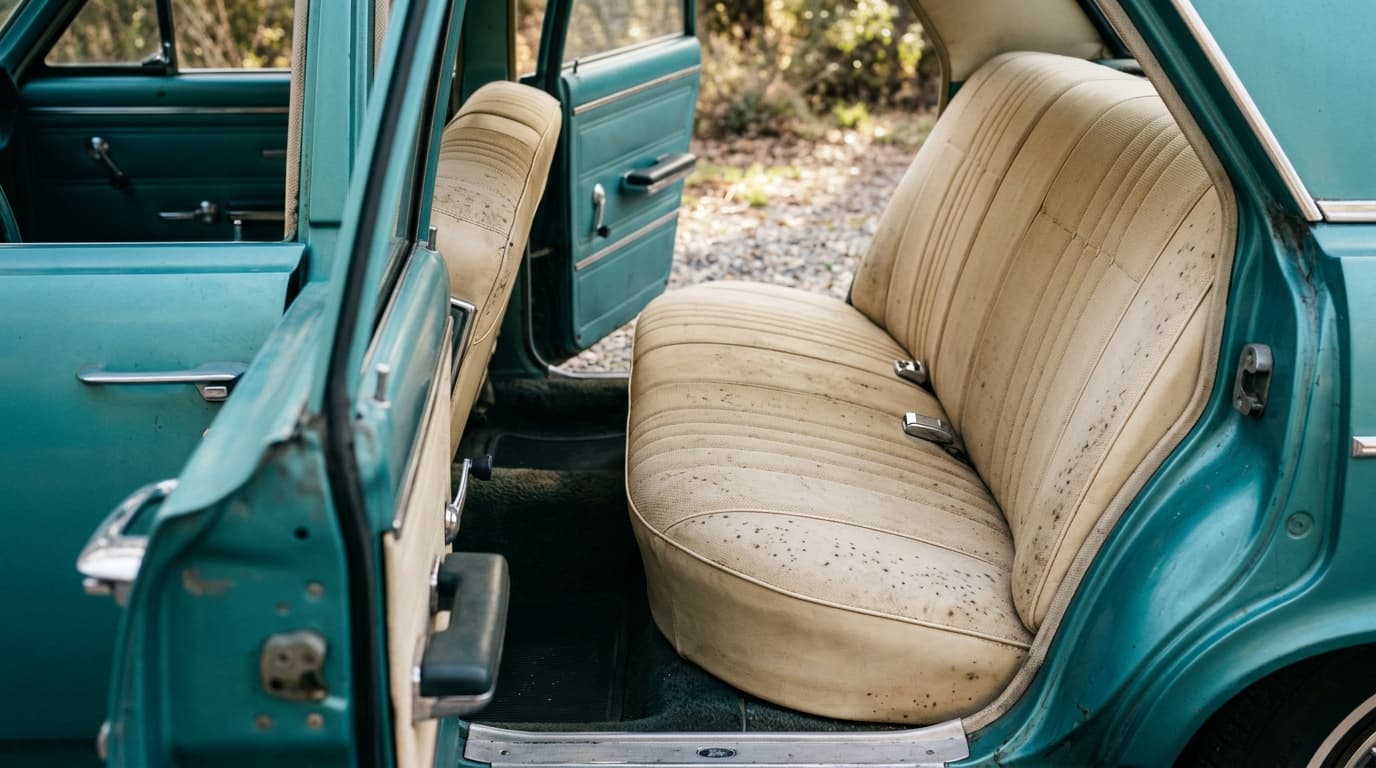
Mould on car seats comes off in three stages: wipe damp without ever brushing dry, treat with diluted white vinegar, dry in under 48 hours. The clean only lasts if the water entry point is found. And trim that still smells of cellar after two passes can no longer be rescued with a cloth.
How do you remove mould from a fabric car seat?
Without a brush and without a vacuum cleaner, at least to begin with. That is the opening mistake: dry rubbing loosens the spores and sends them through the whole cabin. The practical sheet from the French lung health charity Santé respiratoire France asks you to avoid dry scraping and the household vacuum cleaner alike, and to wear a mask, gloves and goggles.
Allow half an hour of work, then a day of drying.
- Work outside, without the children. Doors open, child seats taken out and set aside. Brussels Environment asks for cleaning to be done "in the absence of fragile people and children".
- Wipe damp. A microfibre cloth dipped in lukewarm water with a drop of washing-up liquid, well wrung out. Pick up, fold, change side. The cloth then goes in the machine at 60 °C, or in the bin.
- Test the vinegar on a hidden patch, under the seat cushion for instance. White vinegar at 14°, cut with an equal part of water.
- Spray lightly, wider than the stain. Leave for five to ten minutes, then dab with a clean microfibre cloth. The fabric should be damp and the foam beneath should stay dry.
- Dry fast. Doors open, ventilation on, sunshine if the sky allows.
- Judge by smell, two days later. Car closed overnight, then one door opened: the smell tells you whether the foam is affected.
Nothing heroic.
The deadline in step 5 is not a whim. The guide from the US Environmental Protection Agency sets the most widely quoted benchmark: a wet area has to be dry within 24 to 48 hours, or mould takes hold.
Fabric, leather, seat belt, carpet: what to do in each case?
| Where the mould is | What to do | When to stop cleaning |
|---|---|---|
| Fabric cushion or backrest, surface specks | The six-step method | Cellar smell after two passes: the foam is affected |
| Leather or leatherette | As a rule a damp cloth and mild soap, dried at once, following the car's care instructions | Mould lodged in seams or perforations: upholsterer |
| Seat belt | Mild soap and water, webbing pulled out until completely dry | Webbing frayed, soiled or damaged: replacement |
| Mats and carpet | Mats taken out and dried separately, carpet wiped then aired | Carpet wet underneath: garage, there is a leak |
| Child car seat cover | Washing machine, at the temperature in the manual | Damaged cover: original cover, never a universal one |
| Child harness straps | Damp sponge, lukewarm water, mild soap | Stain that stays: new straps from the maker |
White vinegar or bleach: which one?
Vinegar, on upholstery. Bleach discolours dyed fabric, and the carmakers' handbooks I have read provide for mild soap only on a seat belt. The one for a 2024 Kia hybrid puts it in a single line, translated here: "Use mild soap and water to clean the seat belts."
The American guide adds that a biocide is not recommended as routine practice, because dead mould may still cause allergic reactions. Killing is not enough. It has to be removed.
Two official Belgian fact sheets, two sets of advice
I put side by side the two Belgian public documents I found on the subject. The "humidity" sheet on the environment portal of Wallonia, the French-speaking southern region, updated in September 2006, recommends diluted bleach, one measure to two to four measures of water, ten to fifteen minutes of contact, rinsing and drying, and specifies that the product is to be used only diluted and when necessary. The sheet from CRIPI, the indoor pollution unit of Brussels Environment, written from data supplied by Sciensano, the Belgian public health institute, does not mention bleach: it advises cleaning at the first traces with washing-up liquid or a little bicarbonate of soda, and handing over to a professional beyond 3 m². Both are about housing. I found no public guidance, Walloon, Brussels or Flemish, written for the inside of a car.
For a rear bench, the Brussels advice is the only one that transfers: a textile cannot be rinsed like a tiled floor. The two sheets agree on what matters. The cause first, and mouldy textiles are washed or replaced.
Is mould in a car dangerous for children?
Repeated exposure, yes. The Brussels sheet links mould to rhinitis, irritation of the eyes, nose and throat, recurring cough and asthma symptoms, and names the most vulnerable: "young children, fragile people such as asthmatics". The Walloon sheet says the same in one sentence: "Children are the most affected."
One detail in the Brussels document changes how you clean. Spores, even dead, "keep their irritant and allergenic power".
24 to 48 h
Maximum time to dry a wet area before mould takes hold, according to the guide from the US Environmental Protection Agency
A child who coughs mostly in the car, or whose asthma flares on the school run, is a matter for the doctor, not for vinegar.
Why does mould come back after cleaning?
Anaïs and Florian live in Mouscron, in western Wallonia on the French border, with two children aged 1 and 4 and a van-based people carrier that spent three weeks of August shut up on the drive. When they came back, grey-green specks dotted the bench and the cover of the elder girl's seat. They cleaned on a Saturday. Ten days later the specks were back, in the same place, and Florian ended up lifting the rubber mat behind the passenger seat: the carpet was soaked.
The cleaning had worked. The car, though, was still taking in water.
Before starting again, six places can be checked by hand:
- the carpet under the rubber mats, especially in the rear footwells;
- the door and tailgate seals, traced with a finger after a shower;
- the boot floor and the spare wheel well;
- the front passenger floor, where a badly drained air conditioning system can drip;
- forgotten textiles: swimming towels, boots, umbrella, a soft toy fallen under a seat;
- the windows in the morning, since four people release close to 12 grams of water in a ten-minute trip, a sum set out in our article on car windows fogging up.
What do you do with a mouldy child car seat?
Open its manual before the cleaning cupboard. The cover comes off and goes in the machine at the temperature given by the maker. For the straps, Britax's care instructions are plain: warm water and mild soap, spot cleaning only, without submerging the straps, no machine, no iron and no bleach, because harsh soaps may weaken the fibres. The brand adds that a frayed or heavily soiled harness is best ordered as a replacement.
Fifteen euros of equipment, priced in the shops
The figure that counts: 15.38 euros. On 9 October 2026, Starwax The Fabulous 14° white vinegar was listed at 5.99 euros a litre at Brico, a Belgian DIY chain. Cut half and half, it gives two litres at 7°, or 3.00 euros per litre ready to spray, enough to treat the car several times. The same day, the 300 g Bison Auto moisture absorber cost 9.39 euros at GAMMA, another DIY chain, where its listing describes it as rechargeable in the microwave and where 40 buyers rate it 4.6 out of 5. I have tested neither: these are the shops' figures.
The absorber is the purchase to put off. In a car that lets water in, it saturates and hides the symptom while the carpet rots.
For Anaïs and Florian, a rear door seal was letting the water through. The garage replaced it, the carpet dried for four days with the doors open, under cover, and the grey specks have not returned. For a family, fabric left damp first leaves a ring before it goes mouldy: our method for water stains on car seats deals with that stage, and the comparison tool sets family cars side by side on real boot space and Isofix positions.
Comparateur Pas chères & occasion
Compare tous les pas chères & occasion côte à côte.
Comparer maintenant →
Frequently asked questions
Audrey teste des familiales depuis 2015, maman de deux enfants, basée à Wavre. Elle installe vraiment les sièges Isofix avant de juger l’habitabilité et calcule le budget sur cinq ans, carburant et entretien compris. Sa boussole : peut-on y mettre deux sièges-auto et les courses sans jouer à Tetris ?