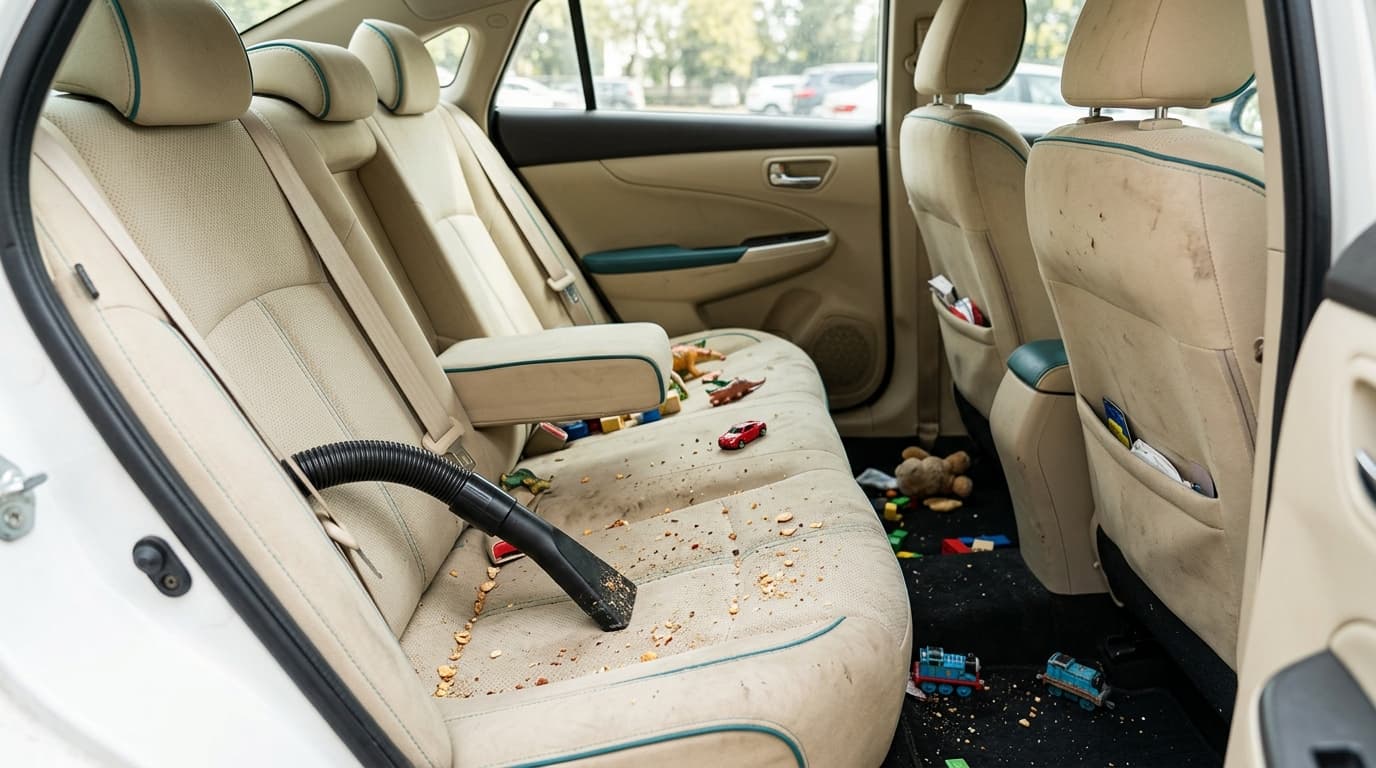
A family car interior can be brought back to life in three hours, for around twenty euros of products. The order of operations matters more than the products themselves: vacuum before you wet anything, treat stains before you deodorise, and never put a child seat's harness straps in the washing machine. Here is the full procedure, with figures and temperatures.
How do you clean a family car interior, step by step?
In seven steps, in this order: empty, remove, vacuum dry, treat stains, clean hard surfaces, do the windows, then deodorise. Allow 2 h 30 to 3 hours for a genuinely dirty estate or MPV, and €20 to €30 of products that will last several years.
The order is not a stylistic choice. Cleaning windows before plastics guarantees you will redo them, vacuuming after wetting turns crumbs into paste, and perfuming a cabin without dealing with the source of the smell only masks it for three days. Here is the sequence.
- Empty everything, including door pockets and the centre console. Take out the mats, the boosters and the child seats — they go back in at the end. Time: 15 minutes. This is the step people skip, and it undermines every step that follows, because you end up vacuuming around objects.
- Vacuum dry, top to bottom and back to front. Headlining first, rear bench next, mats last, outside the car and shaken out. A narrow nozzle is essential for the seat rails, where thirty months of biscuits end their career. Time: 45 minutes on a family estate.
- Treat stains one at a time, before any general cleaning. Each type of stain has its own product (see the table below). Work from the edge inwards so you don't spread the ring, with a wrung-out microfibre cloth, never a soaking one.
- Clean the hard surfaces: dashboard, console, door cards, seat belts. Use a matt interior plastic cleaner, never a glossy product — the reflection in the windscreen is tiring and silicone attracts dust. Meguiar's, Turtle Wax and Kärcher all offer interior ranges that do this job properly.
- Do the windows last, inside included, with two microfibres: one damp, one dry. The greasy film that settles on the windscreen comes from plastics off-gassing and shows up mainly against the light, which is precisely when a parent is looking for a child on a crossing.
- Deodorise what is clean, not what is dirty. Bicarbonate of soda on the carpet and fabrics, left overnight, then vacuumed. It works well on dust and crumbs, and does nothing on a dried organic stain.
- Refit the child seats last, once the interior is dry, and redo the harness adjustment straight away. A seat removed and refitted in a hurry is a badly strapped seat.
Take Noémie and Simon, in their mid-thirties, two children aged 2 and 4, a family estate and 17,000 km a year between Malmedy and Verviers. After two winters of back-seat snacks, their rear bench had turned grey and the cabin smelled of milk on every start-up. Three hours one Saturday, €26 of products, and a clear answer about what really smells in a car full of children — it wasn't the bench.
2 h 30 to 3 h
Realistic time for a full interior clean on a family estate or MPV, working alone and without professional equipment
Should you do it yourself or pay a professional?
Do it yourself if you have three hours and a vacuum cleaner. Pay a professional if the interior is soaked deep down: a wet-and-dry extractor is the only machine that washes fabric and returns it dry, and no supermarket product replaces that.
Belgian prices are easy to read. An interior clean at a station costs €19 for a small car, €25 for a medium one and €29 for a large family car at N5 Car Wash (checked August 2026). An at-home service averages around €62 among the providers listed by Yoojo Belgium. At home, the initial outlay is €20 to €30 and covers several years.
| Option | Cost | Your time | What it fixes |
|---|---|---|---|
| Monthly upkeep at home | ~€0 | 20 min | Crumbs, dust, windows |
| Full clean at home | €20-30 of products | 2 h 30 - 3 h | Fresh stains, surfaces, surface smells |
| Interior clean at a Belgian station | €19-29 | 30 min waiting | Vacuum + surfaces, not old stains |
| At-home service in Belgium | ~€62 | 0 | Same, at your door |
| Detailing with a wet-and-dry extractor | On quotation | 0 | Soaked fabrics, settled smells |
The honest calculation, for a family: a full clean at home every four to six months, monthly vacuuming as upkeep, and one professional session before resale. Paying €25 for a vacuum you would do in forty-five minutes only makes sense if your Saturday is worth more than that — which it often is, and that is a trade-off, not laziness.
How do you remove the most common kids' stains?
By reacting fast, and with the right type of product for the nature of the stain. Organic stains (milk, vomit, urine) need an enzymatic cleaner, greasy stains a degreaser, coloured stains a fabric stain remover. A single all-purpose fabric product fails on at least two of the three.
The rule that changes everything: a fresh stain is absorbed, a dried stain has to be dissolved. Blot immediately with a dry cloth or kitchen paper, without rubbing, to lift as much matter as possible before it enters the foam. Five seconds of effort saves an hour of work two days later.
| Stain | Suitable product | Trap to avoid |
|---|---|---|
| Milk, vomit, urine | Enzymatic cleaner | Bicarbonate alone: the smell returns in the heat |
| Chocolate, greasy biscuit | Fabric degreaser or diluted washing-up liquid | Hot water, which sets the grease in the fibre |
| Fruit juice, cordial | Fabric stain remover such as Dr. Beckmann or Vanish | Rubbing, which widens the ring |
| Felt-tip, ballpoint pen | Household alcohol on cotton wool, dabbed | Acetone, which bleaches the fabric |
| Dried mud | Dry brush then vacuum, water afterwards | Wetting before brushing |
A stain remover made specifically for car seats exists from most laundry-care brands — Vanish sells one in Belgium — but heavily diluted washing-up liquid does 80% of the job on a recent sugary stain. Keep the specialist product for what resists.
How do you wash a child seat without making it unsafe?
Cover in the machine at 30 °C maximum, delicate programme, mild fragrance-free detergent and no fabric softener. The harness straps never go in the machine: damp sponge and mild soap only. This is the one rule in this article that touches the child's safety.
Maxi-Cosi states it in its Belgian care instructions, Britax Römer repeats it in its user manuals, and Cybex and Joie give the same instruction: 30 °C for the cover, sponge for the harness. The reason is mechanical. The straps are woven fibres calibrated to restrain a child's body during a violent deceleration; the drum, the spin cycle and the heat fatigue them without anything becoming visible. A clean, weakened strap is more dangerous than a stained, intact one.
Drying follows the same logic: in open air, never with a hairdryer or on a radiator. Concentrated heat shrinks the fibres, and a shrunk cover no longer fits back properly. Refit it slightly damp and it will sit better on the shell.
Should child seats be cleaned more often than the car?
Yes, and on a different rhythm. The shell and straps get a sponge every month if the child eats in the car, because sugary residue sticks in the buckles and eventually interferes with the closing click. The cover goes in the machine two or three times a year, or immediately after an incident. It is the one item in the cabin you clean for the child's hygiene rather than for the car's appearance.
Where does the smell that keeps coming back come from?
From the cabin filter and the air-conditioning evaporator, in the vast majority of cases. If your car smells while the interior is clean, the bench is not what needs rewashing: it is a €15-30 part that needs replacing.
The mechanism is simple. The evaporator, housed behind the dashboard, cools the air and produces condensation. That moisture, plus the dust and pollen trapped by the filter, creates an environment where mould and bacteria thrive. Every time the ventilation starts, they are blown back into the cabin. The cabin filter is replaced every 15,000 km or once a year, whichever comes first, for €15 to €30 in standard form and €25 to €45 in activated carbon. It is a five-minute job behind the glovebox on most family cars, and Kärcher sets out the procedure in its Belgian interior cleaning guide.
For Noémie and Simon, that was exactly it: the bench had been clean for three weeks and the smell came back every morning. Filter replaced, €22 and ten minutes, and it was gone. The six hours spent scrubbing the fabrics the month before had gone after the wrong culprit — and that is the most common mistake on this subject.
15,000 km
Cabin filter replacement interval, or once a year, whichever comes first
Is bicarbonate of soda really enough against smells?
For surface smells, yes. For dried organic stains, no, and that is a negative fact you rarely read. Bicarbonate neutralises volatile acidic compounds: it works very well on a dusty carpet, a damp mat or a stale smell. Faced with a protein — soured milk, vomit, urine — it masks for a few days then gives up, because it does not break the matter down. Only an enzymatic cleaner splits those molecules. Apply it across the whole soaked area, not just the visible stain: the liquid ran further than what you can see.
Should you drive with the windows open after cleaning?
For half an hour, yes, and it costs nothing. A freshly cleaned interior always holds residual moisture in the fabrics and the carpet, plus product vapours. Thirty minutes of airflow at moderate speed clears both, and saves you the condensation the next morning. Failing that, leave the doors open for two hours in a dry garage.
What a clean interior changes at resale in Belgium
A used-car buyer opens the rear door before looking at the service book. Car-Pass documents the mileage, not the interior condition: your cabin speaks for you, and it speaks first.
A stained bench and a stale cabin smell are read as symptoms of a car neglected across the board, mechanical servicing included. That is unfair, often wrong, and perfectly human. A €29 professional clean at a station, or a home session with €26 of products, pays for itself several times over when negotiating a €15,000 used family car. It is the best effort-to-euro ratio in the whole sale preparation, far ahead of bodywork polishing.
The reverse applies when buying. If you are inspecting a used family car, the interior tells you more than the seller does: dirty seat rails, greyed seat belts, a very strong air-freshener smell during the test drive. That last point is worth noting — a new cabin scent on a seven-year-old car almost always covers something. Our notes on reliable used family SUVs and on family car value for money complete the mechanical inspection.
Noémie and Simon have since adopted two habits that cost nothing: a bin bag hooked onto the back of the passenger seat, and the garage vacuum brought out on the first Sunday of the month. Three hours of cleaning every six months instead of a full day once a year. To compare family cars on their real boot space, their Isofix positions and their total budget, use our comparison tool or our selection of family cars on a small budget.
Comparateur Pas chères & occasion
Compare tous les pas chères & occasion côte à côte.
Comparer maintenant →
Frequently asked questions
Audrey teste des familiales depuis 2015, maman de deux enfants, basée à Wavre. Elle installe vraiment les sièges Isofix avant de juger l’habitabilité et calcule le budget sur cinq ans, carburant et entretien compris. Sa boussole : peut-on y mettre deux sièges-auto et les courses sans jouer à Tetris ?