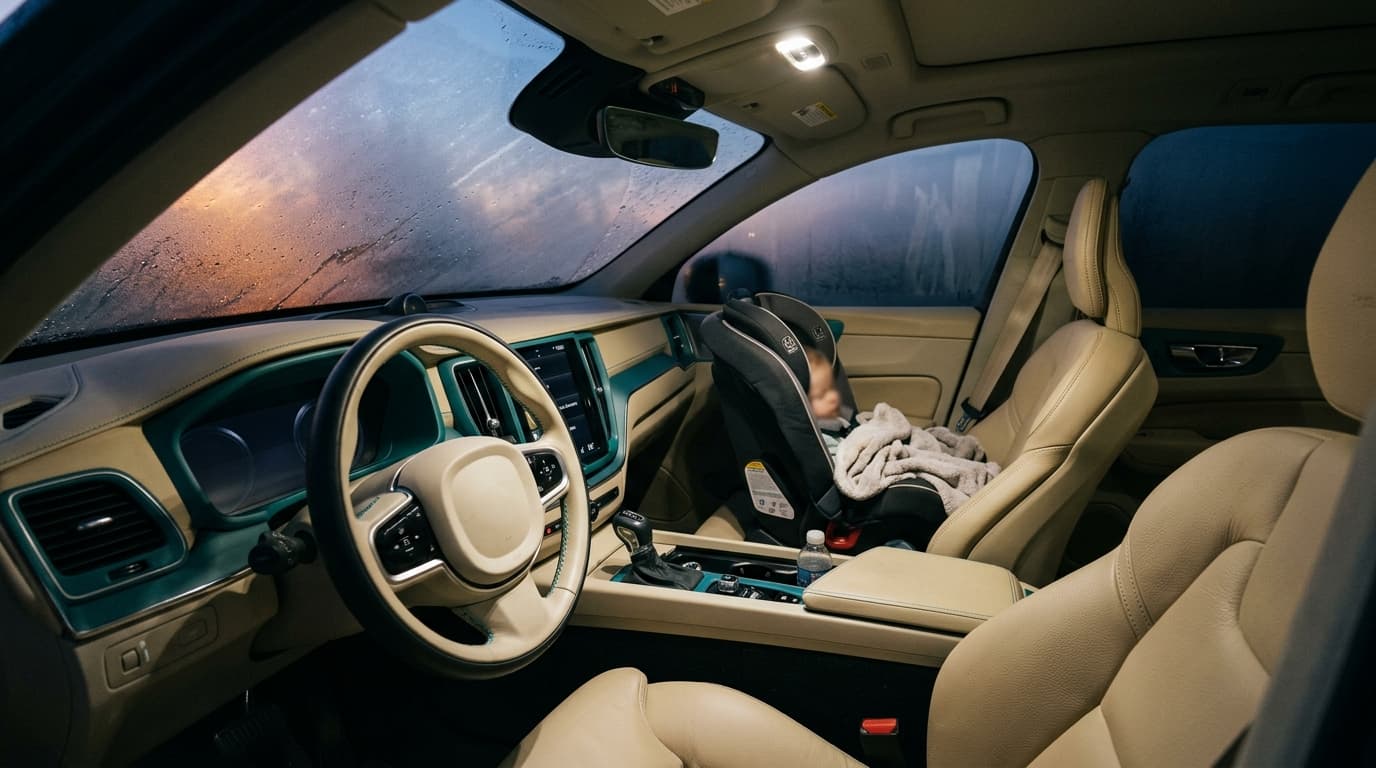
Demist setting at maximum, air recirculation off, air conditioning on, fan at full blast on the windscreen. Two minutes are enough, and it is the air conditioning doing the work, not the heater. If the fog is back the next morning, it means the water never actually left the cabin.
How do you clear car window fog in under two minutes?
In this order: windscreen demist, recirculation off, air conditioning, fan at maximum, heated rear screen, heat last. The compressor dries, the fan sweeps, the heat warms the glass. Together they clear the windscreen of a family estate in one to two minutes.
- Select the windscreen demist setting, the icon of a window crossed by curved arrows. It redirects every vent onto the glass. Five seconds.
- Switch off air recirculation. The button with the arrow looping back on itself traps your air and your humidity inside the car. Plenty of family cars keep it engaged from one journey to the next.
- Press A/C, even at 2 °C outside. The compressor condenses the water onto the evaporator, which drains it under the car through a small pipe. Air conditioning is a dehumidifier before it is a cooler, and that is precisely why it earns its keep in winter.
- Fan at maximum. Flow matters more than temperature here: it is what tears away the saturated layer of air stuck to the windscreen.
- Heated rear screen at the same time. It works on its own while you deal with the front.
- Raise the heat last, once the glass is clear. Warm air keeps the windscreen above the dew point and stops the fog returning five kilometres down the road.
Inge and Dries live near Hasselt, in Limburg, in the east of Flanders, with two children aged 3 and 7 and a compact MPV covering 16,000 km a year. Every autumn, the same scene: four people, two soaked coats, and a white windscreen before they have even left the driveway. They blamed the heater. The culprit was elsewhere.
1 to 2 min
Real time needed to clear the windscreen of a family estate with the full sequence, air conditioning included
Four people add twelve grams of water in ten minutes
Fog is not a question of cold. It is a gap between how much water the air carries and how cold the glass is: as soon as the windscreen drops below the cabin's dew point, the vapour settles on it as droplets. Nothing else happens.
An adult at rest exhales roughly 17.5 millilitres of water per hour, on the pulmonary expiration figures commonly used. Four people, ten minutes on the way to school, and a little under 12 grams of water lands in an air volume of around 3 m³ on an estate or a compact MPV.
The number that matters: those 12 grams take the cabin air from 6.6 to 10.5 grams of water per cubic metre, on a typical Belgian morning at 6 °C and 90 % humidity. The dew point climbs from 4.5 °C to a little over 11 °C, while the windscreen has stayed at the overnight temperature. Five degrees of gap, and the glass turns white.
Alone at the wheel, you add only 3 grams. The dew point rises by a degree and a half and the glass stays nearly dry. Same car, same morning, same weather: it is the passenger count that tips the calculation, which is why a family fogs up systematically where a solo commuter never notices a thing.
+7 °C
Rise in dew point inside a 3 m³ cabin after ten minutes with four people on board, on a 6 °C morning
Hot air or cold air: which one actually works?
Both, in that precise order. Cold outside air is drier than the air you have just breathed out, and it clears fast. Warm air comes afterwards to hold the glass above the dew point.
Touring, the Belgian motoring club, sums it up in one line few drivers have taken on board: in this climate, air conditioning demists at least as much as it cools. Moniteur Automobile, the Belgian motoring magazine, confirms the mechanical side, noting that a circuit left unused for six months loses its gas and its oil.
Without air conditioning, or with an empty circuit, the same sequence takes three to five minutes. And it removes nothing: the water stays on board, it has simply moved.
The potato and the shaving foam
Both tricks have circulated for twenty years and rest on the same principle: laying down a surfactant film that stops water beading. It works, for a few days. It also leaves a greasy veil you will not notice in daylight and which, at night, turns every oncoming headlight into a star. On the December school run, at the hour children are crossing, that is a poor trade.
Why does the fog come back every morning?
Because the water stayed. Demisting moves humidity from the glass into the air, then the air cools overnight and puts it straight back in the same place. As long as the reserve is on board, the cycle repeats.
At Uccle, the Royal Meteorological Institute counts 189.8 days of precipitation a year in the 1991-2020 normals. A Belgian family car therefore spends more than one day in two taking on water, in one form or another. The sources that bring the fog back:
- Rubber mats, which hold water in a puddle instead of letting it evaporate. Take them out and empty them rather than just shaking them.
- The umbrella and the boots drying in the boot. On an estate or an MPV, the boot and the cabin share the same air as the windscreen.
- A soaked winter coat laid on the rear bench, releasing its water all night.
- The foam-backed cover of a child seat, which holds water for days and never dries in a closed car.
- Air recirculation left engaged the previous evening, sealing the humidity in for twelve hours.
- A saturated cabin filter, which throttles the flow and stretches out the demist.
- A leaking windscreen, quarter-light or boot seal, putting water under the carpet where nothing dries any more.
Does cat litter in a sock work?
A little. Silica adsorbs moisture, like the dehumidifier sachets sold on the shelf, and a well-filled sock pulls out a few dozen grams of water before it saturates. Set against the 12 grams your family releases in ten minutes, the order of magnitude is reached quickly: it earns its place in a car that sleeps outdoors and barely moves, it does not replace ventilation in a family car doing two school runs a day. And it needs drying on a radiator every week.
Should you buy an anti-fog product, and which one in Belgium?
Start with the microfibre and a proper glass clean. Greasy glass catches fog in wide opaque drops; degreased glass fogs too, but as a thin film that clears twice as fast.
List prices checked on 20 September 2026 at auto5.be, excluding the running promotion.
| Action | Kit needed | Cost | Effect |
|---|---|---|---|
| Demist + A/C + outside air, fan at maximum | Nothing, it is all in the car | €0 | Clear windscreen in 1 to 2 min |
| Cold ventilation alone, no A/C | Nothing | €0 | 3 to 5 min, and a faster return |
| Two windows cracked open 30 s while driving | Nothing | €0 | Immediate, needs repeating |
| Wiping dry | Norauto glass microfibre | €5.99 | Immediate, back in 2 min |
| Degreasing the glass properly | Glass cleaner 500 ml + microfibre | €11.98 | 20 min of work, several weeks |
| Preventive treatment | Norauto anti-fog 500 ml | €7.99 | Redo after every glass wash |
| Preventive treatment, tier above | Rain-X anti-fog 500 ml | €14.99 | Same use, twice the price |
| One-off fix | Magic Clean anti-fog sponge | €4.90 | Does not replace ventilation |
| Drying mats, textiles and boot | One hour with the doors open | €0 | Several days of relief |
The shelf says something interesting about itself. The three anti-fog sprays are rated 3.2 across 19 reviews, 3.5 across 47 and 3 across 31, while the glass microfibre on the same shelf sits at 4.7 across 98 reviews. On the Belgian market, the best-rated product in the category costs €5.99 and contains nothing.
The Belgian roadworthiness test checks the demister
Autocontrole, the Belgian roadworthiness testing body, checks glazing, wipers, washer and the demisting system at the inspection that becomes compulsory from four years old. A dead fan or a heated rear screen that no longer works shows up there. And driving with a white windscreen amounts to driving without the field of vision required by article 8.3 of the Code de la route, the Belgian highway code, a federal rule identical in Wallonia, Brussels and Flanders.
Inge and Dries changed three things, all of them free. Wet coats travel in the boot rather than on the bench, the mats come out on Sundays, and recirculation no longer stays engaged overnight. The windscreen now takes forty seconds to clear instead of four minutes. For the rest of the cabin, our procedure after an incident in the back seat deals with soaked textiles, and our comparison tool ranks family cars on real boot volume, Isofix positions and total budget.
Comparateur Pas chères & occasion
Compare tous les pas chères & occasion côte à côte.
Comparer maintenant →
Frequently asked questions
Audrey teste des familiales depuis 2015, maman de deux enfants, basée à Wavre. Elle installe vraiment les sièges Isofix avant de juger l’habitabilité et calcule le budget sur cinq ans, carburant et entretien compris. Sa boussole : peut-on y mettre deux sièges-auto et les courses sans jouer à Tetris ?