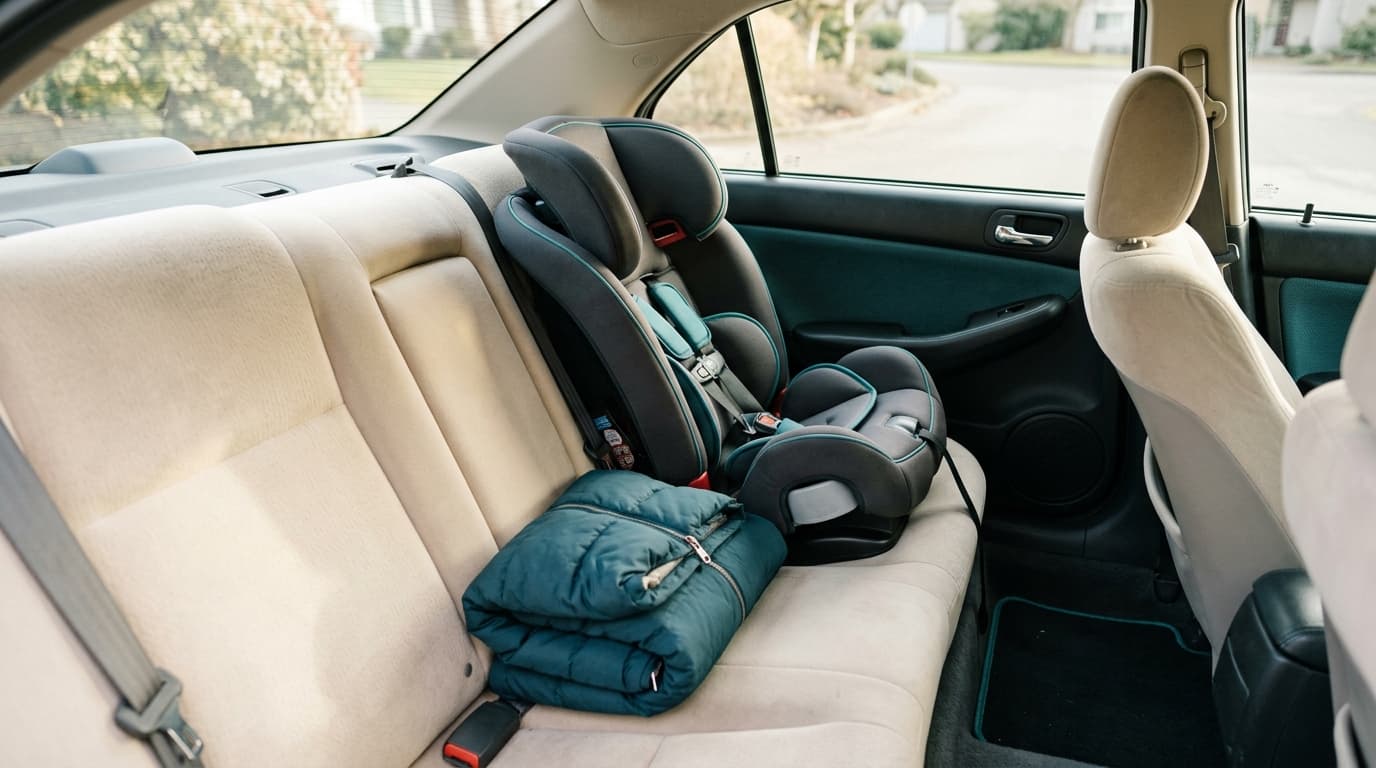
No, the coat does not stay on under the harness. Pulled tight over a padded jacket, the harness is set to the thickness of the fabric, and that fabric collapses in a few milliseconds when the crash happens. Buckle the child without the coat, then lay the coat over the straps. It takes twenty seconds and costs nothing.
The harness tightens the coat, not your child
The gesture is identical. The result is not.
When you pull the adjuster strap, you compress whatever is in the way: first the filling of the jacket, only then the body. Once the harness is as tight as a hand can make it, several centimetres of down or polyester still sit between the strap and the shoulders. Those centimetres are invisible. They are trapped air, and trapped air disappears at the first violent deceleration.
What does the ADAC crash test at 16 km/h show?
A belt cutting into the abdomen. At sixteen kilometres an hour.
The German motoring organisation recreated the most ordinary scene there is, a rear-end shunt in town, at the speed of a missed traffic light. The file published by the ADAC on 21 November 2025 is unambiguous about the mechanism: the padding of the jacket stops the belt from lying against the body, so it sits too high, on the lower abdomen instead of the thighs on a child, and it cuts in deeply. Liver, spleen, intestines. The organs the club names are precisely the ones behind a badly placed belt, and the injuries it describes happen at a speed nobody imagines being hurt at.
The setting is a neighbourhood roundabout, not a motorway.
16 km/h
Speed of the simulated rear-end impact run by the ADAC, enough for a belt worn over a winter jacket to cut into the abdomen (file dated 21 November 2025)
The same file gives the fix in one sentence: buckle up without the jacket, then cover the child with a pre-warmed blanket. No purchase, no product reference, no brand to remember.
Fifty-nine journeys a winter, counting frost days only
Justine and Thibaut, both in their thirties, live near Saint-Hubert, in the central Ardennes in the south of Belgium, with a boy of 4 and a baby girl of 10 months. Twenty thousand kilometres a year, a nursery and a school twelve kilometres from the house, a compact MPV parked outside because the garage holds the firewood. From December to February the windscreen is white almost every morning.
The Belgian met office, the IRM, records 29.7 frost days per winter at Uccle on the 1991-2020 normal, plus 5.6 days on which the temperature never climbs above zero (seasonal climate report). Uccle sits at the mild end of the Belgian scale, and the Ardennes freeze considerably more. Apply those 29.7 mornings to the school run out and back, and you get around sixty journeys a winter where the coat question arises, counting frost days alone. Add the mornings at three or four degrees, when the child leaves the house in a padded jacket because it is winter, and the count doubles.
59 journeys
Return school runs affected per winter, applying the IRM normal of 29.7 frost days at Uccle (1991-2020) to two daily school trips
The cause is not the parent, it is the volume of air to be heated. An MPV or a van-based family car has twice the cabin of a city car, glass everywhere, rear seats far from the vents and often a single heater outlet aimed at the windscreen. Warm-up takes correspondingly longer. A parent choosing between a child shivering for twelve minutes and an approximate harness picks what feels like comfort, and picks it again every morning. Nursery-goods pages never frame that trade-off, because they talk about the seat and never about the car.
Justine changed one thing. She starts the car three minutes before bringing the children out, while she puts her own shoes on.
Do you really have to undress a child for every trip?
Yes, and the word is wrong. You do not remove the coat, you move it: from the child's back to on top of the harness, where it keeps them just as warm without sitting between anything.
The objection deserves to be stated plainly. At minus five, on a six-minute run, a ten-month-old undressed in a car park gets properly cold, and a parent who has been through that twice will not repeat it. So the answer is less about discipline than about the order of operations: warm the car first, buckle second, cover third. The child is never cold for more than twenty seconds.
Five checks, worth running once at the start of the season and then by instinct:
- start the engine three minutes before loading up, or schedule preconditioning on a hybrid or an electric car, where it is free and works remotely;
- buckle without the coat, then lay the coat over the child upside down, hood towards the feet;
- keep a fleece blanket in the boot from November to March, and leave it there;
- pinch the strap at collarbone height, and take up another notch if the webbing folds between two fingers;
- put nothing between the child and the harness that did not come with the seat.
That last point is not negotiable. A separately bought strap pad, a generic insert, a support cushion, a footmuff whose back panel slides behind the child: anything inserted moves the harness and takes the seat outside its approval.
One figure never settles this on its own. The whole case fits into eight lines.
| The figure | Its value | Where it comes from |
|---|---|---|
| Speed of the simulated rear-end impact | 16 km/h | ADAC, file dated 21 November 2025 |
| Organs named when the belt rides onto the abdomen | liver, spleen, intestines | ADAC |
| Frost days per winter at Uccle | 29.7 | IRM, 1991-2020 normal |
| Days freezing from morning to night | 5.6 | IRM, 1991-2020 normal |
| School runs affected per winter | about 59 | calculation: 29.7 days × 2 trips |
| Belgian children unrestrained or badly restrained | over 50% | Test-Achats |
| Cybex Snogga 2 footmuff, Belgian catalogue | €99.95 | cybex-online.com, 7 September 2026 |
| Fleece blanket already in the boot | €0 | your own cupboard |
The test that convinces in a minute comes from Securange, a French child-safety reference: buckle the child with the coat on, tighten normally, unbuckle, take the coat off, buckle again without touching the adjuster. The slack you find is the slack you had for the entire journey.
Footmuff or blanket: which one goes under the harness?
Neither, and that is the whole question.
A footmuff designed for a car seat lets the harness come out through the shell's original slots: the padding stays around the child and under the legs, never between the back and the strap. Cybex describes its Snogga Mini 2 as fitting all infant carriers and all harness systems. The pushchair version, the Snogga 2, is rated TOG 4 down to minus ten degrees with suitable clothing, weighs 400 grams, uses a recycled 3M Thinsulate lining and washes at 30 °C on a delicate cycle. On the Belgian market, its price checked on 7 September 2026 on the maker's own shop is €99.95, delivery included.
A hundred euros for a job a fleece blanket does in full.
I am not saying you should go without one. A footmuff does not slide off, stays put when the child falls asleep and packs into a bag. It simply buys no additional safety, and a first winter often has better uses for a hundred euros. The generic insert sold as universal, on the other hand, deserves a hard look: if it slides in as a single piece behind the child's back, it recreates the coat problem, thicker and far less visible.
Boosters and three-point belts share the same flaw
Past the age of four, most children move from a harness to the car's own belt. The problem does not go away, it gets worse.
A three-point belt has no adjuster. It sits wherever the thickness of the clothing lets it sit, and over a padded jacket the lap section rides up from the pelvis onto the abdomen, precisely the position the ADAC calls the most dangerous. Nothing flags the fault: the buckle clicks normally, the child sits upright, the journey passes without incident.
The manufacturer's handbook says it before anyone else. Britax Römer asks, in the user instructions for its Advansafix II SICT, that you avoid dressing the child in thick clothing under the belt. The instruction sits in the document that binds the maker, not in a blog post.
Article 35 stops at the approval of the seat
The Belgian highway code requires an approved restraint for any child under 1.35 m, and the rule is federal, identical in Wallonia, Brussels and Flanders. On clothing it says nothing, and it never will. Nobody will ever be fined over a padded jacket. The check therefore happens entirely at home, which is hardly reassuring when Test-Achats, the Belgian consumer organisation, reports that more than 50% of Belgian children are unrestrained or badly restrained in the car.
And a snowsuit?
Worse than a coat. It adds thickness at the pelvis, exactly where the lap belt has to run, and it comes off before getting into the car, no exceptions, including for a slope twenty minutes away. Lined waterproof trousers, being thinner, get in the way less, but they still have to pass the pinch test.
Hats, scarves and heavy boots
Three items, three answers. A hat does not interfere with a harness, but it pushes the head away from the headrest on seats with a built-in insert, and it comes off as soon as the child falls asleep. A long scarf has no business near a strapped-in child; a closed neck warmer replaces it and does the job better. Heavy boots concern the front seats only: the ADAC notes that no rule bans winter footwear at the wheel, but that fine control of the throttle and the brake becomes harder.
Three minutes of engine before loading up change more than a hundred-euro accessory. Check the pinch on the strap this weekend, before the first frosts. For the rest of the installation, our guide to the support leg and our piece on rear-facing seats cover what happens under the seat, and the comparison tool lists Isofix positions model by model.
Comparateur Monospaces & ludospaces
Compare tous les monospaces & ludospaces côte à côte.
Comparer maintenant →
Frequently asked questions
Audrey teste des familiales depuis 2015, maman de deux enfants, basée à Wavre. Elle installe vraiment les sièges Isofix avant de juger l’habitabilité et calcule le budget sur cinq ans, carburant et entretien compris. Sa boussole : peut-on y mettre deux sièges-auto et les courses sans jouer à Tetris ?