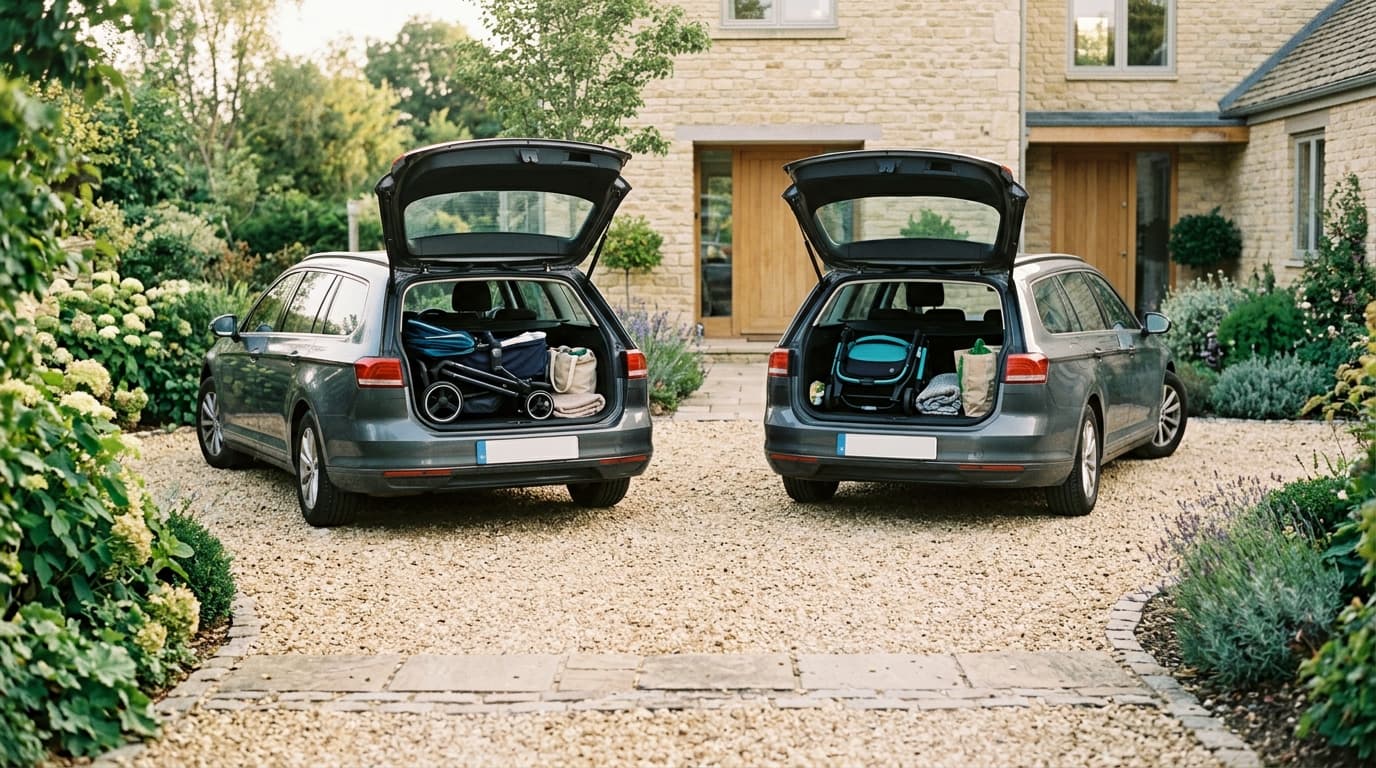
Between an Octavia Estate and a Corolla Touring Sports, the choice comes down to two figures: 44 more litres of boot for the Skoda, about one litre per 100 km less for the Toyota. In the Belgian price list, where the Skoda is sold as the Octavia Combi, 1,060 euros separate the entry versions. The rest, child seats included, is decided by details that data sheets keep at the bottom of the page.
Octavia Estate or Corolla Touring Sports: which one for a family?
The Octavia if you carry a lot or want a third Isofix position. The Corolla if you mostly drive in town and on ordinary roads, and you keep your cars for a long time.
Pauline and Arnaud live near Chimay, in the rural southern tip of Hainaut province in Wallonia, with two children aged 2 and 6. They drive 17,000 km a year, almost all of it on main roads, and their current estate is at the end of its life. Their shortlist has two lines: one estate chosen for its boot, another for its hybrid system.
| Criterion | Skoda Octavia Estate 1.5 TSI 116 | Toyota Corolla Touring Sports 1.8 Hybrid 140 |
|---|---|---|
| Belgian list price, 4 October 2026 | 33,880 euros | 34,940 euros |
| Gearbox | 6-speed manual | e-CVT automatic |
| Boot, five seats | 640 L | 596 L (581 L with the 2.0) |
| Boot, bench folded | 1,700 L | 1,606 L (1,591 L with the 2.0) |
| Length | 4.69 m | 4.65 m |
| Kerb weight | 1,291 kg | 1,325 kg |
| WLTP consumption | 5.4 to 5.8 L/100 km | 4.6 L/100 km |
| Fuel tank | 45 L | 43 L |
| Euro NCAP child occupant | 84% (2022 test) | 84% (2019 test, rating expired) |
| Isofix positions recorded by Euro NCAP | 3: two in the rear, one in the front | 2: the two outer rear seats |
| Parts and labour warranty | 2 years | 10 years, with conditions |
Prices, weights and dimensions come from the Le Moniteur Automobile data sheets for the Octavia Combi and the Corolla Touring Sports, excluding options and discounts.
44 litres separate the two boots
That is not much. Forty-four litres is the volume of a cabin suitcase. On paper the Octavia wins with 640 litres against 596, and the gap grows to 94 litres once the bench is folded, 1,700 against 1,606.
But the figure that matters depends on the engine you pick at Toyota. The Corolla 2.0 hybrid houses a bulkier battery under the floor and drops to 581 litres, then 1,591 with the bench down, as Top Gear points out in its review dated 24 October 2025. The gap to the Skoda then rises to 59 litres. At Skoda, the mild hybrid version with the DSG gearbox keeps its 640 litres: the data sheet for the Corporate trim shows the same value as the manual petrol car.
I divided the price by the volume, just to see. The entry Octavia works out at 52.94 euros per litre of boot, the Corolla at 58.62 euros. There is nothing scientific about that sum, it simply says that the Skoda sells volume and the Toyota sells a powertrain.
44 L
Boot gap between the Octavia Estate (640 L) and the Corolla Touring Sports 1.8 hybrid (596 L), bench in place
For a family, the difference is felt less in the boot than behind the front seats. Top Gear finds rear legroom in the Corolla limited, with feet cramped under the seat in front, whereas the French weekly L'argus wrote in June 2026 that tall passengers travel without constraint in the second row of the Octavia. With a rear-facing seat, which pushes the front passenger's backrest forward by several centimetres, that point weighs more than 44 litres. I have measured neither: try both cars with your own seat, installed, before you decide.
Our ranking of estates with the biggest boots sets these two volumes among their rivals.
How much does the Toyota hybrid save at the pump?
Between 243 and 364 euros a year over 15,000 km, at the current Belgian price.
The sum is simple. The Corolla 1.8 is homologated at 4.6 L/100 km. The 116 hp Octavia 1.5 TSI manual is rated between 5.4 and 5.8 L/100 km depending on the trim, according to its technical sheet. The maximum price of 95 E10 petrol has been set at 2.021 euros per litre since 3 October 2026 by SPF Économie, the Belgian federal economy ministry, which caps fuel prices. Over 15,000 km, the Toyota burns 690 litres, or 1,394 euros. The Skoda burns 810 to 870, or 1,637 to 1,758 euros.
So the 1,060 euros of difference in the price list are paid back in three years in the best case, four and a half in the worst.
Two reservations. The first favours Toyota: the Corolla is automatic as standard, while the Octavia at that price has a clutch pedal, and the only 116 hp mild hybrid DSG Octavia whose price I checked, the Corporate, is listed at 44,170 euros. The second works against it: a full hybrid loses a good part of its advantage at 120 km/h, fully loaded, on the E411 motorway on a holiday departure day. Our article on the real-world fuel consumption of a loaded family car puts figures on that erosion.
Same Euro NCAP child score, not the same car
Both estates show five stars and 84% for child occupant protection. The two scores are not built the same way.
The Octavia sheet, tested in 2022 as an estate, gives 21.2 points out of 24 for the crash tests, 8 out of 13 for safety features and 12 out of 12 for child seat installation. Euro NCAP rates neck protection for the 10-year-old dummy as "marginal" in the frontal offset test. The Corolla sheet, tested in 2019 as a five-door hatchback and valid for the estate, gives 23.6 out of 24 for the crash tests, 6 out of 13 for safety features and the same 12 out of 12 for installation. So the Toyota protects slightly better in the impact itself. The Skoda makes up the difference on equipment.
The Corolla's rating has expired
Euro NCAP gives its results only six years of validity. The Corolla's has been marked "expired" since 1 January 2026. The car has not become less safe, but it was judged against an older and less demanding protocol than the Octavia. Comparing the two percentages line by line flatters the Toyota. Our explainer on the Euro NCAP crash test shows how to read those three blocks of points.
Where do the child seats go in each car?
On the two outer rear seats in both cars, and nowhere else with Isofix in the Corolla. The Euro NCAP sheets show Isofix and i-Size anchors on the outer rear seats of both estates, none on the centre seat, and one extra position on the front passenger seat of the Octavia tested.
That third position matters for a parent driving alone with a baby, or for a family of three children. It requires switching off the front airbag whenever the seat is rear-facing, without exception. Also check that the trim you order in Belgium actually has it, as equipment varies from one market to another.
Before you sign, with two child seats in the back, check on the test car:
- the Isofix and i-Size labels at each seat, front passenger seat included;
- where the top tether anchor sits, on the back of the bench, and whether you can reach it with the boot loaded;
- how far the front seat can still slide back once the rear-facing seat is installed;
- the seat's compatibility list, which must name the car's model and year;
- the centre seat, to see whether a third child on the belt fits between two seats.
Ten years of warranty against two
Le Moniteur Automobile shows ten years for the Toyota, two for the Skoda. Toyota's long cover depends on yearly servicing in the dealer network. Over eight years of ownership, that counts.
Pauline and Arnaud decided on a point the table does not show: the grandparents' folding caravan, 900 kg on its plate. With 750 kg allowed, the Corolla dropped off the list. They still have to read the Octavia's towing capacity on its certificate of conformity, version by version, before ordering. To set these two estates against other family cars on boot space, Isofix positions and budget, our comparison tool lines up the figures model by model.
Comparateur Breaks & familiales
Compare tous les breaks & familiales côte à côte.
Comparer maintenant →
Frequently asked questions
Audrey teste des familiales depuis 2015, maman de deux enfants, basée à Wavre. Elle installe vraiment les sièges Isofix avant de juger l’habitabilité et calcule le budget sur cinq ans, carburant et entretien compris. Sa boussole : peut-on y mettre deux sièges-auto et les courses sans jouer à Tetris ?