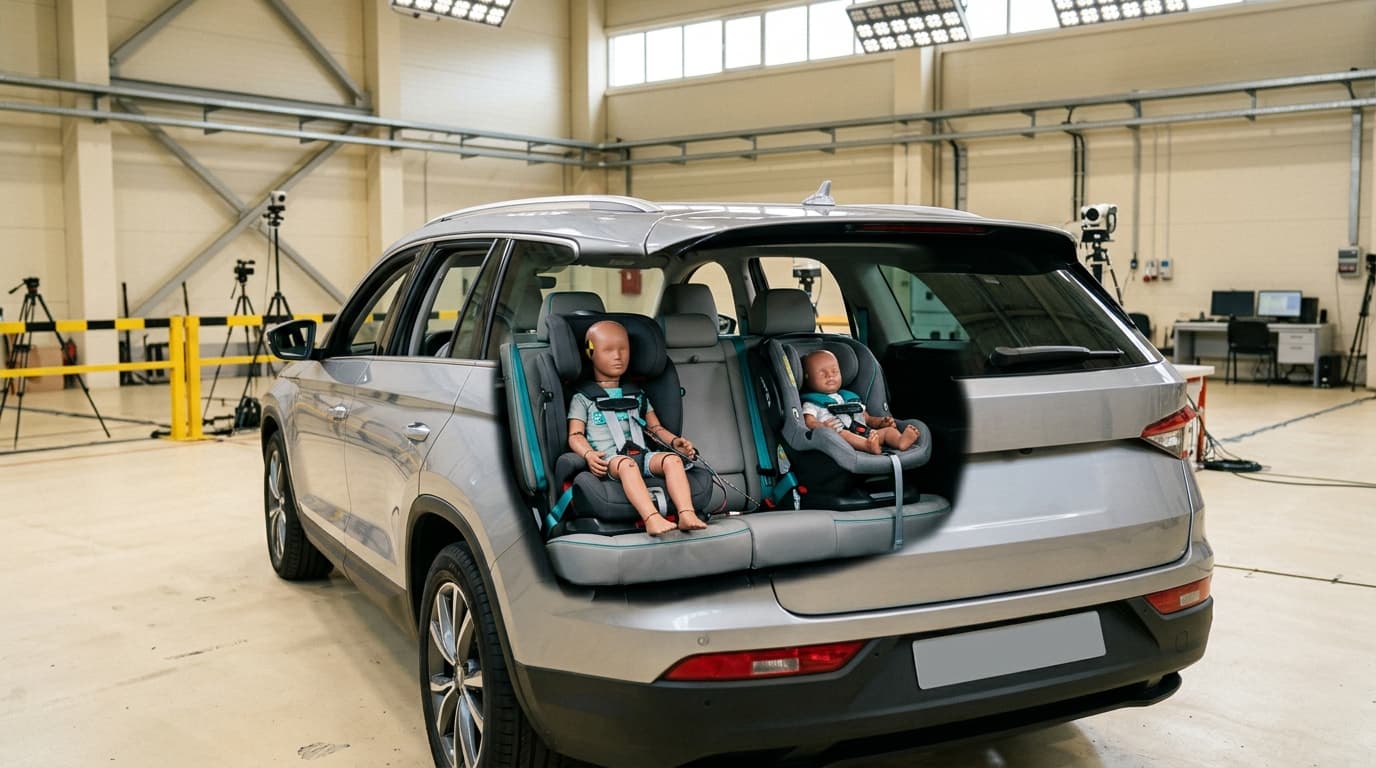
Euro NCAP stars judge a car on its weakest area, not on how well it protects your children. For a family, the line to read is the "child occupant protection" score, and within that score only 24 points out of 49 come from the crash tests. The rest counts equipment and how easily child seats fit.
A single star can therefore hide fairly well protected children. And five stars, the opposite.
The stars judge the car on its weakest point
Euro NCAP, the European New Car Assessment Programme, does not average anything. To earn five stars, a car must reach the threshold in each assessed area, and the worst area alone decides the final rating: the rules call it the worst score principle. Under the 2023 and 2024 protocol, five stars required at least 80 % in adult occupant protection and 80 % in child occupant protection, with separate thresholds for pedestrians and driver assistance.
The Dacia Jogger is the clearest illustration. Rated in 2021, it shows 70 % for adult occupants and 69 % for child occupants, two respectable scores for a car at that price. Its safety assist score stops at 39 %, below the threshold needed for two stars, partly because its third row has no warning for an unbuckled seatbelt. Published result: one star.
No star tells you which of the four scores dragged the car down. That is the first reason never to stop at the pictogram.
What does the child occupant score actually measure?
Three different things, added up to 49 points. Only the first says anything about what happens to your children during a crash.
The first block, 24 points, comes from frontal and side crash tests with two dummies sitting in the rear, one the size of a 6 year old, the other of a 10 year old. They ride in off-the-shelf child seats recommended by the carmaker: for the 2024 Škoda Kodiaq, Britax Römer Kidfix i-Size seats, according to the Euro NCAP datasheet. Head, neck and chest are scored area by area.
The second block, 13 points, rewards equipment: Isofix and i-Size positions, passenger airbag deactivation, integrated child seat, detection of a child left behind. The third, 12 points, checks that a list of common child seats fits correctly in every position declared compatible.
24 of 49
Points of the Euro NCAP child score that come from the crash tests with the 6 and 10 year old dummies; the other 25 count equipment and child seat installation
The forgotten-child detector weighs on the score
Since 2023, a system that spots a child left alone in a parked car earns points in the equipment block. The 2024 Kodiaq does not have one, the datasheet says so in plain words, and it scores only 6 points out of 13 in that block. Useful, no doubt. But it is a parking feature, with no effect at all on what a child goes through during the impact.
Jogger, Kodiaq, Berlingo: the child score broken down
Julie and Samir live near Ciney, in the Condroz area south of Namur in Wallonia, with two children aged 18 months and 5 years and 19,000 km a year, a good share of it on the N4 to Namur. Their estate car is reaching the end. On their list: a Dacia Jogger, a Škoda Kodiaq, a Citroën Berlingo. Julie started with the stars, and crossed out the Jogger within a minute.
I went back to the three datasheets published by Euro NCAP and laid out their points block by block, the only way to see where the difference comes from.
| Model and test year | Crash, 6 and 10 year old dummies (out of 24) | Equipment (out of 13) | Child seat installation (out of 12) | Published child score |
|---|---|---|---|---|
| Škoda Kodiaq, 2024 | 23.9 | 6.0 | 11.0 | 83 % |
| Citroën Berlingo, 2018 (tested on a Peugeot Rifter) | 23.8 | 7.0 | 9.0 | 81 %, rating expired |
| Dacia Jogger, 2021 | 18.6 | 5.0 | 10.5 | 69 % |
Sources: Euro NCAP datasheets for the Dacia Jogger, the Škoda Kodiaq and the Citroën Berlingo, consulted on 30 September 2026.
The figure that matters: between the Kodiaq and the Berlingo, two points apart on the child score, and only a tenth of a point apart in the crash tests. Their difference lies almost entirely in child seat installation, 11 against 9. Between the Kodiaq and the Jogger, the gap changes nature: 5.3 points lost in the crash tests, where no better child seat can make up the difference. The Jogger's datasheet rates the neck and chest protection of the 10 year old dummy as weak in the offset frontal test, and the neck protection of the 6 year old as marginal.
So Julie was right to be wary of the Jogger, but for a different reason than its single star. And she was about to settle on the Berlingo on the strength of an 81 % dating from 2018, earned under more lenient rules than the Kodiaq's.
Does a five-star car always protect your children better?
No, and the objection deserves to be taken seriously, because it sounds like common sense. Five stars guarantee that no area is clearly poor. They do not guarantee that the car beats a four-star car on the line you care about.
Take two fictional cars, but ones the grid allows perfectly well. One earns five stars with 81 % in child occupant protection, including an average crash block offset by plenty of equipment. The other gets only four, because its emergency braking misses a few night-time scenarios, while it scores 23.9 out of 24 in the crash tests with the dummies. For children sitting in the back, the second is the more reassuring of the two, and its pictogram says the opposite.
The reverse exists too, and that is where the nuance becomes useful. A high crash block says nothing about the centre seat, which the tests do not use, nor about an occasional third row: on the Kodiaq, the datasheet states that child seats cannot be installed on the foldable third-row seats. The crash test scores two children sitting in the outer second-row seats, in seats chosen by the carmaker. Your three-child setup, with your own seats, has not been tested.
My view, after breaking down these three datasheets: read the first block of the child score first, then installation, and keep equipment to separate two otherwise equal cars.
Why does a Euro NCAP rating expire after six years?
Because the tests change faster than the cars. Euro NCAP says so in its FAQ: each rated model is issued with a test year that is valid for six years, and that year is what lets you compare cars judged against the same criteria.
A car can stay in the catalogue long after that. The Berlingo is the example: its rating, obtained in October 2018, now shows as expired on the Euro NCAP website, while the model is still sold new, in a facelifted version. A star from 2018 and a star from 2024 do not weigh the same: in between, the protocols have been tightened several times, and nobody knows how many stars the Berlingo would earn if it went through the tests again today.
Twins inherit the rating
Euro NCAP does not test every body style. The Berlingo's rating comes from tests carried out on a Peugeot Rifter, identical apart from a few front-end details that only affect the pedestrian impact test. The Jogger's comes from a Sandero Stepway, with points deducted for the third row. It is written on each datasheet, and it is legitimate. You still need to know it before quoting "the Jogger's rating" as if a Jogger had hit the barrier.
Since 2026, four stages have replaced the four scores
The protocol applied since January 2026, which Euro NCAP presents as its largest revision since 2009, no longer publishes the four scores everyone knows. It publishes four others, each out of 100 and expressed as a percentage: safe driving, crash avoidance, crash protection, post-crash safety. The worst score principle remains, with 80 % per stage for five stars, and softer thresholds in 2026 and 2027 for the first two stages, according to the overall rating protocol.
For a family, the change is visible at a glance. Child protection no longer appears among the four headline scores: it is assessed within the crash protection stage, with occupant sizes that now range from children to tall adults. You will therefore have to scroll further down the datasheets of cars rated since January to find the 6 and 10 year old dummies, and a 2024 child score can no longer be set directly against a 2026 one.
In Belgium, none of this has legal standing. A car is sold new here with one star, an expired rating or no rating at all, as long as it has European type approval, the same in Brussels, Wallonia and Flanders. The Belgian obligation bears on use, not on purchase: article 35 of the Belgian highway code requires a suitable restraint for every child under 135 cm. The Euro NCAP rating remains a tool for choosing. The law takes care of the seat.
Before buying, five lines of the datasheet are worth more than the stars:
- the test year, and therefore the protocol applied, to compare across the cars on your list;
- the crash block of the child score, out of 24 points, the only one that measures what the dummies go through;
- the remarks on the 6 and 10 year old dummies, where the datasheet flags a neck or chest rated weak or marginal;
- the table of Isofix and i-Size positions, which tells you how many seats you can actually fix, and where;
- the line on what the rating applies to, which says whether it comes from a twin model or whether some versions are excluded.
Julie and Samir kept the Kodiaq and a Berlingo test drive on their list, and they added a column: the year of the rating. To choose the seat that goes in it, our guide to which car seat for which age gives the height thresholds, and our Dacia Jogger vs Škoda Kodiaq duel compares the two cars on boot space and budget. To count the Isofix positions you can actually use, model by model, use our comparison tool.
Comparateur SUV familiaux & 7 places
Compare tous les suv familiaux & 7 places côte à côte.
Comparer maintenant →
Frequently asked questions
Audrey teste des familiales depuis 2015, maman de deux enfants, basée à Wavre. Elle installe vraiment les sièges Isofix avant de juger l’habitabilité et calcule le budget sur cinq ans, carburant et entretien compris. Sa boussole : peut-on y mettre deux sièges-auto et les courses sans jouer à Tetris ?