Two figures are enough. Your car's payload is the maximum authorised mass minus the mass in running order, both printed on the registration certificate. On an ordinary family car, that leaves 400 to 450 kg. Five people, their luggage and a roof box swallow almost all of it.
It is the calculation nobody runs on the morning of departure, even though it is one subtraction. Here is the tool, then the method, then the two places where everyone gets it wrong.
Am I overloaded?
Take two figures off your registration certificate, add what you are loading, and read the kilos left.
From the registration certificate
Field G already includes the driver at 75 kg and the tank filled to 90 %. Source: Commission Implementing Regulation (EU) 2021/535, Annex XIII, consulted on 03/09/2026.
Equipment margin
The TCS weighed 42 cars: around 80 % weigh more than the manufacturer figure, the gap reaches 70 to 150 kg on richly equipped cars, and 16 of the 42 were 80 kg over. Sunroof, large wheels, full-size spare, audio system. Test consulted on 03/09/2026. Enter 0 if you have weighed your car.
On board
The driver does not go here: those 75 kg are already inside field G. Counting the driver twice is the most common mistake, and it invents an overload that does not exist.
75 kg is the nominal mass of one occupant in the European type-approval regulation, not a Belgian average. Sciensano reports a mean adult BMI of 25.5 and 49.3 % of adults overweight: enter your real weights.
An i-Size seat with its Isofix base is heavy: 7.9 kg for a Maxi-Cosi Pearl 360 and 8.0 kg for the FamilyFix 360 base, so 15.9 kg together, per the ADAC test sheet consulted on 03/09/2026. Weigh yours.
On the roof and on the towball
Figure from the vehicle handbook. 75 kg on a Škoda Octavia and Octavia Combi, every engine, manufacturer specification sheet dated 23/02/2025. Bars and empty box count towards it.
Vehicle handbook or towbar data plate. 80 kg on a Škoda Octavia (sheet dated 23/02/2025). This load presses down on the car, so it counts towards the maximum authorised mass.
Result
Close to the limit · Left over 20 kg
Under 25 kg of margin: one more suitcase on the doorstep tips you over.
Type-approved payload420 kg
Load on board400 kg
Estimated total mass1 880 kg · 98.9 % of the maximum authorised mass
Calculation breakdown
Adult passengers75 kg
Children81 kg
Child seats25 kg
Luggage90 kg
Roof49 kg
Towball0 kg
Equipment margin80 kg
An estimate, not a weighing
Only the figures printed on your registration certificate and in your vehicle handbook are authoritative. The result above is an estimate built from the numbers you entered: it is neither a weighing nor an official document. In a roadside check, only a weighing on a calibrated weighbridge counts. This site is neither an inspection body nor a vehicle expert.
How do I work out my car's payload?
Maximum authorised mass minus mass in running order. The first is the weight the loaded vehicle may not exceed, the second is what it weighs ready to drive. The difference is what you have left for everything else.
Both values are harmonised across Europe. The mass in running order is defined by Commission Implementing Regulation (EU) 2021/535, which replaced Regulation 1230/2012: it covers the bodied vehicle, the fluids, the tank filled to 90 %, the onboard tools, and a nominal 75 kg for the driver. Everything that climbs in afterwards comes out of the payload.
On a Škoda Octavia Combi, manufacturer specification sheet dated 23 February 2025, the line exists as such: 1.5 TSI of 110 kW, total weight 1,860 to 1,900 kg, quoted payload of 415 to 603 kg depending on trim and options. That 188 kg spread between two examples of the same model is not a rounding quirk. It is the whole subject of this article.
Where do you read the maximum mass and kerb weight on a Belgian registration certificate?
Fields F.1 and G. Nothing else to hunt for.
The registration certificate issued by the DIV follows the harmonised European coding, identical in all twenty-seven countries.
| Field | Content of the field | Role in the calculation |
|---|---|---|
| F.1 | Technically permissible maximum laden mass | The ceiling of the sum |
| F.2 | Maximum mass permitted in service in Belgium | Used when it is lower than F.1 |
| F.3 | Maximum permissible mass of the combination | Car plus trailer, a different sum |
| G | Mass in service, including a 75 kg driver | Subtract this from F.1 |
| O.1 / O.2 | Braked and unbraked towable mass | Nothing to do with payload |
Take F.1 and G, do the subtraction. If your certificate predates 2010 or one field has gone unreadable, the vehicle's European certificate of conformity carries the same values, and so does the handbook.
Why should you never count the driver twice?
Because the driver is already in there. This is the point on which almost every French-language guide misleads its reader, and the mistake is paid for in phantom kilos.
The formula those pages repeat is right in principle: payload equals gross vehicle weight minus kerb weight. The slip happens on the next line, when they add that the payload covers the weight of everyone in the car, driver included. On a French registration document there is a field G.1 giving the national kerb weight, driver excluded, and the sentence holds. On a Belgian certificate you read field G, which is the mass in service, driver included. Adding the driver afterwards means counting the driver twice.
Škoda leaves no ambiguity and labels both of its lines the same way: kerb weight incl. driver 75 kg, then payload incl. driver 75 kg. The manufacturer is telling you, in the same column, that the 75 kg sit on both sides.
The gap is not cosmetic. Take the default configuration of the tool above: 400 kg loaded against 420 kg of payload, so 20 kg of margin and no offence. Count the driver twice and you get 475 kg, a displayed overload of 55 kg, and a family putting a suitcase back on the pavement for nothing. The other way round, a page that makes you add 75 kg where none belong leaves you suspicious of the wrong item and blind to the one that really matters. That one comes next.
Your car weighs 80 kg more than its specification sheet
The Touring Club Suisse did what nobody else does: it put 42 cars on a calibrated weighbridge, the one at the Lucerne traffic office, and compared the result with the factory figures.
Around 80 % of the cars weighed more than advertised. Sixteen of the forty-two were 80 kg over. On models whose optional equipment was worth more than 10,000 francs, the gap ran between 70 and 150 kg, and two heavily specified cars cleared 150 kg. Exactly one, a Subaru Impreza 1.6i, weighed 40 kg less than its sheet.
Panoramic sunroof, electric seats, 19-inch wheels, full-size spare, subwoofer audio: each of those runs into kilos, and none of them changes the maximum authorised mass, which is fixed at type approval. The full TCS test puts it bluntly: the payload shrinks by the same amount.
That is why the tool above carries an equipment margin line, preset at 80 kg and editable. Set it to zero if you have had your car weighed. Otherwise keep it: on a well-equipped family car, it is the item that decides the result.
How much weight can you put in a family car?
Less than the boot can swallow. Here is where 420 kg of payload goes on a family car the size of an Octavia Combi, with an 80 kg equipment margin included in every line.
| Configuration | Occupants excl. driver | Seats and luggage | Roof and towball | Total load | Left |
|---|---|---|---|---|---|
| Couple, one weekend | 75 kg | 40 kg | 0 kg | 195 kg | 225 kg |
| Couple and a baby, infant seat and base | 84 kg | 76 kg | 0 kg | 240 kg | 180 kg |
| Two adults, two children aged 7 and 10 | 132 kg | 99 kg | 0 kg | 311 kg | 109 kg |
| Two adults, three children, roof box | 156 kg | 115 kg | 49 kg | 400 kg | 20 kg |
| The same family plus a loaded bike rack | 156 kg | 115 kg | 109 kg | 460 kg | 40 kg over |
The table tells a simple story. A family of four never gets near the limit. A family of five reaches it on the first holiday departure. And the tipping point comes from neither the children nor the suitcases: it comes from the roof and the towball, the only two items people add without ever weighing them.
Do the roof box and the towbar count towards the payload?
Yes, and each of them faces a second limit of its own.
On the roof, everything counts: the bars, the empty box, its contents. A set of aluminium bars weighs 4 to 5 kg, a 400-litre box around fifteen, and the 30 kg of gear you put inside are the ones you did not want in the cabin. Those kilos leave your payload like any suitcase. They also run into the maximum permitted roof load, which Škoda sets at 75 kg on every Octavia and Octavia Combi. Emptying the boot buys nothing on that side: the two ceilings are independent.
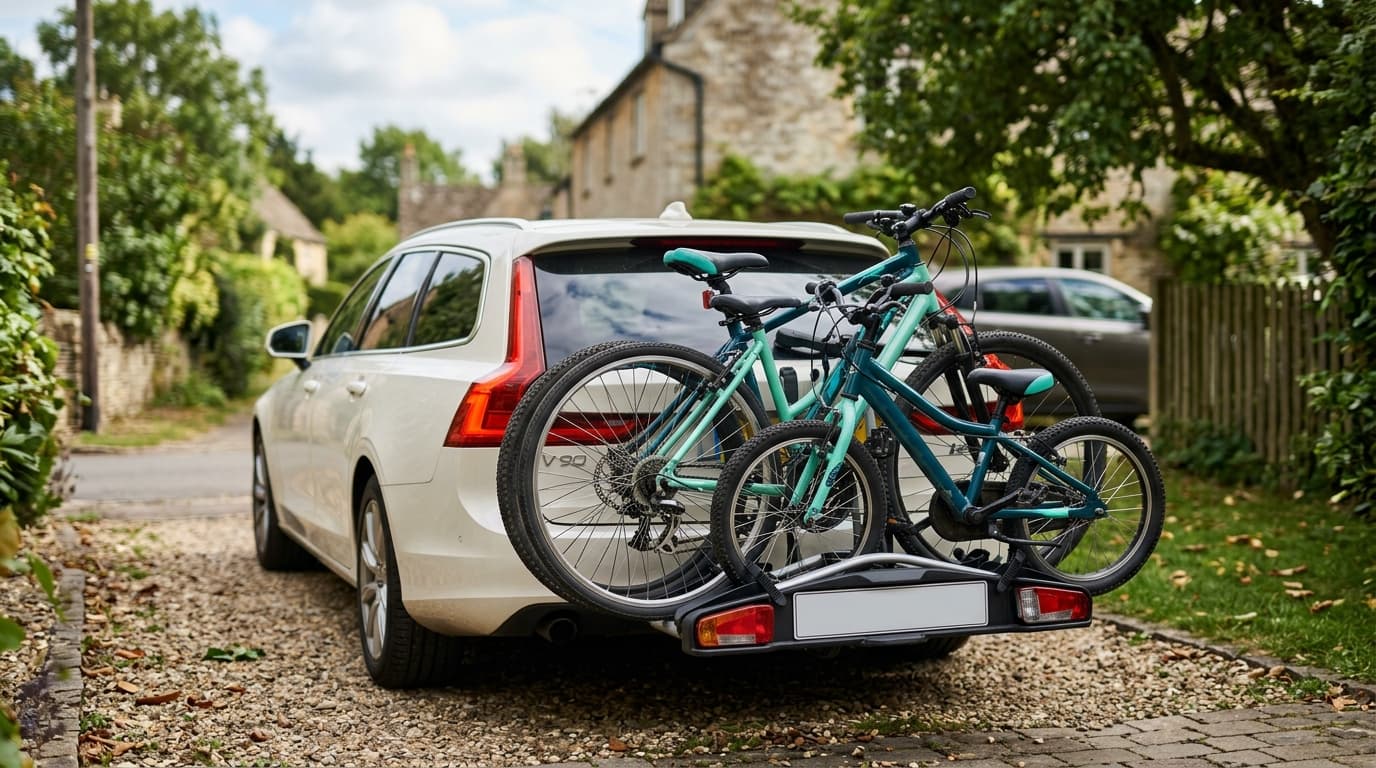
At the towball, what counts is the vertical load on the ball, not the weight of the trailer. A well-balanced caravan presses 50 to 80 kg onto the hook, and those kilos sit on the car exactly as if they were in the boot. Škoda quotes 80 kg of maximum noseweight on the Octavia. A loaded bike rack behaves the same way, and we have set out the full sum elsewhere in our piece on noseweight with a bike rack, which runs between 32 and 100 kg depending on the car.
Sophie and Farid travel five-up: 20 kg to spare
Braine-l'Alleud, a Saturday in July, heading for the Vendée. Octavia Combi 1.5 TSI of 110 kW, five people, a fortnight.
On the registration certificate, field F.1: 1,900 kg. Field G: 1,480 kg. The type-approved payload is therefore 420 kg. Farid drives the outward leg, and his 75 kg are already inside the 1,480.
Sophie weighs 68 kg but enters the nominal 75 kg in the tool to stay on the safe side: 75 kg. The three children are 4, 7 and 12 and weigh 17, 24 and 40 kg on the bathroom scales, so 81 kg. The youngest one's i-Size seat and its base come to 16 kg, the two boosters to 9 kg between them: 25 kg. Suitcases, cool box, parasol and beach bag reach 90 kg. On the roof, bars and box weigh 19 kg empty and they have put 30 kg inside: 49 kg, under the 75 kg allowed on the roof. No trailer.
Then comes the line nobody writes down. Their car has the sunroof, 18-inch wheels and the upgraded factory audio. They apply the 80 kg the TCS measured on sixteen cars in its sample.
Total on board: 75 plus 81 plus 25 plus 90 plus 49 plus 80, so 400 kg. Against 420 kg available, they have 20 kg left, and the car weighs 1,880 kg, or 98.9 % of its maximum authorised mass. They are legal, by a whisker.
Then the mother-in-law turns up with a box of preserves and two bikes for the towball. Rack and bikes press 60 kg on the ball. The total goes to 460 kg, and the family drives 40 kg over the limit with nothing to warn them.
Which mistakes distort a payload calculation?
Five, and they all pull the same way: they suggest a margin that is not there.
- Confusing volume with mass. A 640-litre boot fills long before the car reaches its weight limit if you are carrying books, tiles or timber. It fills long afterwards if you are carrying duvets. The litre says nothing about the kilo.
- Forgetting what lives in the car all year. Child seats, boosters, a folded pushchair, the toolbox, snow chains, a full-size spare wheel. Nobody counts them, and they are all there at the roadside check. A modern i-Size seat weighs more than people picture: the ADAC test of the Maxi-Cosi Pearl 360 records 7.9 kg for the seat and 8.0 kg for the FamilyFix 360 base.
- Using the catalogue weight of an entry-level trim. Specification sheets give a range, never a single figure. Always take the top of the range, or have the car weighed.
- Ignoring the rear axle. The maximum authorised mass is not the only ceiling: each axle has its own. A boot loaded to the roof lining and 80 kg of noseweight can saturate the rear while the total mass stays legal.
- Believing there is a tolerance for private cars. There is none. The threshold is the maximum authorised mass, to the kilo.
What do you risk driving overloaded in Belgium?
A fine, yes, but that is not the worst of it.
Exceeding the maximum authorised mass breaches the Belgian technical regulation, the Royal Decree of 15 March 1968, whose articles 21 to 32bis set the permissible masses. A roadside finding ends in an immediate levy, on top of the €10.67 administrative surcharge applied to every road fine under the scale of 1 July 2026. The heavy administrative fines, the ones running into thousands of euros, target lorries weighed at checkpoints, not the family estate of a couple leaving on holiday.
The real cost is physical. An overloaded car brakes later, squats under acceleration, lightens its front axle and makes the steering vague at the exact moment you need it. The tyres work beyond their load index, the rear dampers hit their stops, and the headlights rise into other people's eyes. Add the insurance question: an insurer who establishes an overload at the time of a claim has grounds to argue about paying, and that argument always lands at the worst possible moment.
One last word on the weights used. Sciensano records a mean body mass index of 25.5 among Belgian adults and 49.3 % of the adult population overweight. The 75 kg of the European regulation is a nominal type-approval value, not a national average. In a load calculation, the real scales decide, not the regulatory figure.
The sum takes two minutes once a year, and what it mostly changes is how you load: heavy items low down and against the rear seat back, light items on the roof, and nothing above the line of the head restraints. To compare family cars on real capacity rather than advertised volume, the rankings and the comparison tool give the figures model by model, and our guide to family estates with the biggest boots sets out the measured volumes.
Comparateur Breaks & familiales
Compare tous les breaks & familiales côte à côte.
Comparer maintenant →
Frequently asked questions
Audrey teste des familiales depuis 2015, maman de deux enfants, basée à Wavre. Elle installe vraiment les sièges Isofix avant de juger l’habitabilité et calcule le budget sur cinq ans, carburant et entretien compris. Sa boussole : peut-on y mettre deux sièges-auto et les courses sans jouer à Tetris ?