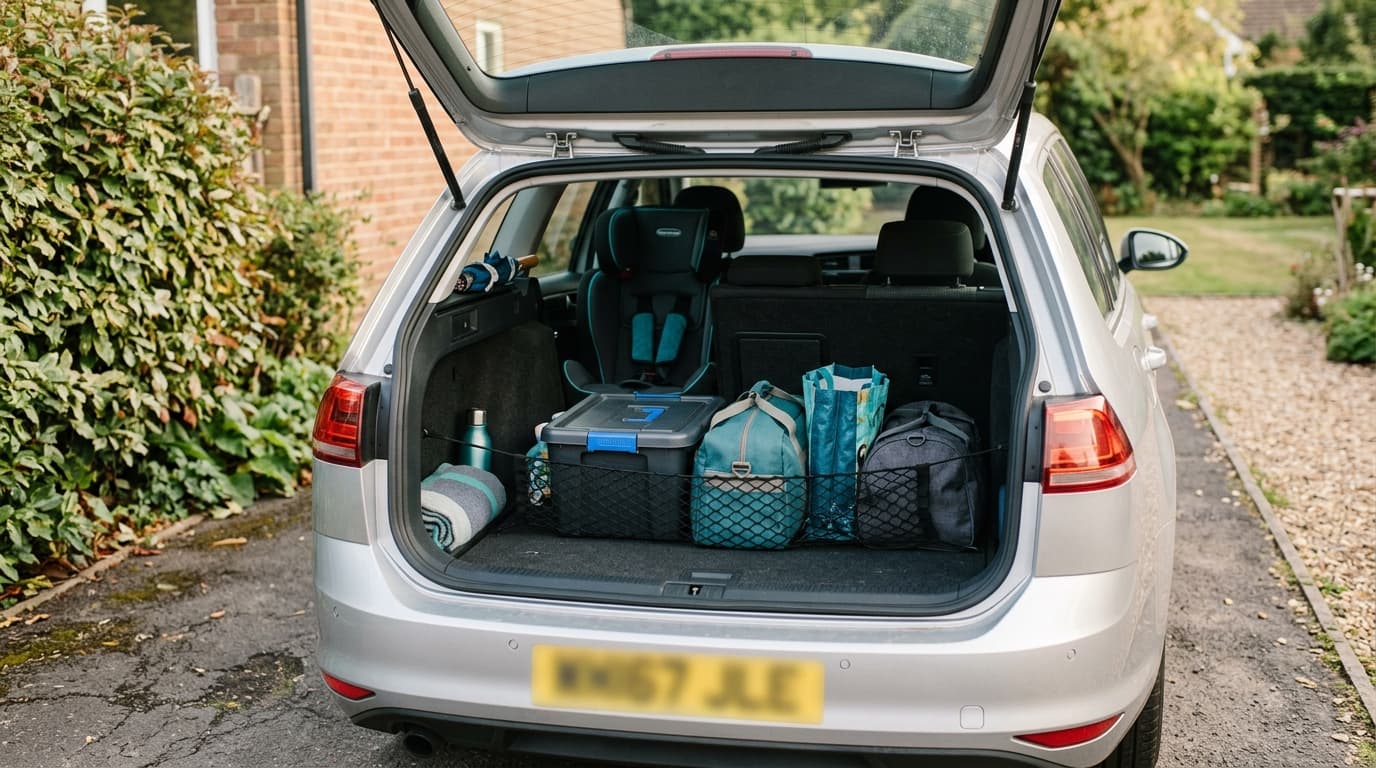
A family car boot is organised in three layers: heavy items on the floor, tight against the rear seat back; medium items held by an organiser or a net; light items on top, never higher than the seat backs. The fire extinguisher and first aid kit, mandatory on a Belgian registration, get secured too. Left loose, they are the heaviest objects in the boot.
Why is organising the boot a safety issue?
Because an object sitting in a car is held by nothing. Vias, the Belgian road safety institute, quoted by Touring, the Belgian motoring club, gives an example every parent should remember: a 2 kg thermos left on the parcel shelf weighs nearly 57 kg under hard braking at 80 km/h. Not a crash. Braking.
Families know it and do it anyway. In a survey of 1,020 Walloons in March 2023, the AWSR, the Walloon road safety agency, found that 65% of them sometimes put luggage or heavy objects on the passenger seats, and advised loading the heaviest items at the back and centre of the boot.
Ellen and Rachid live in Sint-Niklaas, in the Waasland area of East Flanders, with two children aged 2 and 7 and a compact estate car. The boot worked as a wardrobe on wheels: folded pushchair, swimming bag, a crate of shopping, and a fire extinguisher sliding from side to side at every roundabout. They took everything out one Sunday morning, and it took them forty minutes to put it all back in the right order, with the rule set once and for all.
The rear seat back only holds what sits behind it
The European regulation that type-approves seats, UN Regulation No. 17, sets a precise test: test blocks are placed in the boot, the vehicle undergoes a deceleration matching a 50 km/h crash, and the seat backs must stay in place, locks included, without moving more than 100 mm ahead of the seat's reference point. Blocks of this type weigh 18 kg and measure 30 cm on each side, according to the data sheet of test equipment maker Humanetics. Thirty centimetres. Well below the top of a seat back.
The consequence for a family is direct. The seat back is designed as a wall for whatever sits on the floor and rests against it. A load that rises above its height goes over the top, and nothing in the test claims otherwise.
How do you organise a car boot, step by step?
Allow three quarters of an hour the first time, then five minutes before each big outing.
- Empty everything and make three piles: what stays all year (mandatory kit, charging cable, umbrella), what is used every week (pushchair, shopping bags, sports bag), what only comes out for holidays.
- Secure the mandatory kit first. Extinguisher on a bracket or strapped to a lashing eye, first aid kit stuck to the boot carpet by its hook-and-loop strip, or slipped into a side tray if the car has one.
- Heavy items on the floor, against the seat back. Suitcase, pack of water bottles, wet swimming bag: flat, in the centre, tight against the rear seat back, where the Regulation 17 test puts its blocks.
- Hold medium items with an organiser. Stuck with hook-and-loop against the seat back or wedged between the wheel arches, it stops the shopping sliding towards the tailgate at the first hard stop.
- Stretch a net across the four lashing eyes for things that roll: balls, bottles, bike helmet.
- Nothing above the seat backs, nothing on the parcel shelf. The parcel shelf is there to hide things, not to carry them.
- The pushchair goes in last, because it comes out first. The high-visibility vest does not go in the boot at all: it rides in the driver's door pocket.
69 kg
Weight the mandatory Belgian kit (extinguisher and first aid kit, 2.42 kg) would take on if left loose under hard braking at 80 km/h, applying the ratio Vias gives for a 2 kg thermos
How much does boot storage gear cost?
Between 13 and 72 euros for storage, plus 45 euros for the mandatory kit if the car has none. Prices shown on 17 October 2026 on Belgian shops, excluding delivery and with no promotion running.
| Item | Price noted | Weight or size (product sheet) | Useful for | Limit |
|---|---|---|---|---|
| Carpoint 1 kg fire extinguisher, GAMMA | €19.99 | 1,870 g, 29.2 cm tall | The Belgian requirement | No bracket mentioned on the sheet |
| Carpoint DIN 13164:2022 first aid kit and triangle, GAMMA | €24.99 | 550 g, 23 x 18 x 7 cm | The Belgian requirement, in one pack | Detailed contents not published |
| Carpoint Large boot organiser, GAMMA | €12.95 | 199 g, one large compartment | Shopping, kit, shoes | Conflicting dimensions on the sheet |
| Carpoint M storage bag, Hubo | €15.99 | 264 g, hook-and-loop closure | Small boot, everyday items | No reviews published |
| Carpoint 75 x 85 cm boot net, GAMMA | €13.79 | 182 g, four hooks | Balls, bottles, things that roll | Needs four lashing eyes on the floor |
| Thule Go Box M, thule.com | €71.95 | 61 x 36 x 30 cm, so 66 litres | Holiday gear, picnic | No fixing described on the sheet |
The figure that matters: €26.74. That is the price of the organiser and the net together, and it is all most families need.
The Thule Go Box is a good box, foldable, with a side pocket and a flap against the rain. But 66 litres of rigid, unstrapped gear lead straight back to the original problem, only bigger. In an estate car, it belongs against the seat back and held by a strap to the lashing eyes; otherwise, a €12.95 soft organiser does the same job without turning storage into a projectile. I have not tested any of these products: the figures are those of the product sheets and the shops.
What must the boot contain in Belgium?
A car registered in Belgium must carry a fire extinguisher and a first aid kit, as Moniteur Automobile, the Belgian motoring magazine, points out, plus a warning triangle and a high-visibility vest for the driver. The rule is federal: the same in Brussels, Wallonia and Flanders. None of the sources consulted sets a location, but an extinguisher is used within the minute, so it has to come out without unloading the suitcases.
The triangle is changing role. From 1 June 2027, according to New Mobility, hazard lights become the main way to signal a breakdown, and the triangle is only placed when that is not possible, on motorways and expressways. The vest remains mandatory to step out of the vehicle on those roads.
Before heading abroad, four points to check:
- in France, the vest must be within reach, so not in the boot;
- in Germany, the first aid kit is only required of German-registered cars, but the DIN 13164 standard used there remains a good benchmark when buying;
- in Luxembourg, a triangle and a vest are enough, and the Belgian kit does no harm;
- everywhere, the Belgian kit rule only applies to Belgian plates: a foreign hire car will not necessarily have one.
The pushchair and everyday bags go on the floor
Flat, pushchair against the seat back if it is heavy. That is where geometry matters more than litres. Our investigation into whether a pram fits in the boot gives the measurements to take before buying one or the other.
In practice, for a family, a well-organised boot is also a lighter boot. Last week's sports bag and the winter boots weigh on the payload, and a family of five with luggage exceeds it more often than you might think, as our calculation on overloading shows.
At Ellen and Rachid's, the extinguisher is now strapped to the left lashing eye, and the rule fits on a sticky note on the tailgate: nothing higher than the seat backs. To compare family cars on their real boot space and Isofix positions, the comparison tool lines up the figures model by model.
Comparateur Breaks & familiales
Compare tous les breaks & familiales côte à côte.
Comparer maintenant →
Frequently asked questions
Audrey teste des familiales depuis 2015, maman de deux enfants, basée à Wavre. Elle installe vraiment les sièges Isofix avant de juger l’habitabilité et calcule le budget sur cinq ans, carburant et entretien compris. Sa boussole : peut-on y mettre deux sièges-auto et les courses sans jouer à Tetris ?