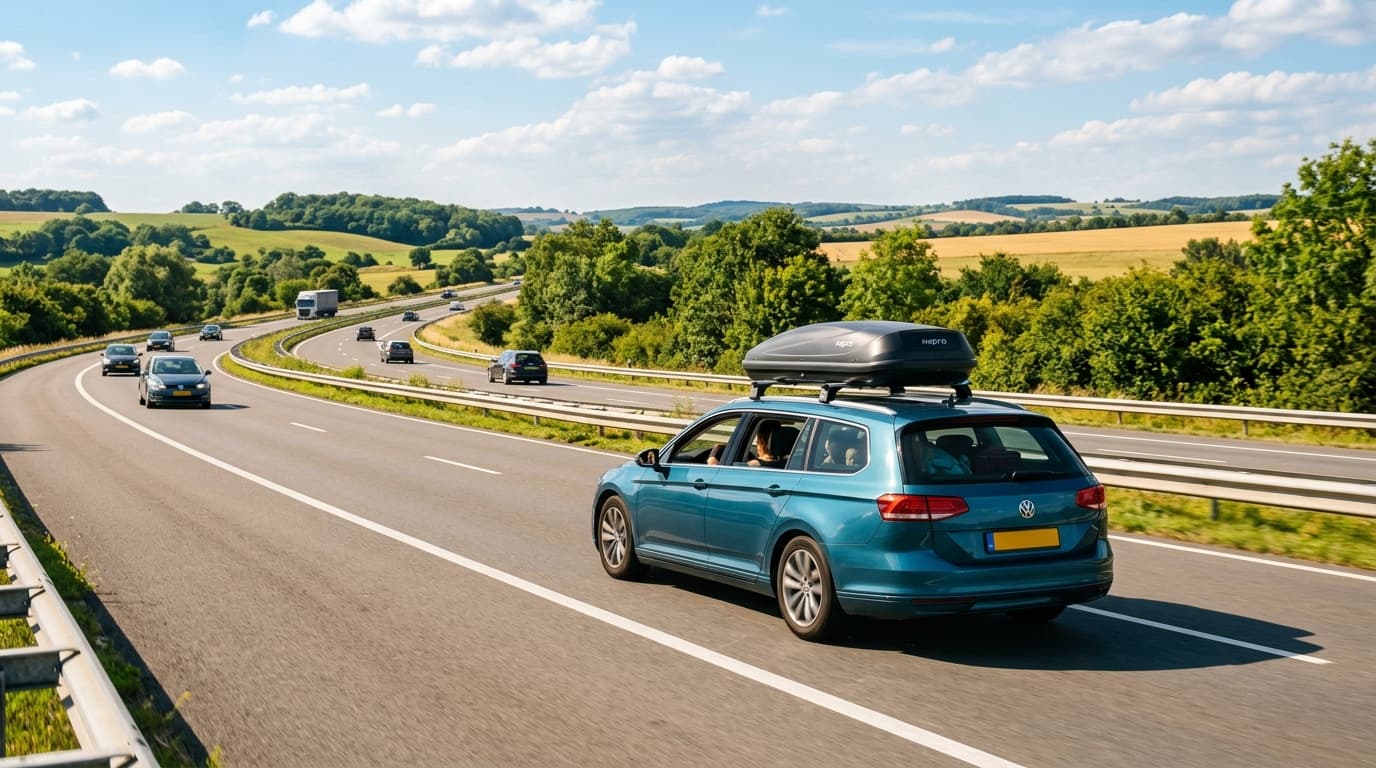
A family car homologated at 6 L/100 km has never used 6 L/100 km on the way to the holidays. The average gap measured across the fleet is 20%, and a car loaded with five people and a roof box goes well beyond that. Here is how the figure builds up, and how to measure your own.
What is the real-world fuel consumption of a family car?
Count on 20% more than the WLTP figure in everyday use, and 30 to 45% more on a loaded holiday run. Petrol cars drift further (+23.7%) than diesels (+18.1%). A family car quoted at 6 L/100 km therefore really sits around 7.2 L, and touches 8.5 L when loaded.
These averages come from the on-board consumption readings manufacturers have been submitting since 2021, reported on the Belgian side by Moniteur Automobile (checked August 2026). They cover millions of cars rather than a single road test, which is what makes them usable for building a budget.
Take Virginie and Pascal, in their forties, two children aged 8 and 11 plus an Australian shepherd, a house near Sint-Truiden and 14,000 km a year. Every summer they drive down to the Ardèche: 1,100 km each way, five aboard, roof box on the roof rails. Their family SUV is homologated at 6.4 L/100 km. On that trip they read 9.1 L on the trip computer, and 9.4 L once the maths is redone at the pump.
| Situation | Measured consumption | Gap vs official figure |
|---|---|---|
| WLTP homologation (reference) | 6.4 L/100 km | — |
| Daily trips, driver alone | 7.3 L/100 km | +14% |
| Five people + luggage | 8.2 L/100 km | +28% |
| Five people + luggage + roof box at 120 km/h | 9.4 L/100 km | +47% |
| Same, speed brought down to 110 km/h | 8.6 L/100 km | +34% |
+47%
Gap between the WLTP figure and consumption measured at the pump on a family SUV loaded with five people and a roof box, motorway at 120 km/h
Why does real-world consumption always exceed WLTP?
Because WLTP is a laboratory protocol, designed to be repeatable from one model to the next, not to imitate your holidays. It measures an almost empty car, on a rolling road, at a controlled temperature, with no wind, no air conditioning and no bike rack.
WLTP, the Worldwide harmonised Light vehicles Test Procedure, has been the European Union's homologation procedure since September 2018. It replaced the even more lenient NEDC and brought official values closer to reality, without ever claiming to match it. It is a yardstick for comparing models, and it is very good at that: two cars quoted at 5.8 and 7.1 L/100 km will rank in the same order on the road.
The mistake is to turn it into a budget. The WLTP cycle runs at an average of 46.5 km/h with a peak at 131 km/h, over 23 kilometres. It includes neither the 300 kg a family loads aboard, nor the drag of a roof box, nor the air conditioning running for four hours straight in August. The European Commission tracks that gap closely and has been publishing its real-world emissions monitoring reports since March 2024.
How much do luggage and a roof box really cost?
Around 6% more fuel per 100 kg carried, and 10 to 25% more for a roof box as soon as the needle passes 110 km/h. The two penalties add up, and the second grows with the square of speed.
Weight matters mainly under acceleration and on climbs: the heavier the car, the more energy it takes to get it moving. A family of five with suitcases, cool box, pushchair and beach gear easily adds 300 kg over the lone driver of the homologation cycle, so 15 to 18% more fuel. That alone is the equivalent of a litre per 100 km on an ordinary family car.
The roof box itself weighs almost nothing, 15 to 20 kg empty and 75 kg maximum once loaded on most roof bars, but it breaks the airflow exactly where the body designers did their work. Around town the penalty is marginal. At 120 km/h it commonly reaches 20%. Over Virginie and Pascal's 1,100 km that means roughly 13 extra litres of fuel, about fifteen euros on the way out, and the same again coming back.
≈ 6%
Additional fuel consumption per 100 kg carried in a family car
Does 110 km/h instead of 120 really make a difference?
Yes, and it is the cheapest lever of the lot. Air resistance rises with the square of speed: going from 120 to 110 km/h removes around 16% of drag, and more still with a roof box amplifying the effect. On Virginie and Pascal's trip those 10 km/h bring consumption down from 9.4 to 8.6 L/100 km, at a cost of 55 extra minutes over 1,100 km. Each family can weigh that up, but the calculation deserves to be done before complaining about the price of diesel.
Which powertrain loses the most once the car is loaded?
The plug-in hybrid, by a wide margin. Its real-world emissions come out around five times its official figure, against a 20% gap for a conventional combustion car. Diesel stays the most predictable under load, while the self-charging hybrid loses its advantage as soon as you leave town.
The figure comes from on-board fuel consumption monitoring (OBFCM) data submitted for around 8 million cars registered between 2021 and 2023, analysed by the ICCT (published June 2026). The explanation fits in one percentage: the rules assumed these cars drove 84% of the time on electricity, and the measured reality is 27%. A Renault Espace E-Tech, or any other family plug-in hybrid, keeps its promises on one condition and one only: that the battery is plugged in almost every evening. Over 1,100 km of motorway, the first 50 km are electric and the remaining 1,050 are driven hauling a flat battery around. The European Commission began correcting that utility factor in 2025 for new registrations, and in 2026 for models already homologated.
The self-charging hybrid, Toyota-style or the standard Renault E-Tech, behaves differently. It shines in town, where energy recovery works at full effect, and becomes an ordinary combustion car on a loaded motorway. Diesel is the only one to show a contained real-world gap (+18.1%) and not to collapse under load. It remains the best choice for towing, even if its administrative horizon in Belgium is closing. A Skoda Kodiaq TDI or a Peugeot 5008 BlueHDi are, on that precise criterion, more dependable than a plug-in hybrid nobody ever plugs in.
Is a family car's trip computer accurate?
It is optimistic by 2 to 6%. The on-board computer works out consumption from injector opening times and an engine model, never from the fuel that actually went into the tank. The gaps I have recorded on recent family cars run from 0.15 to 0.4 L/100 km, always in the same direction: the computer claims less than the pump. That isn't cheating, only an estimate. If you are building a five-year budget, add 3% to the displayed figure.
How do you measure your own real consumption in five steps?
Five consecutive fill-ups are enough to know your consumption to within 0.2 L/100 km. The method is free, needs no equipment and gives a truer figure than any online comparison tool.
- Fill the tank completely at a pump you will be able to find again, and stop at the nozzle's first click, never topping up drop by drop. That click is your reference point.
- Reset the trip meter to zero and note the car's total mileage on your phone. Allow five minutes for this step.
- Drive normally until around a quarter of a tank is left. Change nothing about your habits: the goal is to measure your use, not to set a record.
- Refill at the same pump, to the same first click, and read the exact number of litres from the receipt. Divide those litres by the kilometres on the trip meter and multiply by 100: that is your consumption for this cycle.
- Repeat over five fill-ups and take the average. A single fill can be skewed by a poorly calibrated nozzle or an unusual month; five smooth out the noise.
Common mistakes: topping up after the click (the volume varies by more than a litre depending on the driver's patience), switching stations between fill-ups, or measuring on a single motorway run and applying the result to the whole year. Cost of the exercise: zero euros and around ten minutes spread over two months.
Does a trailer use more fuel than a roof box?
Not necessarily, and that is counter-intuitive. A small covered trailer runs in the car's wake, in air that is already disturbed, whereas a roof box attacks the clean flow above the roof. For an equal volume carried, the trailer often comes out better beyond 110 km/h. It does impose a 90 km/h limit on Belgian motorways, a BE licence category above 750 kg maximum authorised mass, and somewhere to park it the rest of the year. Our family car comparison tool lets you filter on homologated towing capacity.
What real-world consumption changes, and doesn't change, in Belgium
It changes your fuel budget, not your tax position. The benefit in kind (ATN, avantage de toute nature) on a company car and the deductibility percentage are both worked out from the WLTP CO₂ figure on the certificate of conformity, never from what you measure at the pump.
That asymmetry is worth having in mind before signing a renting contract. A family plug-in hybrid quotes 30 g of WLTP CO₂, so a modest ATN and comfortable deductibility, and it can drink 7 L/100 km if nobody plugs it in. The fleet manager is happy, the fuel card much less so. Conversely, a family diesel penalised on tax can cost less per real kilometre for a high-mileage driver who tows.
For a family buying privately the trade-off is simpler: the litre at the pump decides. Over 14,000 km a year, every litre per 100 km of difference is worth around €250. Over eight years of ownership that adds up to €2,000, enough to overturn a ranking built on list price alone, as our analysis of family car value for money shows.
Virginie and Pascal ran the numbers again this year: roof box removed on the way home, speed held at 110 km/h, 8.6 L/100 km instead of 9.4. Thirty-five euros saved on a return trip, and a more durable lesson: their car never lied, it was the brochure figure that described a different journey. To compare family cars on their official consumption and their real boot space, use our comparison tool or our guide to the real range of an electric family car.
Comparateur Hybrides & électriques
Compare tous les hybrides & électriques côte à côte.
Comparer maintenant →
Frequently asked questions
Audrey teste des familiales depuis 2015, maman de deux enfants, basée à Wavre. Elle installe vraiment les sièges Isofix avant de juger l’habitabilité et calcule le budget sur cinq ans, carburant et entretien compris. Sa boussole : peut-on y mettre deux sièges-auto et les courses sans jouer à Tetris ?