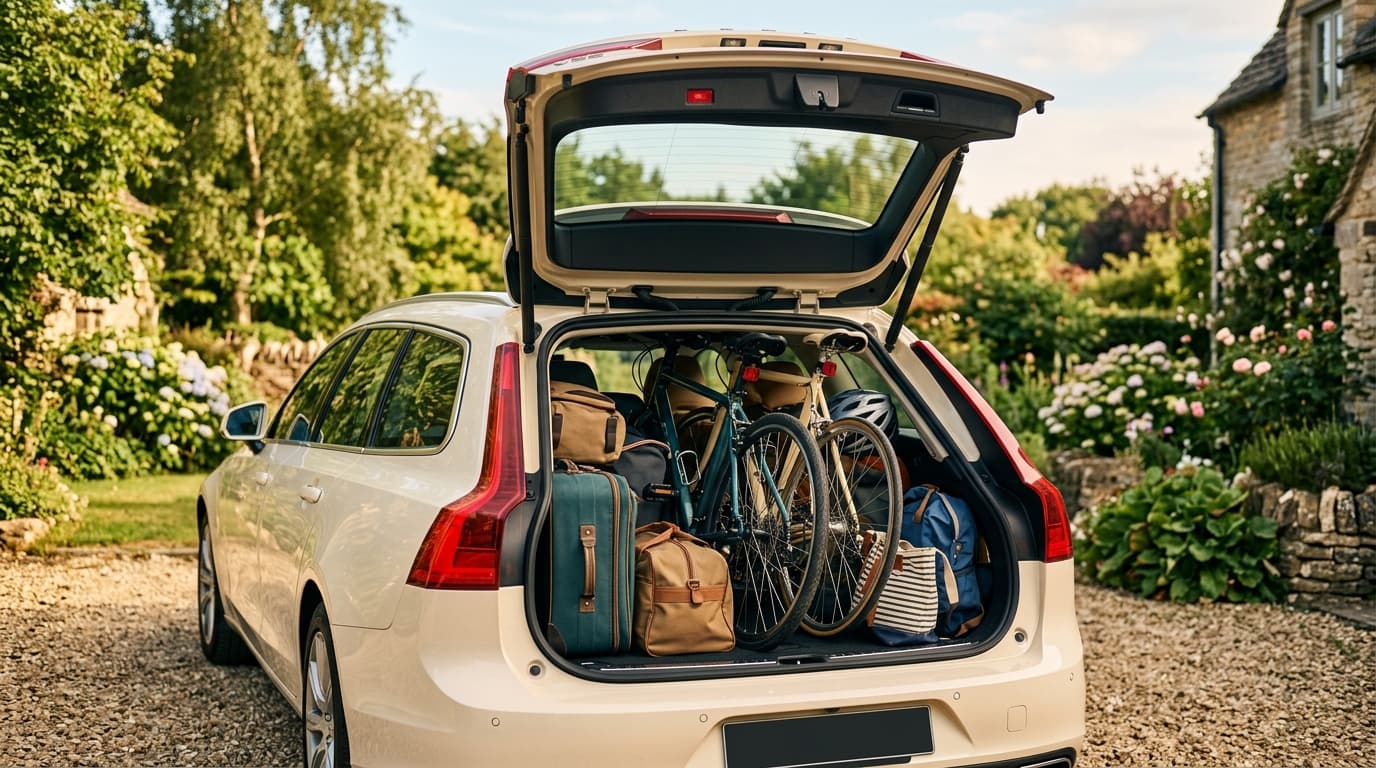
The estate with the biggest boot sold in Belgium in 2026 is the Skoda Superb Combi, with 690 L. But a five-seat Dacia Jogger beats it for half the price, and the litre figure does not tell the whole story. Here are five estates ranked by real volume, tax and budget in hand, for families that load up.
Which estate has the biggest boot in 2026?
The Skoda Superb Combi leads the classic estates with 690 L behind the bench, extending to 1,920 L seats folded. The five-seat Dacia Jogger pips it on paper with 708 L, but plays in another price and finish category. Next come the Volkswagen Passat Variant (650 L) and the Skoda Octavia Combi (640 L).
A big-boot estate here means a car with an extended tailgate, five seats, whose usable volume exceeds 500 L behind the rear seats, with no third row to manage. It is the format built for everyday loading and big departures, where the MPV bets on seats and the SUV on height.
The figure that counts: according to the technical sheets recorded on moniteurautomobile.be and automobiledimension.com in June 2026, the Superb Combi swallows 690 L, the equivalent of eight to nine cabin cases. The nuance is that the Jogger shows its 708 L because it derives from a seven-seater with the last row removed. Before comparing, set your priority: raw volume, budget or ride comfort.
How many litres does a family really need?
For a family of four, aim for at least 500 L, and 600 L or more if you load up. Below 450 L, a roof box or tow bar quickly becomes necessary by the holidays. The raw volume gives a first idea, but the shape of the boot matters as much as the figure.
In practice, for a family, 600 L hold a pushchair, two dismantled children's bikes and the family's cases for a week. The Superb Combi and its 690 L take all that on a flat floor; a 380 L compact forces a choice between the pushchair and the third case. This is where estates open the gap on saloons and most compact SUVs.
With two child seats in the back, the real question is not the headline number but the usable volume: low loading sill, floor length once the bench is folded, width between the wheel arches. A premium estate combines these three strengths better than a high-set SUV boot. Our comparison of the best family estates covers the trade-off with seven-seaters segment by segment.
Five big-boot estates sold in Belgium
Here are five estates available everywhere in Belgium, ranked by boot volume in five-seat configuration, from most affordable to most premium. Prices are Belgian list ranges recorded in June 2026, excluding options and incentives, to refine by engine.
| Model | Boot | Max boot | Engines | Belgian budget |
|---|---|---|---|---|
| Dacia Jogger (5 st) | 708 L | 1,819 L | petrol, hybrid | €20,000–26,000 |
| Skoda Superb Combi | 690 L | 1,920 L | petrol, diesel, PHEV | €42,000–52,000 |
| Volkswagen Passat Variant | 650 L | 1,780 L | diesel, PHEV | €44,000–55,000 |
| Skoda Octavia Combi | 640 L | 1,700 L | petrol, diesel, PHEV | €33,000–42,000 |
| Peugeot 308 SW | 548 L | 1,574 L | petrol, hybrid, PHEV | €36,000–45,000 |
690 L
Boot of the petrol Skoda Superb Combi, the benchmark family estate in Belgium
The reading is clear: the Dacia Jogger offers the biggest volume at the lowest price, but its finish and ride comfort stay behind the Germans. The Superb Combi and Passat Variant are the true premium load-luggers. The Skoda Octavia Combi, with its 640 L, remains the compact-segment champion, easier to park and to finance. The Peugeot 308 SW plays the style and driving card, with a more modest boot.
Should you take a PHEV estate, at the cost of the boot?
For a company car in 2026, the plug-in hybrid estate improves deductibility, but it eats into the boot. The batteries under the floor cut usable volume by 150 to 180 L on most models. It is the central trade-off of the year for a family driving on a lease.
Concretely, the Skoda Superb Combi iV drops to 510 L versus 690 L petrol, and the Peugeot 308 SW PHEV to 467 L versus 548 L. You gain on the payslip, you lose a case in the boot. For a self-employed person or a company executive who wants the best tax treatment without sacrificing volume, the question deserves to be raised before ordering, not after. Our article on the PHEV family car as a company car breaks down 2026 deductibility in detail.
Does the petrol estate still make sense in 2026?
Yes for a personal purchase, less for a company. A private buyer paying cash or on credit is not affected by deductibility and keeps the full boot with a diesel or petrol. In a company, by contrast, 2026 tax penalises combustion heavily: deductibility shrinks and the CO₂ contribution climbs, which mechanically pushes towards PHEV or electric despite the volume loss.
Estate or SUV for loading up on holiday?
The estate wins on boot and fuel economy. At comparable body length, an estate offers more usable volume than an SUV, with a lower loading sill that spares your back when lifting the cases in. The SUV only regains the edge on the high seating position and ground clearance.
On the Belgian market, a Superb Combi offers more boot than a family SUV from the same maker, while using 0.5 to 1 L/100 km less on the motorway, where big departures are decided. What we would avoid: choosing a compact SUV for its image when you regularly carry bikes, a pushchair and luggage. For that exact need, the estate stays unbeatable, and the MPV only overtakes it once you have a regular fifth passenger.
Three child seats side by side, is it possible in an estate?
Rarely in comfort. Most estates only offer two rear Isofix anchors and a bench too narrow for three wide child seats side by side. Large saloons like the Superb Combi or Passat Variant cope best thanks to their width, but for three young children, an MPV or seven-seat SUV stays a safer choice. Measure the bench before signing.
How to choose your big-boot estate?
The right estate is chosen on three criteria beyond the litre figure: the shape of the boot, the engine matched to your mileage, and the total budget over five years. The headline volume only has value if it is usable and affordable over time.
Look first at the geometry: a flat floor, a low sill and a generous load length with the bench folded beat ten extra litres badly placed. Test-Achats (the Belgian consumer association) points out that modularity and ease of access matter as much as raw volume for family use. On budget, a Dacia Jogger and a Volkswagen Passat Variant bought new do not cost the same to maintain or insure over five years, the gap running into thousands of euros.
Which engine for a family estate that drives a lot?
For a high-mileage driver, the diesel or hybrid stays the most rational. A 2.0 TDI Superb or Passat uses 5 to 6 L/100 km on the motorway with close to 1,000 km of range, perfect for long loaded trips. The PHEV only makes sense if charged daily and above all for company-car tax. Petrol is limited to low urban mileage, where the diesel clogs and the particulate filter suffers.
The real question is therefore not which estate shows the biggest number, but which loads best for your use and fits your budget. Measure your real need, then let the usable litres speak before the catalogue does.
Comparateur Breaks & familiales
Compare tous les breaks & familiales côte à côte.
Comparer maintenant →
Frequently asked questions
Audrey teste des familiales depuis 2015, maman de deux enfants, basée à Wavre. Elle installe vraiment les sièges Isofix avant de juger l’habitabilité et calcule le budget sur cinq ans, carburant et entretien compris. Sa boussole : peut-on y mettre deux sièges-auto et les courses sans jouer à Tetris ?