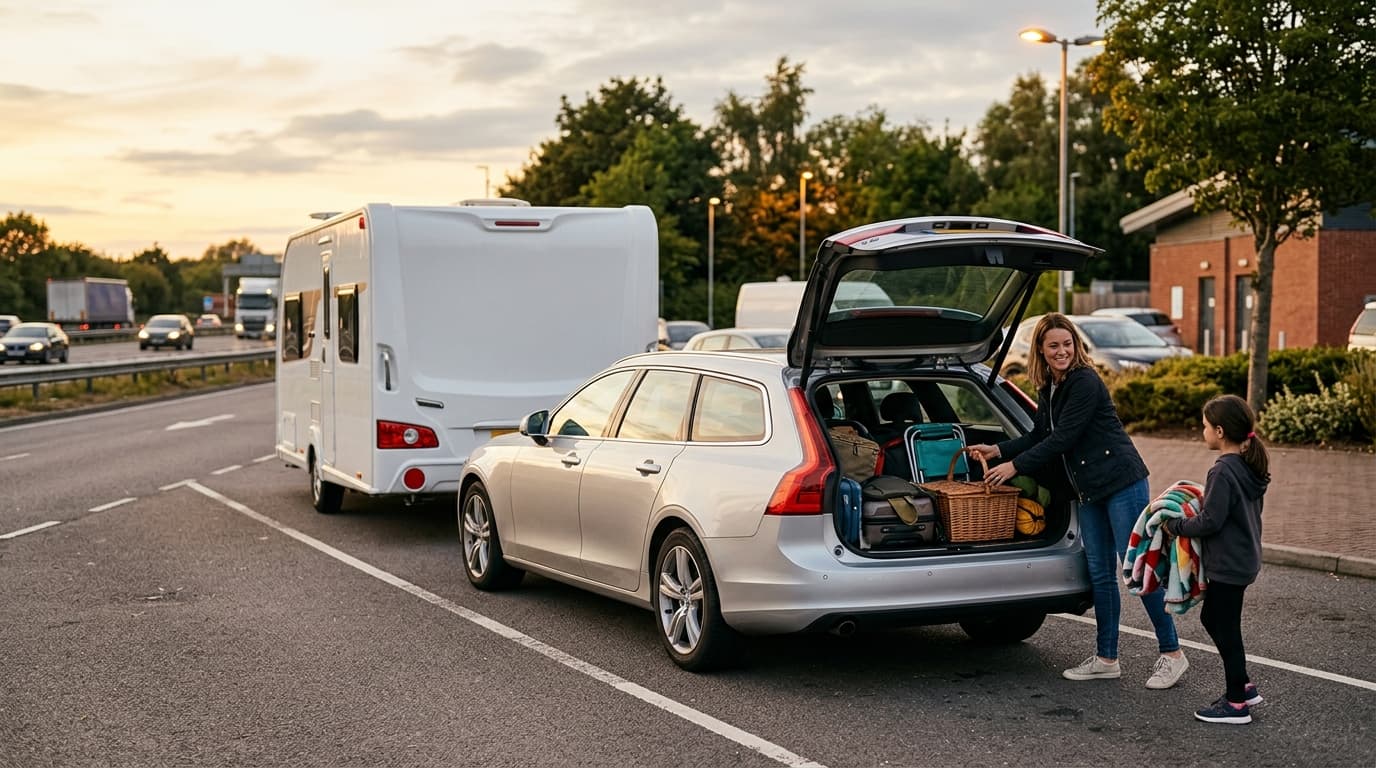
A diesel estate still stacks up in Belgium in three cases only: more than 25,000 km a year, a caravan to tow, and a Euro 6d or 6e rating on the registration certificate. Everywhere else, the Brussels timetable and the price at the pump have already made the decision for you.
Does a diesel estate still make sense for a Belgian family?
Yes, but the deciding factor has moved. It is no longer annual mileage: it is the Euro rating printed in field V9 of the registration certificate, because that is what sets the date your car stops being allowed into Brussels.
The Euro standard is the certified pollutant emission level of a vehicle, running from Euro 1 to Euro 7. For a diesel estate sold in Belgium today, that means Euro 6d, 6e or 7. And the sub-categories within Euro 6 are nothing like equivalent, something most used-car listings carefully avoid mentioning.
Take Vincent and Charlotte, both in their forties, two children aged 11 and 14, a house in Gembloux and a 1,300 kg caravan that heads to the Ardennes in April and to southern France in July. They cover 30,000 km a year, including the E411 into Brussels three mornings a week, and they keep their cars for nine years on average. On paper, that is the perfect diesel profile. In practice, their nine-year horizon runs straight into a date: 2030.
Which Euro rating should you check before buying a diesel estate?
Euro 6d as a minimum, nothing below. Since 1 January 2026, Euro 5 diesel cars, mostly registered between early 2011 and August 2015, can no longer drive in the Brussels low emission zone, which covers all 19 municipalities of the Region (the Ring motorway and the access roads to park-and-ride sites stay outside the zone).
That date deserves a pause, because it nearly did not happen. The Brussels parliament had voted to push the 2025 milestone back by two years, to 31 December 2026. The Constitutional Court suspended that postponement on 11 September 2025, holding that it infringed the right to a healthy environment, and the original timetable snapped back into force overnight. Close to 29,000 cars were caught out, and the fine is €350, capped at one per quarter and preceded by a warning letter, with 353 cameras reading plates at the entrances to and inside the zone.
2030
End of diesel car circulation in the Brussels low emission zone, whatever the Euro rating
The lesson goes beyond Euro 5 owners: an LEZ timetable can be postponed by a parliament and reinstated by a court within weeks. Buying a diesel while betting on political softening means betting against the Constitutional Court.
Will a Euro 6d diesel estate be allowed into Brussels after 2030?
No. The Bruxelles Environnement (the regional environment agency) timetable ends the circulation of all diesel cars in 2030, whatever the sub-rating, and of all petrol cars, hybrids included, in 2035. A milestone lands in between, in 2028: Euro 6b, 6c and 6d-TEMP diesels lose access then, and only Euro 6d, 6e and 7 clear it. Translated for anyone browsing used cars in July 2026: a Euro 6b diesel estate advertised at €18,000 buys you eighteen more months of the capital. Wallonia has no LEZ, while Antwerp and Ghent both do, so your exposure depends on where you drive, not where you live.
Is diesel still cheaper at the pump in Belgium?
No, and that is the opposite of what half of all buyers still believe. In July 2026, diesel costs about €1.97 per litre against roughly €1.85 for 95 unleaded, according to the official maximum prices published by the SPF Économie. Diesel has been the expensive fuel in Belgium for several years now.
So the diesel case rests entirely on consumption, and it now takes a real gap to pay off. An estate like the Skoda Octavia Combi 2.0 TDI, with 150 hp and 360 Nm, sits around 5.0 L/100 km without effort, with a range close to 900 km — genuinely little. Against an equivalent petrol drinking 6.5 L/100 km, the 1.5 L gap still favours diesel despite the 12 cents more per litre. Against a self-charging hybrid holding 5.5 L/100 km on the motorway, it evaporates.
How many kilometres a year does diesel need to pay for itself?
Around 25,000 km, and the threshold climbs every year. The diesel premium sits between €1,500 and €2,500 against a comparable petrol. For Vincent and Charlotte, at 30,000 km a year, a 1.5 L/100 km gap means 450 litres, close to €890 a year at July 2026 prices: the premium is absorbed in three years, and the next six are clear gain. At 15,000 km a year, the same sum takes ten years, longer than the car will stay allowed into Brussels. Our guide to the most fuel-efficient family estates works through the maths engine by engine.
Which diesel estates are still on sale in Belgium?
Five, broadly, and the range narrows every year. Here are the figures that matter, taken from manufacturer specifications, with indicative Belgian market prices in July 2026, excluding options.
| Model | Boot, 5 seats | Combined | Braked towing | Range | Belgian budget |
|---|---|---|---|---|---|
| Skoda Octavia Combi 2.0 TDI | 640 L | ~5.0 L/100 km | up to 2,000 kg | ~900 km | from ~€35,000 |
| Skoda Superb Combi 2.0 TDI | 690 L | ~5.2 L/100 km | up to 2,000 kg | ~900 km | from ~€43,000 |
| VW Passat Variant 2.0 TDI | 690 L | ~5.1 L/100 km | up to 1,800 kg | ~1,000 km | from ~€45,000 |
| BMW 320d Touring | 500 L | ~5.3 L/100 km | up to 1,800 kg | ~800 km | from ~€55,000 |
| Mercedes E 220d Estate | 615 L | ~5.3 L/100 km | up to 2,100 kg | ~1,000 km | from ~€65,000 |
The awkward fact fits in one sentence: the last diesel Volvo V60 left the Ghent plant in February 2024, and the last diesel engine in the brand's history, fitted to an XC90, rolled out of Torslanda on 26 March 2024. The V60 and V90 were exactly the family estates this kind of article recommended five years ago. The diesel estate is not being killed by the LEZ: it is being killed by carmakers, who are pulling out ahead of the legislators. Skoda, Volkswagen, BMW and Mercedes still hold the line, but nobody is developing a new TDI.
Which estate tows a 1,300 kg caravan?
A diesel, and this is the one area where it has no credible replacement. A Skoda Octavia Combi 2.0 TDI in its most powerful versions accepts up to 2,000 kg braked; a Toyota Corolla Touring Sports hybrid is capped at 750 kg braked across every version. A 1,300 kg caravan wipes out the second option in a stroke, before any fuel-consumption argument even enters the room.
This is the point comparisons systematically miss, because they think in litres per 100 km and never in kilos on the towbar. Plug-in hybrids do better (an Octavia iV still pulls 1,500 kg), but they run on the combustion engine as soon as the battery is flat, which brings them back to around 6 L/100 km on the holiday motorway, caravan included. If you are torn between the two types of hybrid, our comparison of family hybrid estates, HEV or PHEV lays out the sums.
Does towing send a diesel's consumption through the roof?
Yes, expect 50% more, and that is precisely why torque matters. A 1,300 kg caravan takes a TDI estate from roughly 5.0 to 7.5 L/100 km on the motorway at 90 km/h, the Belgian legal limit when towing. Having 360 Nm available from 1,600 rpm keeps the engine from screaming up the hills of the Ardennes or the Massif Central. An equivalent naturally aspirated petrol spends its life at 4,000 rpm there and drinks more. That is the real diesel argument in 2026, and it holds on a caravan, not on the school run.
What will a diesel estate be worth at resale in 2030?
Less than the depreciation curve suggests, because two buyers vanish at once. In 2030, no Brussels resident will be able to drive a diesel into the city, and company fleets turned the page long ago: diesel accounts for just 2.3% of new cars registered in Belgium in the first half of 2026, according to Febiac figures.
A market remains, and it is solid without being wide: high-mileage Walloon drivers, caravan owners, rural families covering 40,000 km a year. A recent, well-maintained TDI estate with a full service history finds a buyer — but it finds one in Wallonia or deep in Flanders, not in Ixelles, and the price reflects that. What we would avoid: buying a used Euro 6b or 6d-TEMP diesel thinking you have found a bargain because it is heavily discounted. It is discounted for a reason written in black and white in an official timetable.
Before you sign, do one thing: pull out the registration certificate and read field V9. That line decides whether your estate drives until 2030 or until 2028. The rest can be compared in our family car comparator and in our ranking of the best family estate.
Comparateur Breaks & familiales
Compare tous les breaks & familiales côte à côte.
Comparer maintenant →
Frequently asked questions
Audrey teste des familiales depuis 2015, maman de deux enfants, basée à Wavre. Elle installe vraiment les sièges Isofix avant de juger l’habitabilité et calcule le budget sur cinq ans, carburant et entretien compris. Sa boussole : peut-on y mettre deux sièges-auto et les courses sans jouer à Tetris ?