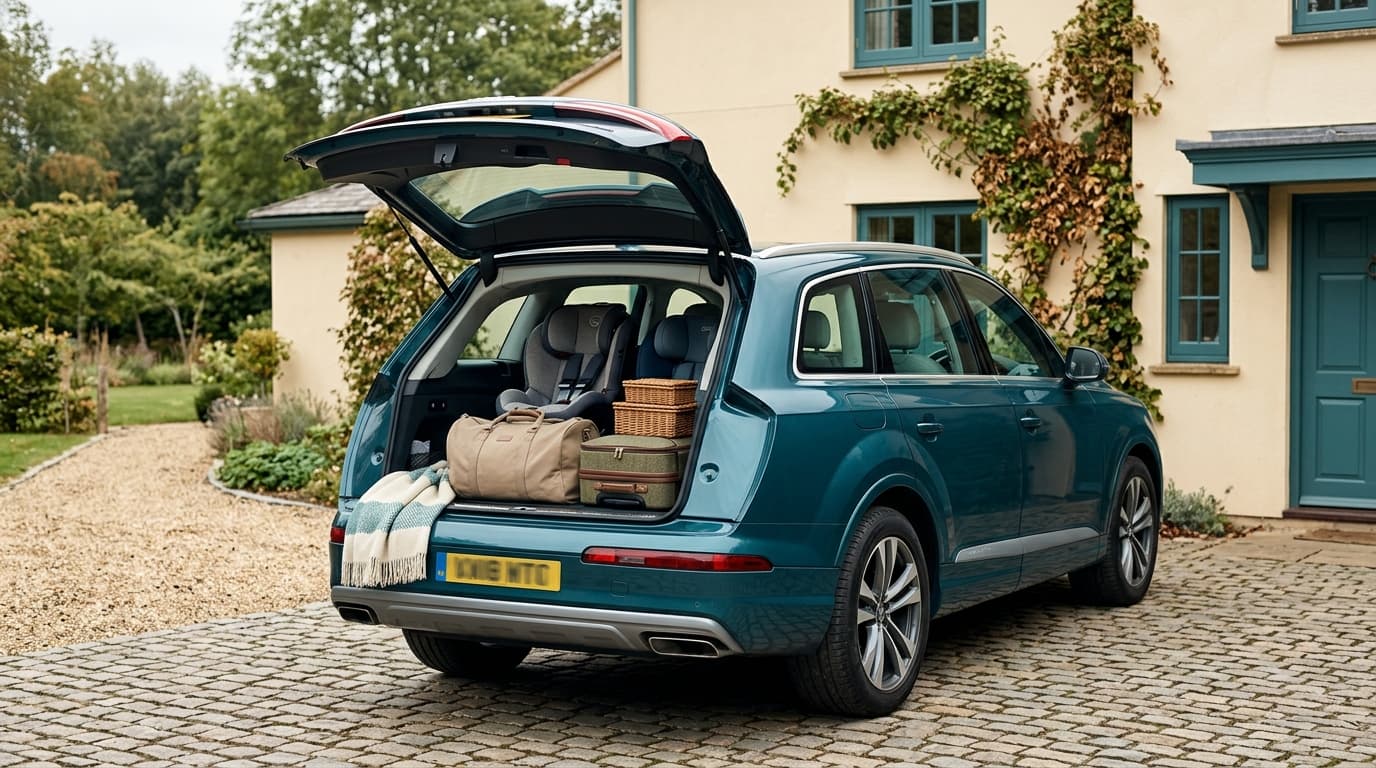
Most 7-seat SUVs are in fact "5+2" designs: two jump seats meant for children on short trips. For a family that really carries seven people, only a handful of models offer a usable third row. Here is which ones, with the real boot space and the Belgian 2026 prices, figures in hand.
Real third row or 5+2: what difference for a family?
A "5+2" is a five-seat SUV to which the maker grafts two jump seats that fold into the floor. They help out for children or a short trip, but headroom, legroom and boot space become tiny there. A real third row, by contrast, stays usable by a teenager for an hour.
The difference is measured in centimetres and litres, not in sales arguments. On a classic 5+2 such as the Kia Sorento or the Skoda Kodiaq, the third row is described by the maker itself as "occasional", suited to children under 10 to 12 and trips of less than an hour.
In practice, for a large family doing the daily school run with five or six aboard, any 5+2 will do. But as soon as the third row is used every day with bigger children, the discomfort soon shows: knees up, head against the roof lining.
Which 7-seat SUVs have a real third row?
Few models, and that is the point general rankings water down. At a reasonable size, the Hyundai Santa Fe stands out: its third row is among the best in the class, with rare headroom and seven seats as standard on every version, genuinely usable by an adult on a short trip.
Above it, in electric form, the Kia EV9 offers a real adult third row, but you need to budget more than EUR 70,000: a different league. The rest of the "family SUV" market you see everywhere, Peugeot 5008, Skoda Kodiaq, Kia Sorento, stays openly 5+2, despite obvious qualities elsewhere.
This is exactly where the segment trap hides: you buy a big SUV thinking you have solved the seven-seat problem, and you end up with a very comfortable five-seater plus two emergency jump seats.
Is the Hyundai Santa Fe worth its price for its seven seats?
Yes, if the third row is used often. The Santa Fe is one of the rare models with enough rear headroom and 628 L of boot in five-seat mode. Its hybrid version drops to 571 L, however, and its price sits above an entry-level Kodiaq or 5008.
How much boot is left with all 7 seats in use?
Very little: this is the figure nobody shows in the showroom. With all seven seats in use, a family SUV's boot falls to between 187 and 348 litres depending on the model, enough for two or three soft bags, not the luggage for a seven-up holiday departure.
187 L
Kia Sorento boot space with all 7 seats in use
The gaps are clear. The Kia Sorento, boot champion with five seats (809 L in hybrid form), leaves only 187 L once the third row is up. The Skoda Kodiaq holds 270 L, the Peugeot 5008 does a little better at 348 L. In other words, with seven aboard, none of these SUVs leaves for a holiday without a roof box or a trailer.
What we would avoid: reasoning on the "five-seat" volume boasted in the ads. A 5008 shows 916 L with five seats and 2,232 L with seats folded, flattering figures that bear no relation to reality once the whole tribe is aboard.
Can you fit three child seats in a 7-seat SUV?
Rarely abreast on the second row. An SUV's bench is wide, but the centre console and the contoured shape of the seats block three child seats side by side. This is the blind spot for families of three children who think a big size will solve it.
The workaround is to split them: two child seats on the second row, a booster or a light seat on the third row. But you still need an Isofix anchor point at the back, missing on many third rows. I have got into the habit of fitting the seats before judging a model, and on this point an SUV often disappoints a family of three children.
Which SUVs offer Isofix in the third row?
Very few. Most 5+2 designs reserve Isofix for the two outer positions of the second row. Before buying, insist on a test with your own child seats: the spec sheet almost never says whether the third row is equipped.
Should you prefer an MPV for three child seats?
Often, yes. A van-based people-carrier such as the Dacia Jogger or a classic MPV offers individual rear seats that take three child seats abreast more easily, where an SUV's bench gets stuck.
Price and budget comparison in Belgium
The 2026 prices spread widely depending on the engine and the real use of the third row. The table below sums up what matters for a large family: Belgian starting price, boot once all seven seats are in use and the real nature of the third row.
| Model | BE 2026 price (from) | Boot, 7 seats in use | Third row | For whom |
|---|---|---|---|---|
| Dacia Jogger Hybrid | ≈ EUR 28,390 | flexible bench | child jump seats | Tight budget |
| Skoda Kodiaq | range from ~EUR 40,000 | ≈ 270 L | occasional 5+2 | Versatility |
| Peugeot e-5008 | EUR 44,990 | ≈ 348 L | 5+2, children | 0 g company car |
| Hyundai Santa Fe | premium | good (real third row) | teen-usable | Frequent third row |
| Kia EV9 | > EUR 70,000 | ≈ 333 L | adult | Large budget |
According to Moniteur Automobile, the Skoda Kodiaq 2026 range comes in Belgium with periodic promotions, up to EUR 3,545 off selected in-stock versions in spring 2026. On the Dacia side, the Belgian price of the Jogger Hybrid in Journey trim, seven-seat option included, sits around EUR 28,390, with a claimed 4.5 L/100 km and 103 g of CO₂.
The total budget over five years depends mainly on the engine, not the badge. A Peugeot e-5008 electric starts at EUR 44,990 but benefits from the 0 g tax treatment; a petrol Kodiaq costs less to buy but more to run and on company-car tax.
7-seat SUV or MPV for a large family?
To really carry seven people and three child seats, an MPV or a van-based people-carrier stays structurally superior. Individual rear seats, sliding doors valuable on a school car park, better-used volume: no SUV of equivalent size matches a Berlingo, a Touran or a Jogger on raw cabin space.
The SUV keeps real strengths: a high driving position, image, available all-wheel drive and often a more upmarket finish. The right call comes down to how often the third row is used. If it serves every day, the MPV wins clearly; if it helps out a few times a month, a comfortable 5+2 such as the Kodiaq or the 5008 does the job perfectly.
And for a company car in 2026?
In the end, the right 7-seat SUV for a large family is not the biggest or the most expensive, but the one whose third row and boot match your real use. Ask yourself the only question that matters: how many times a month will you genuinely be seven on board, child seats fitted and boot full?
Comparateur SUV familiaux & 7 places
Compare tous les suv familiaux & 7 places côte à côte.
Comparer maintenant →
Frequently asked questions
Audrey teste des familiales depuis 2015, maman de deux enfants, basée à Wavre. Elle installe vraiment les sièges Isofix avant de juger l’habitabilité et calcule le budget sur cinq ans, carburant et entretien compris. Sa boussole : peut-on y mettre deux sièges-auto et les courses sans jouer à Tetris ?