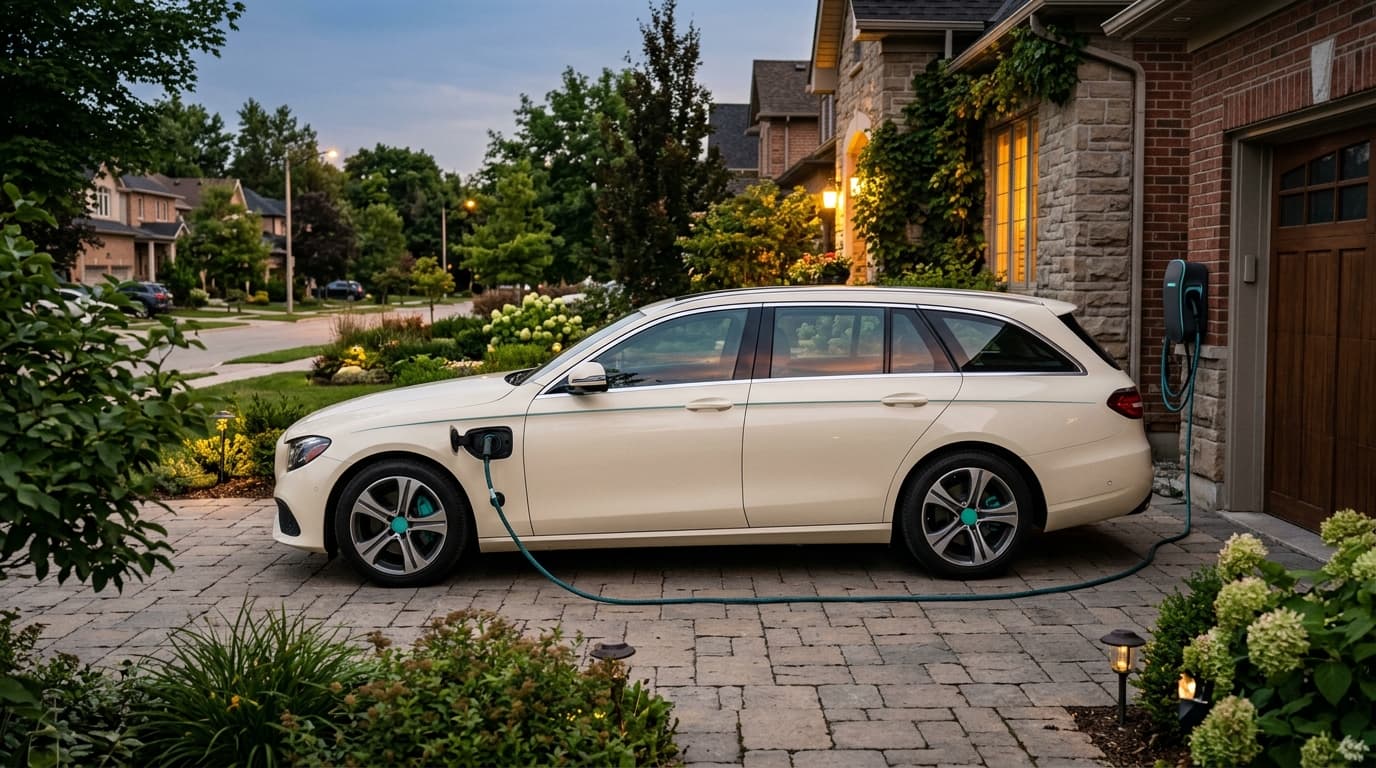
As a Belgian company car, a plug-in hybrid family car ordered new in 2026 is no longer deductible: 0% on the vehicle, with only the charging electricity staying at 100%. Only a self-employed person taxed personally keeps a window until 31 December 2026. Here are the models that still hold up, boot and CO₂ in hand.
Is a family PHEV still deductible as a company car in 2026?
No. For a new order placed from 1 January 2026, the deductibility of a plug-in hybrid under corporate income tax falls to 0%: depreciation, maintenance and fossil fuel are no longer deductible. Only the charging electricity stays, in principle, deductible at 100%.
A plug-in hybrid, or PHEV, combines a combustion engine and a battery you charge from a socket, able to run a few dozen kilometres on electricity alone before switching to petrol or diesel. In the eyes of the Belgian tax authorities, that combustion engine is enough to treat it like a thermal car: since 2026, the legislator recognises only zero emission for a new company order.
0 %
Deductibility of a new family PHEV under corporate income tax in 2026
In concrete terms, a Peugeot 308 SW Hybrid ordered for a company in 2026 generates no deduction at all on its 548 L of family boot, where a fully electric estate stays 100% deductible. The date that matters is the order form or lease contract, not the delivery.
Why does the family PHEV lose all deductibility for a company?
Because the Law of 25 November 2021 organises the tax phase-out of combustion engines in fleets. The PHEV, which keeps a combustion engine, follows this schedule once it is ordered new in 2026, without the protected status of the electric car.
The timetable is public and dated. For a thermal or hybrid ordered between 1 July 2023 and 31 December 2025, a transitional regime caps the deduction at 75% in 2025, 50% in 2026, 25% in 2027, then 0% from 2028. Vehicles ordered before 1 July 2023 keep the old formula for life, the so-called grandfather clause. But a PHEV ordered in 2026 qualifies for none of these regimes: it starts at 0%.
There is a salty footnote on social charges too. According to Le Moniteur Automobile (April 2026), the CO₂ contribution the employer pays each month to the ONSS (the Belgian social-security office) for a thermal or hybrid car is multiplied by 4 in 2026, and will rise to 5.5 in 2027. For a high-mileage company driver, keeping a PHEV therefore costs more every year.
Does the charging electricity stay deductible?
Yes, at 100%, but it is now the only spared item. Since 2023, the fossil-fuel costs of a PHEV were already capped at 50% deduction to encourage plugging in. In 2026, for a new company order, the whole vehicle drops to 0%, with electricity the sole exception. In other words, the PHEV loses most of its tax appeal against an electric car.
Self-employed under personal income tax: the last PHEV window?
Yes, and a single one. A self-employed person taxed under personal income tax can still deduct a Euro 6e-bis plug-in hybrid emitting at most 50 g CO₂/km, provided the order form is signed before 31 December 2026. It is the only exception to the all-electric rule.
The maths stays favourable at that threshold. The historic formula, 120% minus (0.5% x coefficient x CO₂), gives a deduction close to 100% for a PHEV at 25 g, and still high up to 50 g. From 2027 the rate becomes degressive (95% in 2027, 90% in 2028) before disappearing: the self-employed will then be in the same boat as companies, 0% for any new thermal or hybrid order.
The concrete case speaks for itself. A self-employed person in Liège who orders a Peugeot 308 SW Hybrid at 25 g in November 2026 keeps a near-full deduction on the estate; the same order form signed in January 2027 falls to 0%. By 50 g and by a few weeks, the five-year calculation flips entirely.
Family PHEVs under 50 g CO₂ sold in Belgium
To stay within the self-employed tolerance, you still need a "true" plug-in hybrid under 50 g, rather than a "false hybrid" that emits more and is then treated as a thermal car. Most family plug-in hybrids manage it on paper, provided you charge regularly.
| Model | Type | Boot | CO₂ WLTP | Electric range | Company deduc. 2026 |
|---|---|---|---|---|---|
| Peugeot 308 SW Hybrid | Estate | 548 L | ≈ 25 g | ≈ 60 km | 0% (new order) |
| Skoda Superb Combi iV | Estate | 510 L | < 40 g | > 130 km | 0% (new order) |
| Peugeot 3008 PHEV | SUV | 520 L | < 50 g | ≈ 97 km | 0% (new order) |
| Kia Sorento PHEV | 5-seat SUV | 242 L | 38 g | 57 km | 0% (new order) |
| Volvo XC60 Recharge | Premium SUV | ≈ 468 L | < 50 g | ≈ 81 km | 0% (new order) |
The figures are dated and verifiable. According to manufacturer spec sheets, the Skoda Superb Combi iV combines 510 L of boot and more than 130 km of claimed electric range, where the Peugeot 308 SW Hybrid favours volume with 548 L but around sixty kilometres on electricity. The Peugeot 3008 PHEV (520 L, up to 97 km) sits in between on the SUV side.
What a family should take away: the tax column is identical for everyone in a company, 0% on a new 2026 order. The tie-break therefore comes down to real boot space, the everyday useful electric range and, for the self-employed, staying under the 50 g threshold.
What boot and how many seats in a family PHEV?
The battery sits under the floor and eats into the boot, sometimes the seats. A PHEV estate stays very roomy, between 510 and 548 L, but the only would-be seven-seat SUV in the group, the Kia Sorento, loses exactly those seven seats in plug-in form and drops to 242 L.
This is the family trap of the segment. The plain-hybrid Kia Sorento offers up to 809 L with five seats and a seven-seat option, but the PHEV version is limited to five seats and 242 L, its 13.8 kWh battery taking the useful space. For 38 g of CO₂ and 57 km of claimed electric range, the plug is paid here in litres and in seats.
Is the Kia Sorento PHEV a true seven-seater?
No. In plug-in hybrid form, the Sorento exists only as a five-seater. The seven-seat option stays reserved for the plain hybrid and the diesel. A large family wanting both the plug and the third row must therefore look elsewhere, towards an MPV or a large electric SUV.
PHEV, electric or diesel: what to choose for high mileage in a company?
For a high-mileage driver, the tax answer is clear-cut, but real-world use deserves nuance. A PHEV is only worthwhile when charged often; without that, its extra weight makes it thirstier than a diesel over long distances.
In the end, the right plug-in hybrid family car is no longer a tax matter for a company, that ground now being reserved for the electric car, but a matter of use. Ask yourself the only question that counts: how many kilometres will you really drive plugged in, and does your status still leave you a window before 2027?
Comparateur Hybrides & électriques
Compare tous les hybrides & électriques côte à côte.
Comparer maintenant →
Frequently asked questions
Audrey teste des familiales depuis 2015, maman de deux enfants, basée à Wavre. Elle installe vraiment les sièges Isofix avant de juger l’habitabilité et calcule le budget sur cinq ans, carburant et entretien compris. Sa boussole : peut-on y mettre deux sièges-auto et les courses sans jouer à Tetris ?