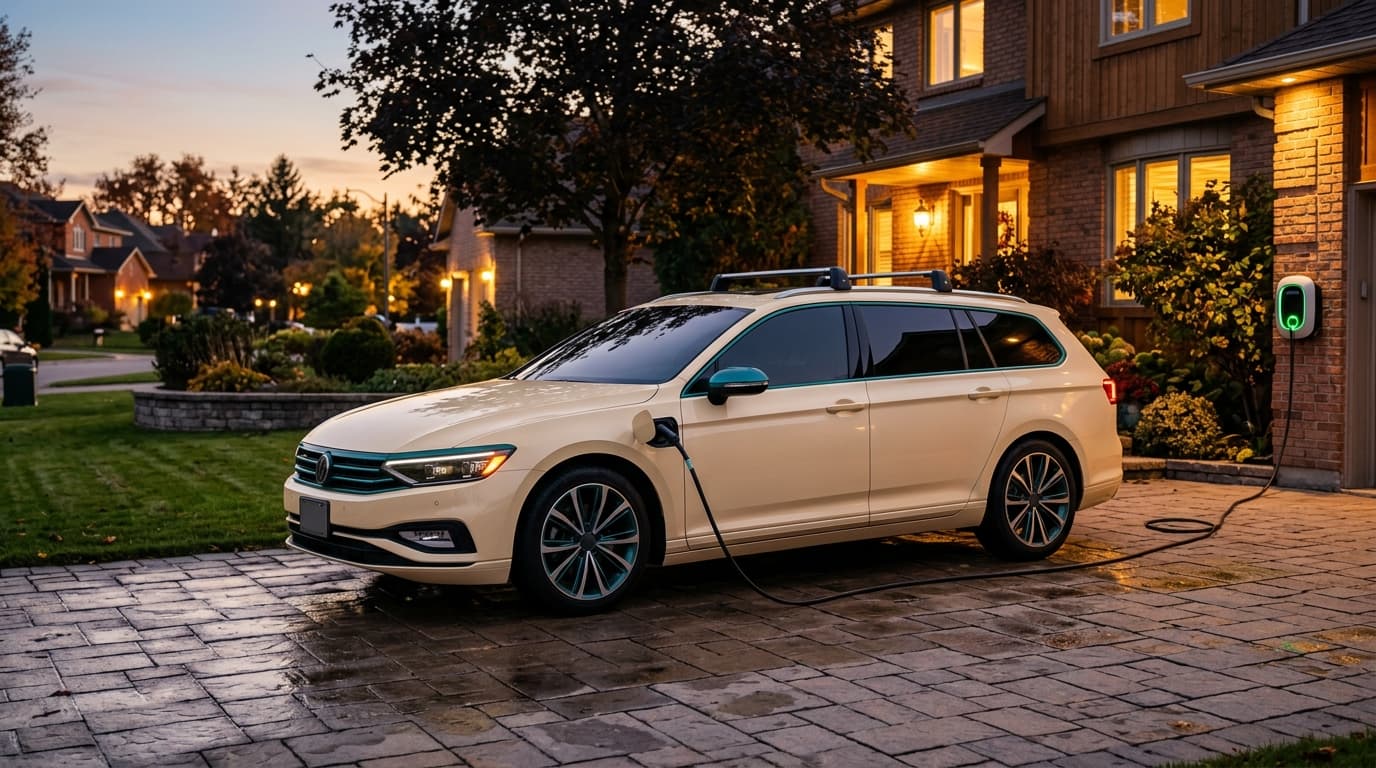
For a Belgian family, a self-charging hybrid estate (HEV) like the Toyota Corolla Touring Sports is enough if you have no home charging: it recharges itself and keeps its full boot. A plug-in hybrid (PHEV) only pays off with a socket at home and short trips, at the cost of a boot cut by the battery. Figures in hand.
Family hybrid estate: HEV or PHEV, which to choose?
Choose a self-charging hybrid (HEV) if you cannot charge at home: it recharges as it drives, keeps its full boot and needs no wallbox. Go for a plug-in hybrid (PHEV) if you have a socket at home and short daily trips you will run on electric.
A family hybrid estate here means a car with an extended tailgate fitted with a hybrid powertrain, petrol plus electric. Two families coexist, and they are often confused. The self-charging hybrid (HEV) recharges its small battery as it drives, never plugging in. The plug-in hybrid (PHEV) plugs into a socket to run 40 to 80 km on pure electric, then works like a regular hybrid once the battery is flat.
In practice, for a family, the choice comes down to one question: can you charge where you sleep? A Toyota Corolla Touring Sports HEV sits around 4.8 L/100 km in real use (autotijd.be figures, 2026) with no charging constraint at all. A Peugeot 308 SW Hybrid recharged every night can run its daily trips below 2 L/100 km, but becomes thirstier than a Corolla if you never plug it in.
Does a plug-in hybrid estate lose boot space?
Yes, always. A PHEV's battery sits under the boot floor and removes 60 to 180 litres versus the combustion version. A self-charging hybrid, with its small battery, keeps nearly all its volume.
The figure that counts for a family: the Mercedes C 300 e Estate drops to 360 L, against 490 L for a combustion C-Class estate (dimensions from Moniteur Automobile, 2026). The BMW 330e Touring loses 90 L and falls to 410 L. The Skoda Superb Combi iV, huge in combustion form (690 L), caps at 510 L as a plug-in. The Peugeot 308 SW Hybrid keeps 548 L.
What we would avoid: paying €60,000 for a premium PHEV estate only to end up with less boot than a €34,000 hybrid compact. With two child seats in the back and a pushchair, a C 300 e Estate at 360 L fills up fast, where the Corolla Touring Sports HEV offers 596. The premium plug-in impresses on the spec sheet, not when you load the boot on a Friday evening getaway.
Comparison: 6 family hybrid estates in figures
Here are six hybrid estates sold in Belgium, compared on hybrid type, real boot, electric range and indicative price. Boots recorded in 5-seat layout (Moniteur Automobile, 2026), ranges on the WLTP cycle, indicative prices incl. VAT for July 2026, excluding options.
| Model | Type | Boot | Electric range | Belgian price (approx.) |
|---|---|---|---|---|
| Toyota Corolla Touring Sports | HEV | 596 L | — | ~€34,000 |
| Peugeot 308 SW Hybrid | PHEV | 548 L | 64 km | ~€42,000 |
| Skoda Superb Combi iV | PHEV | 510 L | ~100 km | ~€48,000 |
| Volvo V60 Recharge | PHEV | 519 L | ~90 km | ~€60,000 |
| BMW 330e Touring | PHEV | 410 L | 92 km | ~€58,000 |
| Mercedes C 300 e Estate | PHEV | 360 L | ~100 km | ~€60,000 |
360 L
Boot of the Mercedes C 300 e Estate PHEV, i.e. 236 L less than a plain Corolla Touring Sports hybrid
The reading is clear: the higher the WLTP electric range, the bigger the battery, and the more the boot shrinks. The Superb Combi iV strikes the best compromise of the group, with 510 L and around a hundred quoted electric kilometres. Conversely, the C 300 e Estate favours range over usable volume. Our ranking of estates by boot volume helps you cross hybrid type with load space.
What real electric range for a PHEV estate?
Count on 60 to 75% of the quoted WLTP range in everyday use. A Peugeot 308 SW Hybrid rated at 64 km does closer to 45 km once the car is loaded and the heating is on; a Skoda Superb Combi iV quoted up to 100 km sits around 75 km in reality.
The WLTP figure flatters the plug-in just as the WLTP consumption flatters the self-charging hybrid. In winter, on the motorway, or with a full boot and four passengers, the electric range drops further. The awkward fact we own up to: with an empty battery, a PHEV estate reverts to a plain petrol car, but 150 to 300 kg heavier. On a long trip, it then uses more fuel than a Corolla Touring Sports hybrid, which never has anything to recharge.
Do you need home charging for a PHEV estate?
In practice, yes. A PHEV only makes sense charged every night, at home or at work. A reinforced domestic socket is enough to fill a 12 to 18 kWh battery overnight, without a costly wallbox. Without regular charging, you carry a useless battery that adds weight and pushes consumption above that of a self-charging hybrid. On the Belgian market, this is the first filter, before you even compare models.
How much does a family hybrid estate cost in Belgium in 2026?
A self-charging hybrid estate starts around €34,000 for a Corolla Touring Sports, while a family plug-in runs from €42,000 (Peugeot 308 SW Hybrid) to over €60,000 for a premium like the BMW 330e Touring or the Mercedes C 300 e Estate. The PHEV therefore costs €8,000 to €25,000 more to buy.
That price gap only pays back in fuel if you drive a lot on electric, so if you charge. For a private purchase, a PHEV's low CO2 cuts the registration tax in Wallonia and Brussels, a small bonus. But the real shift happens on the company-car side.
Is a hybrid estate still tax-deductible as a company car in 2026?
A full hybrid (HEV) is treated like a combustion car: since 1 January 2026, its tax deduction drops to 0% (Securex, FPS Finance). A plug-in hybrid emitting 50 g CO2/km or less, acquired from 2026, keeps a partial deduction via the formula 120% − (0.5% × g CO2/km), but only electricity stays deductible at 100% for energy, not petrol. This is the only context where the PHEV keeps a clear edge over the HEV: as a company car, a plug-in estate stays partly deductible, a self-charging hybrid does not. For a private purchase, this formula does not apply and the HEV becomes the rational choice again.
Which family hybrid estate to choose for your use?
The right estate depends first on your access to charging. Without home charging, the Toyota Corolla Touring Sports HEV is the most worry-free choice: 596 L of boot, no plugging constraint, and a hybrid drivetrain Test-Achats (the Belgian consumer association) ranks among the most reliable. With home charging and short trips, a PHEV like the Skoda Superb Combi iV becomes relevant, because it preserves the boot (510 L) while running on electric day to day.
Take Julie and Grégory, early forties, two children, a house with a garage and socket on the edge of Wavre. Each drives 25 km to work. A PHEV charged every night covers those trips on pure electric and only burns petrol at the weekend. Their profile is the textbook case for the plug-in. Conversely, a family in a flat with no socket would make a poor call: they would pay for the battery without ever filling it, and drive more expensively than with a plain hybrid.
HEV or PHEV for holidays with a full load?
On a big loaded departure, the PHEV's edge fades. The battery empties within an hour of motorway, and the estate runs on petrol while carrying its dead weight. The reduced boot also hampers loading luggage for a family of four. For holidays, a large-boot HEV like the Corolla Touring Sports (596 L) or a volume-preserving PHEV like the Superb Combi iV (510 L) stays more sensible than a compact plug-in down to 360 L. We detail usable volumes in our comparison of the best family estates.
The real question is therefore not HEV or PHEV in the abstract, but where and how you charge, and what you actually put in the boot. Measure your daily trips, check your access to a socket, then let the usable volume speak before you sign.
Comparateur Breaks & familiales
Compare tous les breaks & familiales côte à côte.
Comparer maintenant →
Frequently asked questions
Audrey teste des familiales depuis 2015, maman de deux enfants, basée à Wavre. Elle installe vraiment les sièges Isofix avant de juger l’habitabilité et calcule le budget sur cinq ans, carburant et entretien compris. Sa boussole : peut-on y mettre deux sièges-auto et les courses sans jouer à Tetris ?