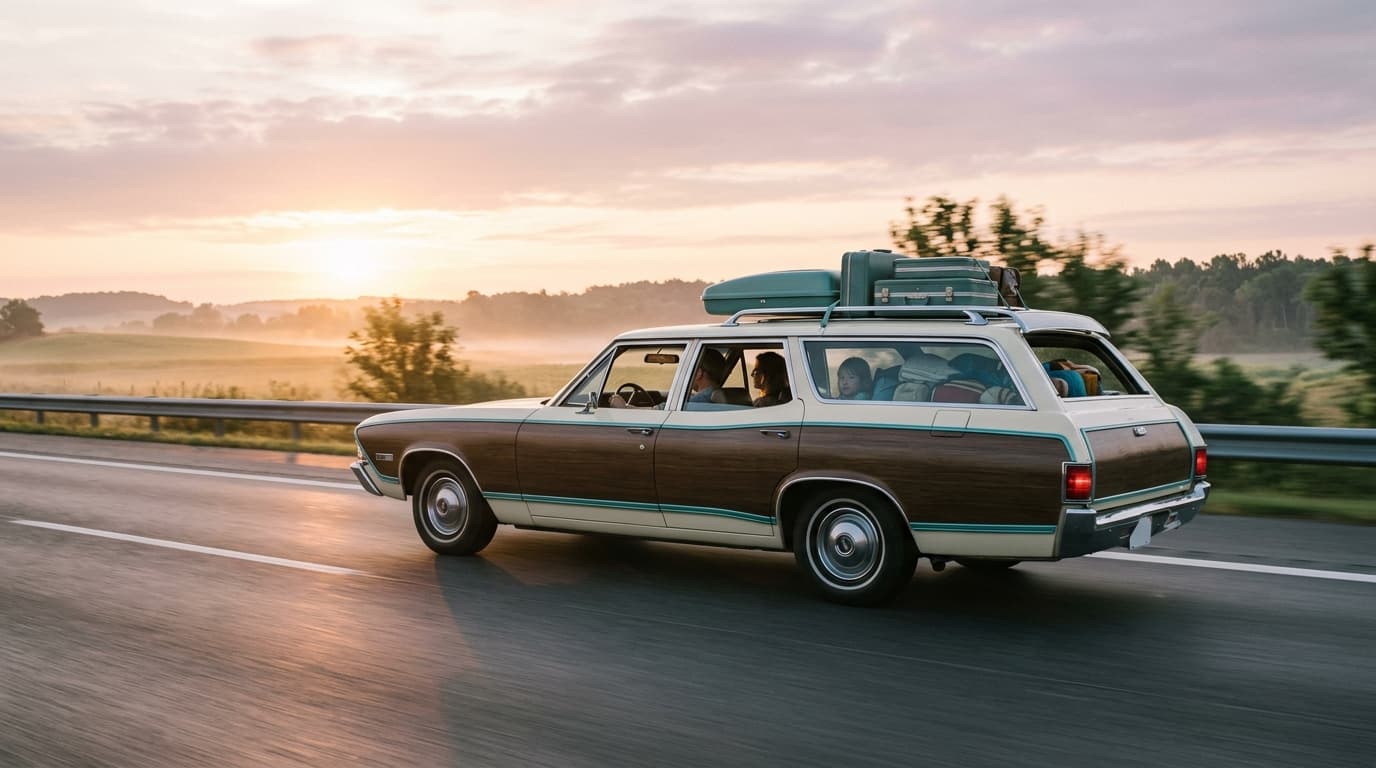
The family estate car that uses the least fuel in Belgium in 2026 is the Toyota Corolla Touring Sports hybrid, around 4.8 L/100 km in real use. But for a high-mileage driver, the real trade-off sits between the hybrid and the diesel, and the 2026 company-car tax reshuffles the deck. Figures in hand.
Which family estate uses the least fuel in 2026?
The most fuel-efficient family estate sold in Belgium in 2026 is the Toyota Corolla Touring Sports hybrid, with a real consumption around 4.8 L/100 km in mixed use. It leads the Peugeot 308 SW and Opel Astra Sports Tourer hybrids, around 5.2 L, and above all the diesels, penalised by a costlier litre at the pump.
A low-consumption family estate here means a car with an extended tailgate able to stay below 5.5 L/100 km in real conditions, all trips combined and boot loaded. The official WLTP figure, by contrast, almost always flatters the powertrain: the Corolla is rated around 4.3 L, but the usage figures from autotijd.be (2026) put it closer to 4.8 L once the car is in a family's hands.
The figure that counts: in town this same Corolla drops below 4.5 L thanks to regenerative braking, but on sustained motorway it climbs toward 5.5 L. That is the whole subtlety of a full hybrid, and the reason a consumption ranking only makes sense with a precise usage profile. On the Belgian market, the Corolla Touring Sports stays the efficiency benchmark, with a catalogue around €33,000 excluding options.
Diesel or hybrid for a high-mileage Belgian driver?
For a high-mileage Belgian driver, the plain hybrid wins in mixed use, but the Euro 6d diesel stays competitive on pure motorway. At 50,000 km a year, the fuel-budget gap rarely tops €1,000, and it is now tax, not consumption, that truly decides.
In practice, for a family that drives a lot, the full hybrid earns its keep in town and on fast roads, where it cuts the engine and recovers energy under braking. The awkward fact we own up to: on the motorway at 120 km/h, a Corolla hybrid climbs to 5.5 L and loses much of its edge over a modern 2.0 TDI, which holds 5.0 L at steady speed with close to 1,000 km of range per tank.
Take Nicolas, 46, a sales rep near Liège, 50,000 km a year in a company car, two children in the back. On his motorway profile, the real gap between a Corolla hybrid and a Skoda Octavia Combi TDI shrinks to 0.2 or 0.3 L/100 km. At that level, it is no longer the spec sheet that decides, but the litre price and, above all, the 2026 tax regime.
How much does fuel cost over 50,000 km a year?
Between about €4,350 and €5,400 a year, depending on the powertrain. The sum rests on the maximum prices of 1 July 2026: €1.811/L for 95 petrol (E10) and €1.928/L for B7 diesel (FPS Economy, the federal economy department). Diesel, now the costliest fuel at the pump, starts with a 6% handicap at equal consumption.
Here are five family estates available everywhere in Belgium, compared on real mixed consumption, boot and estimated fuel budget for 50,000 km. Consumption recorded in real use (autotijd.be, 2026), budget calculated at the July 2026 maximum prices, excluding maintenance and tax.
| Model | Real use | Boot | Budget / 50,000 km | Engine |
|---|---|---|---|---|
| Toyota Corolla Touring Sports | 4.8 L | 596 L | ~€4,350 | hybrid |
| Peugeot 308 SW | 5.2 L | 548 L | ~€4,700 | hybrid |
| Opel Astra Sports Tourer | 5.2 L | 597 L | ~€4,700 | hybrid |
| Skoda Octavia Combi 2.0 TDI | 5.2 L | 640 L | ~€5,000 | diesel |
| Volkswagen Passat Variant 2.0 TDI | 5.6 L | 690 L | ~€5,400 | diesel |
4.8 L/100 km
Real mixed consumption of the most efficient family hybrid on the Belgian market, the Corolla Touring Sports
The reading is clear: over a year, a Corolla hybrid costs about €1,050 less in fuel than a Passat Variant diesel, more than €5,000 over five years. The catch in the detail: at an identical 5.2 L, the Octavia TDI already costs €5,000 against €4,700 for the 308 SW hybrid, a €300 yearly gap due to the litre price alone. The diesel only regains the edge on a 100% motorway profile, where its consumption drops below the hybrid's. Our ranking of estates by boot volume helps you cross efficiency with load space.
How does 2026 company-car tax change the sum?
Since 1 January 2026, a petrol, diesel or hybrid estate bought as a company car is no longer tax-deductible: the deduction drops to 0%. Only electric vehicles stay deductible at 100%, provided they are acquired before 1 January 2027. For a high-mileage company driver, the smartest low-consumption estate is therefore no longer a diesel, nor even a hybrid.
Concretely, the deductibility of costs for CO2-emitting company cars bought, rented or leased from 1 January 2026 is definitively removed (Securex, FPS Finance). For a plug-in hybrid company car, only electricity costs stay deductible at 100%; the fossil fuel no longer counts at all. Saving €1,050 in fuel a year with a hybrid estate never offsets the lost deduction against an electric model.
The signal to keep: in a company fleet, the question "diesel or hybrid" is turning into "combustion or electric". A high-mileage driver like Nicolas now has every reason to look at a long-range electric estate or saloon, the only powertrain that keeps a tax edge in 2026. The per-litre efficiency sum takes second place behind the deduction sum.
Can a self-employed person still deduct a hybrid estate?
Partly, and only as a plug-in hybrid. A self-employed individual (personne physique) who acquires a PHEV emitting no more than 50 g CO2/km from 1 January 2026 calculates the deduction with the formula 120% − (0.5% × g CO2/km). A full hybrid like the Corolla is treated as a combustion car and opens no deduction. In other words, even for the self-employed, the most deductible low-consumption estate stays electric, then marginally the home-charged PHEV.
Which fuel-efficient estate to choose for your use?
The best estate depends first on who buys it and how they drive. For a private purchase in mixed use, the Toyota Corolla Touring Sports hybrid is the most worry-free choice: the thriftiest, a hybrid drivetrain Test-Achats (the Belgian consumer association) ranks among the most reliable, and contained depreciation. Count on 596 L of boot, enough for two children and the luggage.
For a private high-mileage driver who lives on the motorway, a Euro 6d diesel stays rational: a Skoda Octavia Combi or Volkswagen Passat Variant 2.0 TDI holds 5.0 to 5.6 L over long trips, with a 640 to 690 L boot and the range to match. The non-negotiable condition in Belgium is being able to enter the low-emission cities. For a company car, though, only electric keeps a tax interest in 2026, as detailed in our guide to reliable used family estates.
Does a Euro 6d diesel still pass the Belgian LEZ?
Yes, for now. Brussels, Antwerp and Ghent run a low-emission zone that already bans Euro 5 and older diesels but still admits Euro 6d. Before buying a diesel estate, check the Euro standard on the registration certificate: a 2020-2021 Euro 6d stays admitted, a 2014 Euro 5 does not. The thresholds tighten each year, so a diesel bought today for ten years is a bet on rules that will change.
Does a hybrid estate use more fuel on the motorway?
Yes, noticeably more than in town. A full hybrid draws its advantage from regenerative braking, nearly absent at steady speed. On the motorway its petrol engine works alone and consumption climbs toward 5.5 to 6 L/100 km. A plug-in hybrid with an empty battery is more penalised still, because it carries the dead weight of its battery. For long, regular trips a Euro 6d diesel stays steadier, provided you accept the LEZ constraint.
The real question is therefore not which estate shows the lowest consumption in the brochure, but which fits your trip profile and your tax regime. Measure your motorway share, check the Euro standard, then let the five-year fuel budget speak before you sign.
Comparateur Breaks & familiales
Compare tous les breaks & familiales côte à côte.
Comparer maintenant →
Frequently asked questions
Audrey teste des familiales depuis 2015, maman de deux enfants, basée à Wavre. Elle installe vraiment les sièges Isofix avant de juger l’habitabilité et calcule le budget sur cinq ans, carburant et entretien compris. Sa boussole : peut-on y mettre deux sièges-auto et les courses sans jouer à Tetris ?