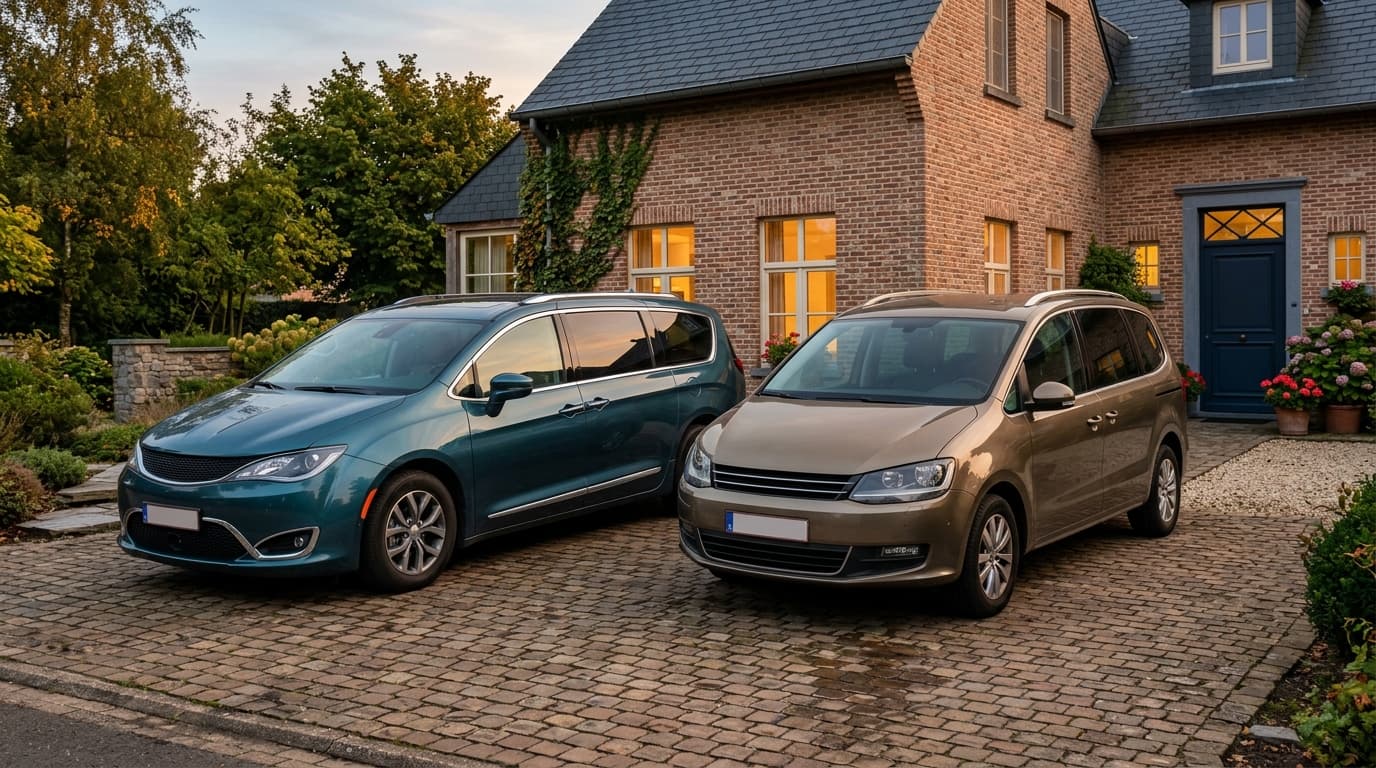
The Dacia Jogger and the Skoda Kodiaq are both seven-seaters, and that's about all they have in common. Nearly twenty thousand euros separate them on the Belgian price list. Here's what that gap actually buys, and the cases where it doesn't justify itself.
Dacia Jogger or Skoda Kodiaq: which one for a family?
The Jogger if you often travel seven-up with little luggage and the budget rules. The Kodiaq if the seventh seat is rarely used but the boot, the safety and the finish are used every day. Between them, €19,805 of difference on the Belgian price list.
This duel pits two philosophies against each other, not two comparable cars. The Jogger is a stretched leisure van that fits seven seats into 4.55 m and charges for the bare essentials. The Kodiaq is a 4.76 m family SUV that adds two occasional seats to an already complete car and charges for everything else: sound insulation, driver assistance, towing capacity, residual value.
Take Estelle and Loïc, early forties, three children aged 6, 9 and 13, a house near Ath and around 20,000 km a year. Their budget runs from €20,000 to €35,000. Their question isn't "which is better" but "does that extra €20,000 serve me every week, or only when the in-laws climb aboard?". That's the right way to frame it.
| Criterion | Dacia Jogger 7 seats | Skoda Kodiaq 7 seats |
|---|---|---|
| BE list price (August 2026) | from €18,990; €25,890 in Hybrid 155 Extreme | from €45,695 (1.5 TSI 150 mHEV Family) |
| Boot, seven seats in use | 160 L | 340 L |
| Boot, 3rd row folded or removed | 565 L (695 L with seats out) | 845 L |
| Length | 4.55 m | 4.76 m |
| Unladen weight | ~1,270 kg | ~1,680 kg |
| Euro NCAP | 1 star (2021, weighted score) | 5 stars, 84% of points (2024) |
€19,805
List-price gap between a 7-seat Dacia Jogger Hybrid 155 Extreme (€25,890) and a Skoda Kodiaq 1.5 TSI Family (€45,695), Belgium, August 2026
What do these two 7-seaters really cost in Belgium?
The Jogger starts at €18,990, rises to €19,690 in Expression TCe 110 trim and tops out at €25,890 including VAT in seven-seat Hybrid 155 Extreme form. The Kodiaq opens at €45,695 including VAT in 1.5 TSI 150 hp mild-hybrid Family trim, and the priciest version in the range passes €53,000 (Moniteur Automobile, checked August 2026).
These prices move, and you need to look at the current offers before drawing conclusions. Škoda Belgium is applying a €6,045 bonus on the Family special edition, valid from 30 June to 31 August 2026 at approved dealers: the Kodiaq then lands around €39,650. Dacia plays the same game at its own scale, with monthly offers across the Jogger range. The gap narrows without ever disappearing: you're still looking at about €14,000 in the best case.
On the Belgian market, that €14,000 to €20,000 doesn't compare to a piece of equipment but to a line in the household budget. It's the price of a kitchen, or three years of holidays. What we'd avoid: reasoning purely on the leasing monthly payment, which hides the capital gap and hands it back at resale time.
How much boot space is left once all seven seats are in use?
160 L in the Jogger, 340 L in the Kodiaq. That's the number that decides, and the one no automated comparison site displays.
160 L is a small city car's boot. In practice, for a family, that means seven people and two backpacks, not seven people and a weekend's worth of suitcases. The Jogger carries people, not people plus luggage. It has a counter-move: the third row comes out entirely, seat by seat, and the boot then grows to 695 L, against 565 L when simply folded. Plenty of families run five-up day to day and refit the two seats when needed.
The Kodiaq keeps 340 L with seven aboard and 845 L once the third row disappears into the floor — with nothing to lift out of the car or store in the garage. The downside shows elsewhere: a five-seat Kodiaq quotes 910 L, so the seven-seat option removes 65 L of boot permanently, even with the seats folded.
160 L
Boot left in a Dacia Jogger when all seven seats are in use — the equivalent of a city car's boot
Can an adult actually sit in the Jogger's third row?
On short trips, yes, and that's the Jogger's real surprise. Its 4.55 m of length is almost entirely devoted to cabin space, with no plunging bonnet or falling roofline to preserve. A 1.70 m teenager sits normally back there, which you can't say of a family SUV's third row, where knees ride up under the chin. The two seats are separate and weigh around ten kilos each, removable without tools. In the Kodiaq, the third row stays reserved for under-twelves on trips of less than an hour. A family with three growing children will think twice.
Does the Jogger fall behind on safety?
Yes, and this is where the price gap justifies itself most clearly. The Jogger scores 1 Euro NCAP star, the Kodiaq 5 stars with 84% of the available points.
That star needs reading properly. Euro NCAP did not put the Jogger through a full crash test: the body judged it too close to the Dacia Sandero and reweighted, against its tougher 2022 criteria, the two-star score the Sandero earned in spring 2021. The protection scores aren't disastrous — 70% for adults, 69% for children. The penalty comes from the missing seatbelt reminder on the third row and the thin driver-assistance package, rated 39%.
The 2024 Kodiaq, tested under the 2023 criteria, scores 89% for adult occupant protection, 83% for child occupant protection and 78% for safety assist, with up to nine airbags including a central airbag between the front seats. With three children, one of whom will regularly travel in the third row, that isn't a spec-sheet footnote.
Should the Peugeot 5008 join the comparison?
If your budget is aimed at the Kodiaq, yes. The 5008 quotes 348 L of boot with seven seats in use (259 L under the stricter VDA 210 standard) and 916 L with the third row folded: the best volume of the three. Its third row stays a children-and-teenagers affair on short to medium journeys, like the Kodiaq's. It doesn't move the underlying trade-off, it adds a credible option on the "safe bet" side. Our family-car comparison tool lets you line them up against your own criteria.
What does an extra €20,000 actually buy?
Boot space with seven aboard, five Euro NCAP stars, serious towing capacity, sound insulation from another world and a firmer residual value. Not more seats, and not more legroom in the third row.
That's the least intuitive conclusion of this duel. On the criterion that gives the segment its name — the number of seats and the room to use them — the Jogger holds its own, and then some. What the Kodiaq adds is everything else: cruising at 120 km/h without raising your voice, towing a 2,000 kg caravan, absorbing a side impact with nine airbags, and selling on properly at five years old. The Jogger weighs 410 kg less and lets you feel it as soon as you load it: lighter and thriftier in town, but also plainer on the motorway.
For Estelle and Loïc, the question becomes measurable. How many times a month do they genuinely travel seven-up? If the answer is "twice a week, school and football included", the Jogger does the job and the €20,000 stays in the account. If the answer is "ten times a year", then they're buying a five-seater that copes in a pinch, and it may as well be good 355 days out of 365. Our guide to 5 or 7 seats: how to choose puts numbers on that frequency trade-off.
Which of the two makes more sense as a company car?
The Kodiaq, for tax reasons more than technical ones. Deductibility for combustion and hybrid powertrains shrinks year after year in Belgium, which pushes fleet managers towards versions calibrated for renting, with established residual values and a dense dealer network — home ground for Škoda. A €25,890 Jogger leaves little to optimise inside a leasing budget, and Dacia doesn't build its range for that market. For a private purchase, the reasoning flips completely.
Three children, 20,000 km a year, a budget between €20,000 and €35,000: the right answer depends on a figure only you know, the real frequency of your seven-up journeys. Count it over a month, then decide with our comparison tool or our ranking of cheap 7-seaters.
Comparateur SUV familiaux & 7 places
Compare tous les suv familiaux & 7 places côte à côte.
Comparer maintenant →
Frequently asked questions
Audrey teste des familiales depuis 2015, maman de deux enfants, basée à Wavre. Elle installe vraiment les sièges Isofix avant de juger l’habitabilité et calcule le budget sur cinq ans, carburant et entretien compris. Sa boussole : peut-on y mettre deux sièges-auto et les courses sans jouer à Tetris ?