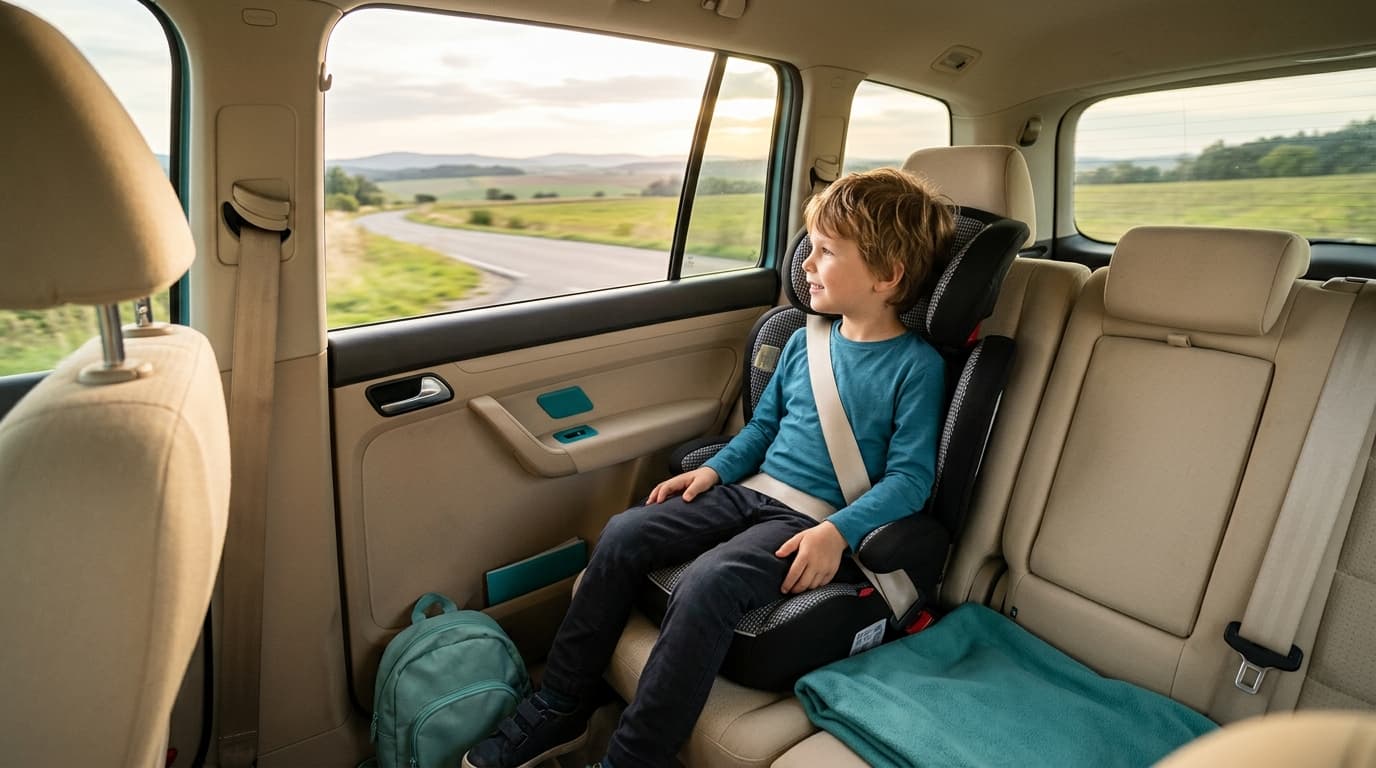
Car sickness strikes mostly between the ages of 2 and 12, and the timing is no accident: those are the years spent in the back, strapped in, with a seatback for scenery. The advice repeated everywhere was designed for adults. And in an electric car, one braking setting can be enough to set it off.
Car sickness is a disagreement between the eye and the ear
The inner ear feels the car turn, brake and accelerate. The eye, meanwhile, stares at a seatback, a book or a tablet, and swears nothing is moving. The brain receives two incompatible accounts and answers with pallor, saliva, drowsiness, then nausea. Doctors call it motion sickness, or kinetosis.
The driver is almost always spared. They see the road and, above all, they know one second ahead that they are about to brake.
Everything else follows from that one-second head start.
Why doesn't the usual advice work for a child?
Because it assumes a passenger who is free to move. The travellers' page of the US Centers for Disease Control and Prevention boils down to two instructions: sit in the front of the car, or drive yourself, then close your eyes or look at the horizon. It adds that children and pregnant women are the most vulnerable. So the most vulnerable are the very people the first instruction fits least.
A four year old does not drive. They sit in the back, strapped into a shell whose side wings frame their head, facing a seatback that rises above their eyes. A review of the paediatric literature places motion sickness "mainly between the ages of 2 and 12": the window overlaps almost exactly with the child seat and booster years.
The table crosses age, seating position and what remains possible. I built it from the Belgian rule, the i-Size standard and the factsheet of the Belgian Centre for Pharmacotherapeutic Information (CBIP, the independent body that informs Belgian prescribers).
| Child's age | Where and how they travel | Susceptibility to car sickness | Levers actually available |
|---|---|---|---|
| Under 2 | Rear-facing, mandatory until 15 months and 76 cm under i-Size | Rare | Smooth driving, fresh air; no medicine |
| 2 to 4 | Rear-facing recommended up to 105 cm, in the back | Start of the sensitive period | View through the rear window, no screen, breaks |
| 4 to 12 | Forward-facing, harness then booster, in the back | Highest | Seat with a view of the road, eyes on the distance, driving settings |
| Over 1.35 m | Seatbelt alone, front seat possible | Fading with age | Front seat, same settings |
In Belgium, article 35 of the highway code requires a suitable child restraint up to 1.35 m, and the rule is federal: it is the same in Brussels, Wallonia and Flanders. It does not ban a correctly restrained child from the front seat, but a rear-facing seat never belongs there in front of an active frontal airbag. Moving a child to the front because of nausea is therefore a choice to weigh, car manual in hand, and not the reflex suggested by pages written for adults.
The lever that remains is modest and free: give them the road back. The rear centre seat, when the child seat can be fitted there, opens up the view between the two front seats. Behind the passenger, a front head restraint lowered by one notch is sometimes enough.
Does an electric car make passengers more sick?
Yes, for some passengers, and research is starting to say why. Saskia and Bart, near Bruges in the north-west of Belgium, swapped their diesel estate for an electric family SUV last spring. Their 6 year old son had never been car sick. On the first trip to the Ardennes, he vomited before Ghent.
Their story is ordinary, according to the researchers who study it. William Emond, a PhD student at the Université de technologie de Belfort-Montbéliard in France, summed it up in the press in the summer of 2025: someone who grew up in combustion cars reads motion from engine revs, vibrations and torque. An electric car removes those signals, and the brain has to relearn how to estimate the forces it is subjected to. A child has no more resources for that than an adult, and cannot see the road.
The second mechanism is regenerative braking. As soon as the driver lifts off, the car slows down by itself to recharge its battery, sometimes sharply, without anyone touching the brake. A study published in the International Journal of Human-Computer Interaction, run with 16 participants prone to motion sickness, compared several levels of regeneration. Its authors write that their results "confirmed that higher levels of RB can induce MS", meaning regenerative braking and motion sickness. The same team observes that sound cues announcing each slowdown ease the symptoms, which brings us back to the driver's one-second head start.
16 passengers
Size of the study linking strong regenerative braking to nausea among electric car passengers: a clear result, on a small sample of adults
A sense of proportion is needed. Sixteen adults, no children, a test protocol: it is a solid lead, not a law. I found no study carried out on children sitting in the back of an electric car.
Turning regeneration down, the first setting to try
Most electric cars and plug-in hybrids let you choose the strength of regeneration, with paddles behind the wheel or in the drive menu. With a susceptible child on board, start at the lowest level and switch off one-pedal driving. The car then coasts again when you lift off, like a combustion car.
The price is small: a little less energy recovered in town, almost nothing on the motorway, where you brake little. Our article on the real range of an electric family car details what actually weighs on consumption.
Saskia and Bart made the next trip on minimum regeneration, with comfort mode engaged. Their son lasted until Namur, then all the way.
Rear-facing is almost never the culprit
The objection comes up in every family: they are sick because they travel backwards. It deserves a calculation.
The i-Size standard requires rear-facing travel until 15 months. Car sickness hardly ever appears before the age of 2, that is 24 months. Between the end of the obligation and the usual start of nausea, nine months go by. During the period when the law requires rear-facing, a child almost never has motion sickness.
The overlap exists for parents who follow the recommendation of safety bodies and keep the child rear-facing up to 105 cm, around the age of 4. That makes two shared years, from 2 to 4, out of the ten the sensitive period lasts: one fifth. And nothing I have read establishes that those two years are worse rear-facing than forward-facing. A child seated backwards watches a receding landscape through the rear window, which beats a seatback thirty centimetres from their nose.
Turning a 2 year old forward because of nausea means trading a measured protection for a supposed benefit. Our article on rear-facing seats and the age to turn sets out the figures.
Should you give medicine before leaving?
Not before the age of 2, and never out of habit. The CBIP factsheet, published in its Folia bulletin of May 2011, is blunt: motion sickness medicines are discouraged in children under 2, and sedating antihistamines should "certainly" be avoided at that age.
For older children, the same factsheet puts non-drug measures first. Sedating antihistamines remain the first choice when those fail, with a limit the CBIP underlines: they cause drowsiness, and children are more sensitive than adults to their side effects. They are taken 30 to 60 minutes before departure and should not be combined with one another. Most are sold over the counter in Belgium, which is no reason to skip asking the pharmacist which product and dose suit the child's age and weight.
The figure that matters: thirty minutes. A tablet swallowed at the first retch, on the hard shoulder, comes too late.
Screens weigh more than breakfast
A study by Ford's research centre in Aachen, Germany, published in April 2017, had adult passengers watch a screen during a short trip: they felt unwell after ten minutes on average. At 120 km/h, ten minutes is twenty kilometres. The tablet hooked to the head restraint is therefore the first thing to put away, long before debating what was for breakfast.
Before setting off, six settings can be checked in two minutes:
- regeneration at its lowest level and one-pedal driving switched off, in an electric car or plug-in hybrid;
- the susceptible child in the seat with the best view of the road, if their child seat can be fitted there;
- screens and books put away, replaced by music or an audio story;
- a cool, ventilated cabin, with no air freshener;
- a light meal before leaving, neither an empty stomach nor a full one;
- a bag, wipes and a change of clothes within reach, not at the bottom of the boot.
A child who is sick on every trip needs a doctor
Systematic vomiting, headaches, balance problems outside the car, or motion sickness that appears suddenly in an older child are not solved with a paddle behind the wheel. That calls for an appointment.
In practice, for a family, a failed trip also leaves a bench seat to rescue: our method to clean vomit from a car deals with the stain, the smell and the child seat. And to choose a family car where the child in the middle can see the road, the comparison tool lines models up on their Isofix positions and real boot space.
Comparateur Hybrides & électriques
Compare tous les hybrides & électriques côte à côte.
Comparer maintenant →
Frequently asked questions
Audrey teste des familiales depuis 2015, maman de deux enfants, basée à Wavre. Elle installe vraiment les sièges Isofix avant de juger l’habitabilité et calcule le budget sur cinq ans, carburant et entretien compris. Sa boussole : peut-on y mettre deux sièges-auto et les courses sans jouer à Tetris ?