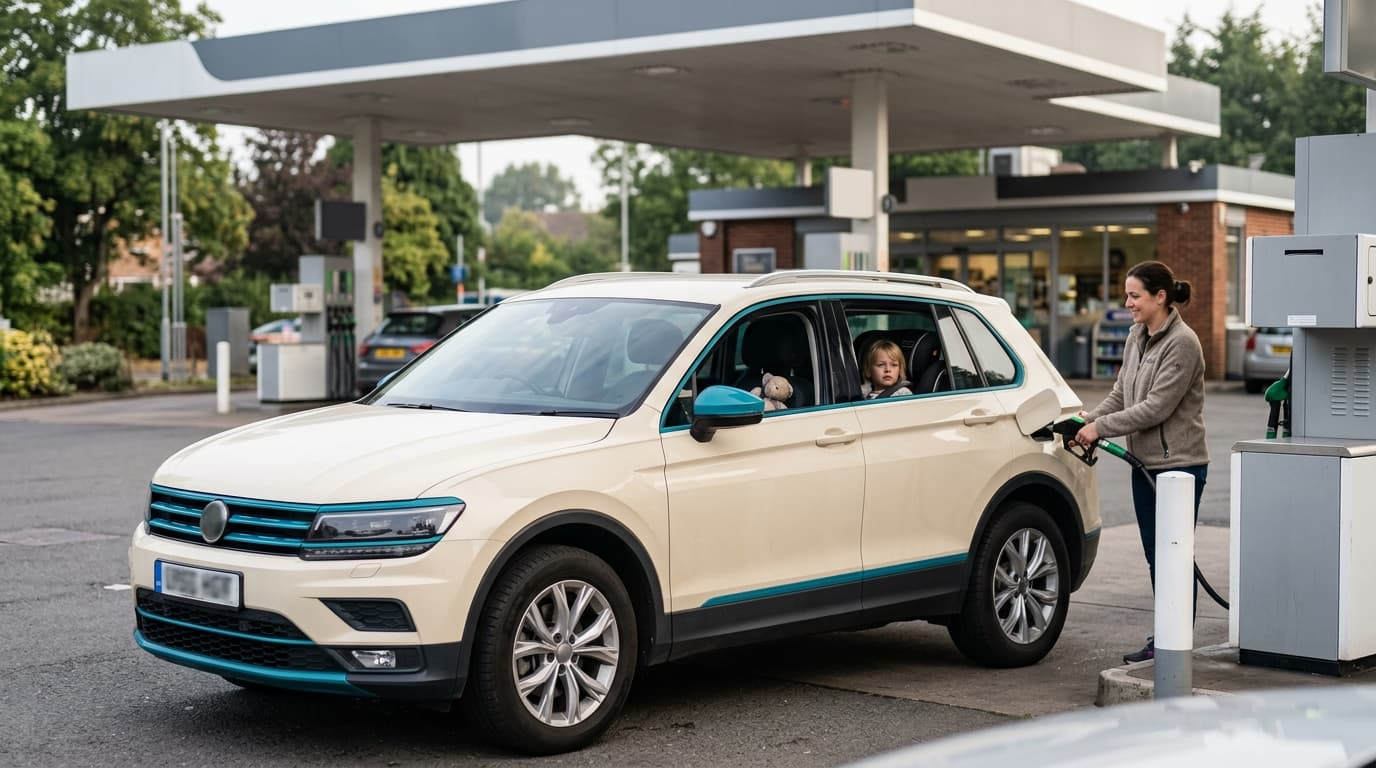
A mild hybrid is a petrol car, sometimes a diesel, whose starter motor has been replaced by a small electric motor fed by a 12 or 48 volt battery. It helps the engine and never replaces it: the car does not drive for a single second on electricity, and it does not plug in. For a family, the fuel saving over a non-hybrid version comes down to a few percent.
The badge on the tailgate, meanwhile, says hybrid in full.
A mild hybrid never drives on electricity
That is where the whole misunderstanding starts. The word hybrid now covers four technologies that have almost nothing in common apart from an electric motor somewhere under the bonnet, and the humblest of the four is the one dealers are keenest to put on display.
On a mild hybrid, the electric motor is a starter-generator, belt-driven from the crankshaft. It does three things. It restarts the combustion engine after a stop, faster and more smoothly than a conventional starter. It adds a little torque when the engine lacks it, pulling away and accelerating. And it recovers energy when you lift off, storing it in a battery that would fit in a school bag.
| Term | Job of the electric motor | Battery, order of magnitude | Drives on electricity alone | Plugs in |
|---|---|---|---|---|
| Micro-hybrid or 12V mild hybrid | Enhanced stop-start, starting assistance | 0.13 kWh (Fiat Panda Hybrid), 0.3 kWh (Suzuki Swift Hybrid) | No | No |
| 48V mild hybrid, or MHEV | Assists acceleration, switches the engine off when coasting at a steady speed | Under 1 kWh | No | No |
| Full hybrid, or HEV | Drives alone at low speed, assists the rest of the time | 1.2 kWh (Toyota Yaris), 1.49 kWh (Kia Sportage) | Yes, for a few kilometres | No |
| Plug-in hybrid, or PHEV | Drives on electricity for several dozen kilometres | Around 10 to 20 kWh | Yes | Yes |
The small-car capacities come from the figures published by Motor1, which also gives the weight of each system: 25 kg on the Panda, 125 kg on the full hybrid Yaris. Between a micro-hybrid and a plug-in, the battery grows a hundredfold. The word stays the same.
12 volts or 48 volts: can you feel the difference behind the wheel?
A little, and mostly in town. A 12 volt system is essentially a smoother stop-start. A 48 volt system gives the engine a real shove and, on the more advanced setups, switches it off while coasting at a steady speed, below roughly 120 km/h.
Behind the wheel of a 48V Kia Sportage, which pairs the 150 hp 1.6 T-GDi with a dual-clutch gearbox, what stays with you is a jolt-free restart at the lights. Nothing more. No electric mode, no minute of silence pulling into the estate in the evening.
The one notable exception: Subaru's e-Boxer, classed as a mild hybrid, moves on its own for 1.6 km at most, below 40 km/h, with a full battery.
Three Sportage in Pulse trim: 4% against 19%
To measure what the 48V system really adds, you need the same car with and without it, then with a genuine full hybrid. The Kia Sportage lends itself to the exercise: same body, same Pulse trim, three powertrains in the Belgian price list. List prices checked on 27 September 2026 on the pages of Moniteur Automobile, the Belgian motoring magazine, VAT included, options excluded. Fuel calculated at 15,000 km a year at the official maximum price of 95 E10 petrol in force since 26 September 2026, €2.108 a litre, set by the SPF Économie, the Belgian federal economy ministry.
| Kia Sportage Pulse | Hybrid type | List price | WLTP fuel use | WLTP CO2 | Litres a year | Fuel a year |
|---|---|---|---|---|---|---|
| 1.6 T-GDi 150 MT6 | None | €36,790 | 7.2 L/100 km | 162 g/km | 1,080 L | €2,276.64 |
| 1.6 T-GDi 150 DCT7 | 48V mild hybrid | €38,790 | 6.9 L/100 km | 157 g/km | 1,035 L | €2,181.78 |
| 1.6 T-GDi 239 HEV AT6 | Full hybrid | €41,390 | 5.6 L/100 km | 126 to 127 g/km | 840 L | €1,770.72 |
The 48V saves 0.3 litres per hundred kilometres, or 4% and €94.86 a year. The full hybrid saves another 1.3 litres, 19% less than the 48V and €411.06 a year.
€94.86
Fuel saved in one year by the 48V Sportage over the non-hybrid version, at 15,000 km and €2.108 a litre (WLTP)
One detail of the spec sheet deserves a pause. The €2,000 gap between the first and second rows does not only buy the 48 volt battery: it also buys the automatic gearbox, since the 48V system is not offered with a manual box on this version. A family that wanted an automatic anyway gets the mild hybrid almost as a bonus. A family paying €2,000 for the word hybrid is making an investment with a payback of around twenty years.
Moniteur Automobile is not fooled, either: its price grid files the 48V Sportage under petrol, not under hybrid.
And on the motorway, loaded for the holidays?
The gap shrinks further. A mild hybrid earns its fuel saving in phases where it can recover energy, braking and deceleration, then give it back at the next pull-away. At a steady 120 km/h on the E411 with four people, the luggage and a roof box, there is almost nothing to recover and the small battery has nothing to give back. The full hybrid also loses part of its lead in those conditions, but it starts from further ahead. Our survey of real-world fuel use in a loaded family car details those gaps between the type-approval cycle and the holiday departure.
Is the 48V still a good buy for a family?
Sometimes, yes, and the objection deserves to be taken seriously. A mild hybrid adds almost no weight, takes no litre out of the boot, needs no charging point, is serviced like an ordinary petrol car and adds real comfort in traffic jams. On a car you would have chosen with an automatic gearbox anyway, it is a free gain.
Delphine and Maxime live in Wanze, next to Huy in the province of Liège, with two children aged 4 and 9. Their odometer shows 15,000 km a year, most of it between home, school and the daily commute to Liège along the N90, where traffic stops and starts twenty times morning and evening. At a dealership one Saturday in September, the 48V Sportage was presented to them as "the affordable hybrid", at €38,790, with the full hybrid at €41,390 two metres away. They were ready to sign for the first one. A sum scribbled on the corner of the order form made them hesitate: €2,600 more to buy, €411.06 of fuel saved every year in favour of the full hybrid, so a little over six years to break even on paper, and more power thrown in.
Six years is a long time. But it is roughly how long a family keeps a car bought new, and their commute to Liège is exactly the terrain where a full hybrid comes closest to its type-approval figures. At 20,000 km a year, the payback drops below five years.
The nuance lies in the use, not in the technology.
The 48V system is not worth the €2,000 you think you are paying for it. It is worth the automatic gearbox that comes with it.
How can you spot a mild hybrid before you sign?
The spec sheet is enough, provided you know where to look. The tailgate badge and the brochure say hybrid in both cases, and the salesperson does not always have an interest in being more precise.
- The acronym. MHEV, mHEV, "48V", "e-TEC", "eTSI", "EcoBoost Hybrid" or "Mild Hybrid" mean a mild hybrid. HEV, "full hybrid", "e:HEV" or "self-charging hybrid" mean a full hybrid.
- The electric power. At around twenty kilowatts or less, the electric motor is generally not designed to move a family car on its own. The one in the full hybrid Sportage delivers 44.2.
- The battery capacity. Under one kilowatt-hour, it is a mild hybrid. Between one and two, a full hybrid. Above ten, a plug-in.
- The electric range. If the spec sheet mentions none at all, not even two kilometres, the car cannot drive on electricity.
- The gearbox. A full hybrid is almost always automatic. Some brands offer a mild hybrid with a manual box, which gives its nature away immediately.
In Belgium, the word hybrid opens no door for a 48V car
None of the three Regions has made room for it. Registration taxes are calculated from the car's type-approval data, under rules specific to each Region, and the distinction between hybrids only matters for the federal taxation of plug-ins, as Ready to Road, a Belgian driving licence platform, sums up. In Flanders, where CO2 weighs in the calculation, the 5 g/km saved by the 48V barely shows. In Brussels, the tax depends on fiscal horsepower and age, not on CO2: the 48V gains nothing there. Wallonia reformed its tax in 2025, without creating a mild hybrid category either.
Same story in the low emission zones of Brussels, Antwerp and Ghent, which look at fuel type and Euro standard: a 48V Sportage is allowed in or kept out exactly like a petrol car of the same standard. As a company car, finally, a mild hybrid is treated like any fossil-fuel car, and our feature on the family plug-in hybrid as a company car details the only case where hybridisation really changes the tax picture.
Delphine and Maxime eventually ordered the full hybrid, for a reason neither of them expected: the silence when pulling away in the evening, once the youngest has fallen asleep in his car seat. To choose between a simple and a plug-in hybrid with a big boot, our comparison of HEV and PHEV family estates takes over, and our comparison tool lines up family cars on real boot volume, Isofix positions and total budget.
Comparateur Hybrides & électriques
Compare tous les hybrides & électriques côte à côte.
Comparer maintenant →
Frequently asked questions
Audrey teste des familiales depuis 2015, maman de deux enfants, basée à Wavre. Elle installe vraiment les sièges Isofix avant de juger l’habitabilité et calcule le budget sur cinq ans, carburant et entretien compris. Sa boussole : peut-on y mettre deux sièges-auto et les courses sans jouer à Tetris ?