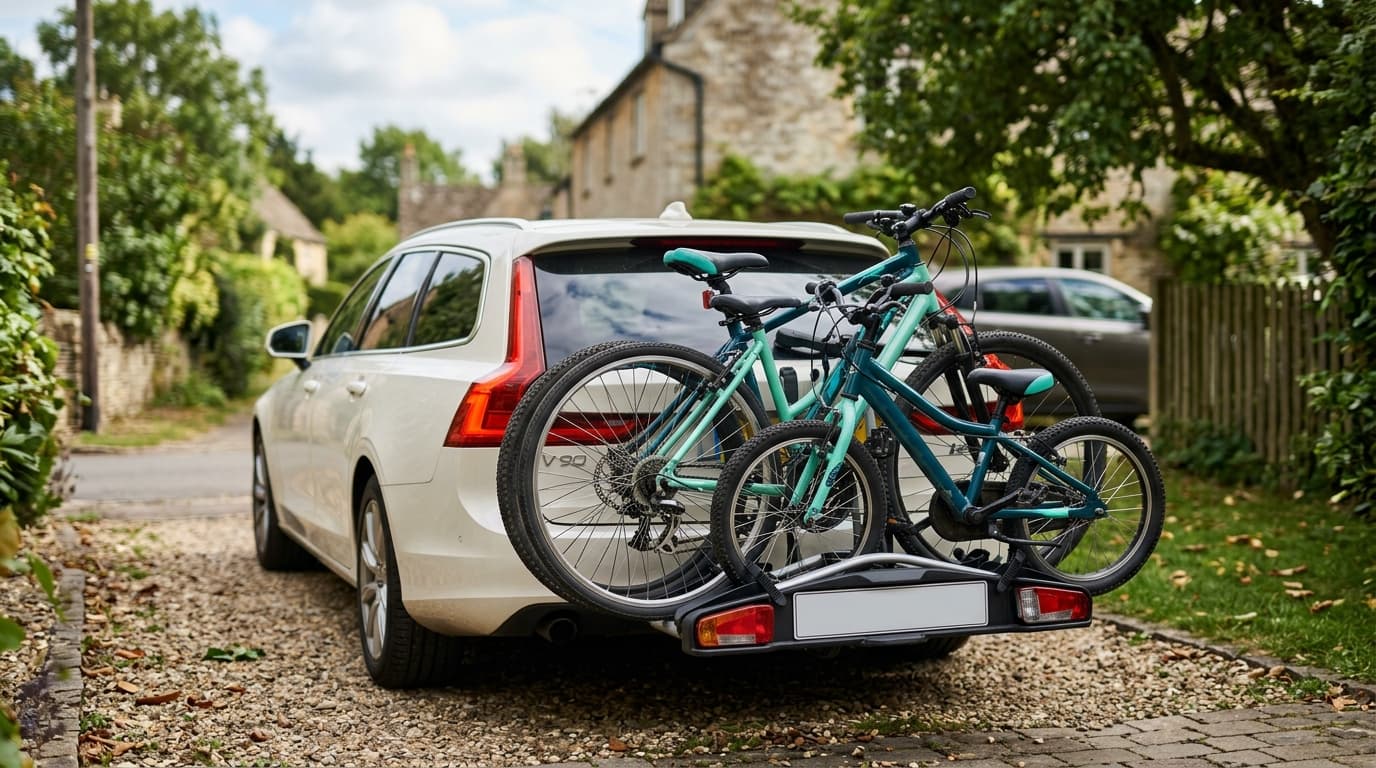
A towbar if any bike weighs more than fifteen kilos, the tailgate in every other case. It really is that blunt. A hanging rack tops out at 15 kg per bike; an electric bike weighs 20 to 30. And in Belgium, fitting a towball adds a roadworthiness inspection nobody warns you about.
Towbar or tailgate rack: which one for a family?
The tailgate for as long as the bikes stay light and few. The towbar as soon as an e-bike enters the equation, or as soon as you need to carry four. Between the two sit just under a thousand euros and a trip to the inspection centre.
Laurence and Kévin live near Dinant, in the Meuse valley, have two children aged 7 and 10 and cover around 15,000 km a year in a family estate. Two children's bikes, two adult bikes, one of them an e-bike bought last year for the runs to Ciney. Their question isn't "which is the best rack" but "can I avoid the towbar". The answer sits in one line of a spec sheet, and it has nothing to do with their car.
| Criterion | Tailgate-mounted rack | Towbar-mounted rack |
|---|---|---|
| Maximum weight per bike | 15 kg (Thule OutWay Hanging 3) | 20 to 30 kg depending on model |
| Total load | 45 kg across three bikes | 60 kg, capped by the car's noseweight |
| Number of bikes | 2 or 3 | 2 to 4 |
| BE price checked 24/08/2026 | from €449.95 | from €869.95 (VeloSpace 3) |
| Equipment needed first | none | towbar fitted: €450 to €1,200 |
| Roadworthiness inspection | no | yes, as soon as it is fitted |
| Boot access when loaded | impossible | by tilting, depending on angle and tailgate size |
€911
Minimum gap between the tailgate option (€449.95) and the towbar option in Belgium: towbar fitted at the €450 floor price, VeloSpace 3 rack at €869.95 and towbar inspection at €40.90
The real ceiling is the weight per bike
Fifteen kilos. That is the maximum allowed per bike on a Thule OutWay Hanging in three-bike form, for 45 kg in total; the Menabo Stand Up 3 quotes the same 45 kg total load. An electric bike weighs 20 to 30 kg with its battery, as Test-Achats points out. The sum is over before it starts.
On a towbar, the Thule range takes 20 kg per bike on the common models and up to 30 kg on reinforced platforms such as the VeloSpace or the EasyFold, for 60 kg in total. That figure is still never the real ceiling. The real ceiling is your car's noseweight: the vertical load the towball can carry, written in the vehicle handbook, on the towbar's data plate or sometimes on a sticker inside the door pillar. Test-Achats puts it between 32 and 100 kg depending on car and towbar, and it includes the rack itself, which weighs 10 to 20 kg. The lower of the two figures always wins: a rack approved for 60 kg fitted to a towball rated at 50 kg is still capped at 50 kg.
Take Laurence and Kévin's estate again, with a 75 kg noseweight. The rack eats 15 to 20 kg, leaving 55 to 60 kg for the bikes. Two e-bikes at 25 kg and two children's bikes at 11 kg come to 72 kg. They are over, by twelve kilos, on equipment they have just bought new.
What if only one of the two adult bikes is electric?
The tailgate is still out, but the trade-off changes character. One e-bike means twenty-five kilos to put somewhere, and no hanging rack accepts them. That leaves the car itself: battery out, front wheel off, an electric bike fits in the boot of a large-boot family estate, laid on a tarpaulin. It isn't elegant. For two departures a year, it is nine hundred euros left in the account.
What does each option really cost in Belgium?
€449.95 for the tailgate. At least €1,361 for the towbar. The gap isn't in the rack, it is in everything people forget to count.
At BJM'Tech Loisirs, an official Thule dealer in Nalinnes, the Thule OutWay Hanging starts at €449.95 including VAT in three-bike form, and the two-bike OutWay Platform — whose raised platform clears the lights and the plate — at €539.95. On the towbar side, the VeloSpace 3 starts at €869.95, the EasyFold 3 at €999.94, the Epos at €1,169.95 and the Epos ParkSecure at €1,499.95 (prices checked on 24 August 2026). Everyone advertises those numbers.
The towbar itself, nobody does. Touring CarSelect puts a fitted towbar at €450 to €1,200 depending on whether it is fixed, detachable or retractable — wiring and coding excluded.
What a towbar quote almost never includes:
- the wiring loom, €50 to €150, which incidentally decides whether you get a 7-pin or a 13-pin socket;
- coding the control unit on a recent car, €50 to €200;
- the towbar inspection, €40.90 on the 2026 fee schedule;
- updating part 1 of the registration certificate, without which an insurer can argue after a claim;
- the loss of the bonus system at the periodic roadworthiness test, which comes back at every due date.
Then there is the inspection. In Belgium a towbar inspection is compulsory as soon as the equipment is fitted and at every periodic test afterwards, and Autocontrôle states in black and white that the rule applies even when the towball is only used for a bike rack. This is the point French guides never mention, for the excellent reason that it doesn't exist there. A quieter second effect: cars fitted with a towbar cannot benefit from the bonus system. So it is not a one-off €40.90, it is a line that keeps coming back.
Is a tailgate rack allowed on your car?
Not always. And the answer isn't in the highway code, it is in your handbook.
Nothing in Belgian law forbids a hanging rack. Carmakers set the limit, and several write it out in full: the tailgate is not designed to carry a bike rack, and a powered tailgate even less so. Modern tailgates are aluminium or composite, their hinges calibrated for exactly that weight, and nothing in that assembly was sized for three bikes pulling downwards at every pothole on the N97.
Spoilers and bonded rear screens add their own veto. Thule publishes a compatibility list by make, model and year: its OutWay Hanging covers most of the saloons, estates and compact SUVs sold here — Golf, Octavia, 308, Mégane, Corolla, i30, Tiguan, X1 — without covering everything else. Menabo does the same for its Stand Up 3. You check before buying, not after.
One last detail few families anticipate: with a hanging rack loaded, the boot no longer opens. For a day trip you live with it. For two weeks of camping with two children, it means unhooking three bikes every time somebody wants a jumper. The towbar solves that by tilting, without solving it entirely: Test-Achats notes that the tilt angle isn't always enough to open a large tailgate, and that the mechanism wears when it is worked under load.
Plate, lights and 13 pins: what Belgium requires
The rear lights and the plate must stay visible. Loaded or not, always. If the bikes hide them, even partly — and one rear wheel is enough — you need a plate-and-light board mounted on the rack, carrying a retroreflective copy of your plate. That is the structural weakness of the hanging rack, and precisely what the OutWay Platform corrects by lifting the bikes higher.
Then comes the socket. A 7-pin socket handles tail lights, brake lights, indicators and the rear fog light; it handles neither the reversing light nor a permanent live feed. A rack fitted with a reversing light therefore needs a 13-pin socket, or an adapter. Several European countries require one, and most racks sold here are supplied accordingly. Check what your loom carries before ordering: on a towbar quote, that line changes the price.
The rest comes down to two figures. The rack, load included, may not overhang the rear of the car by more than one metre (police.be). And the warning sticker found on nearly every rack caps speed at 130 km/h when loaded — a stability figure, not permission to sit at 130 on the E411.
Does a roof rack solve the problem?
It solves the plate and lights question and creates two others. Hoisting a bike to roof height rules out an e-bike immediately, and the wind resistance of a bike on the roof is in a different league from one hanging off the back: Test-Achats ranks the roof rack as the costliest option at the pump, well ahead of the towbar and the tailgate. We have put figures elsewhere on what load does to a family car's real-world fuel consumption. The roof stays relevant for a light road bike, on a car whose towball is already busy.
When you should buy nothing at all
Two children's bikes fit in the boot of an estate, front wheels off, on an old blanket. Three weekends a year don't justify €450.
And when the need is seasonal, hiring exists: several Belgian bike shops rent a rack by the week, for the price of a tank of fuel.
Two children, two adults, one electric bike: the right answer is printed on the rack's spec sheet, not on the car's. Weigh your bikes, compare against the tailgate's 15 kg, and if you are over, budget the towbar in full — inspection included. The rest of the family kit is best planned with our comparison tool, and the children's seats with our guide on rear-facing car seats.
Comparateur Breaks & familiales
Compare tous les breaks & familiales côte à côte.
Comparer maintenant →
Frequently asked questions
Audrey teste des familiales depuis 2015, maman de deux enfants, basée à Wavre. Elle installe vraiment les sièges Isofix avant de juger l’habitabilité et calcule le budget sur cinq ans, carburant et entretien compris. Sa boussole : peut-on y mettre deux sièges-auto et les courses sans jouer à Tetris ?