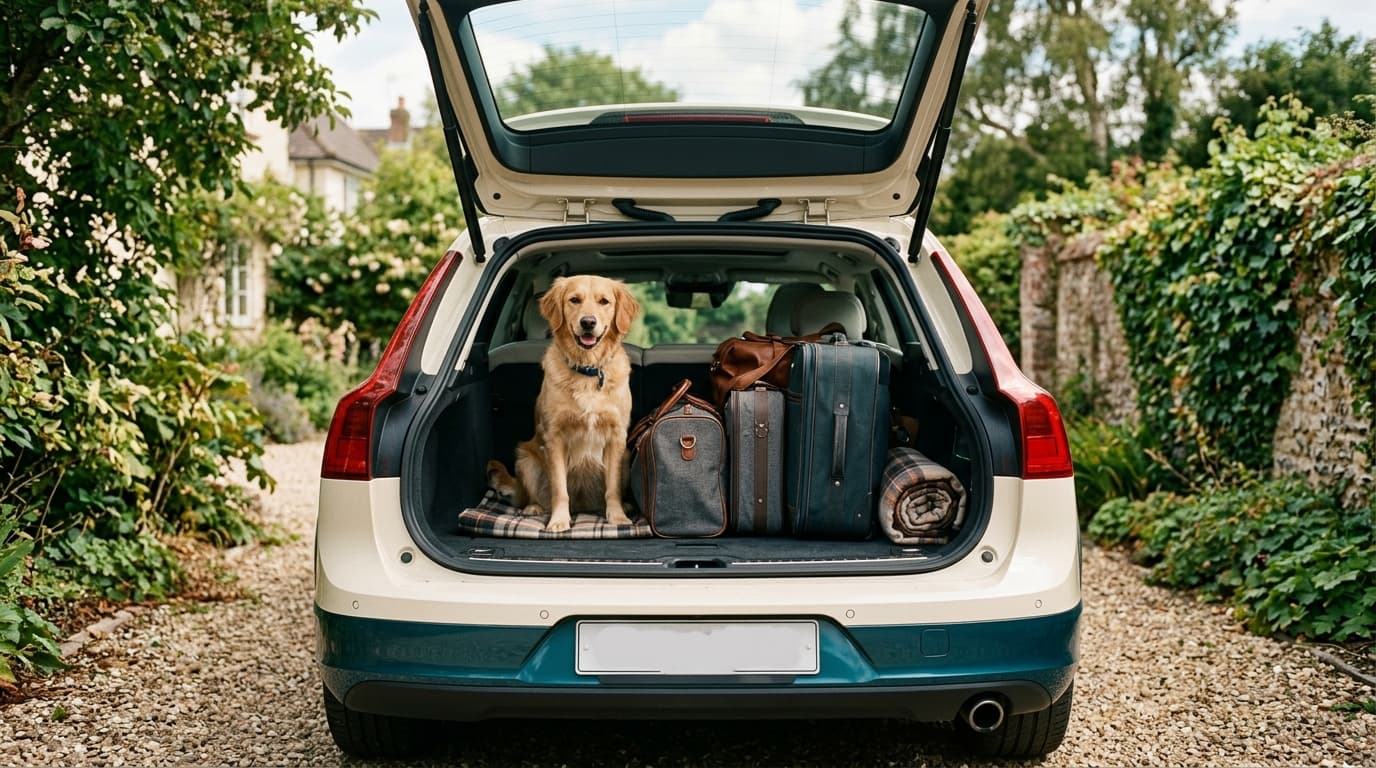
Between a family SUV and an estate car, the headline litres settle nothing: boot geometry decides. Loading sill, floor length, width between the wheel arches, and then the real five-year premium in Belgium. Figures in hand.
Family SUV or estate car: what is the real difference?
An estate car is a saloon whose roof runs all the way back to the tailgate: low floor, long boot, centre of gravity close to the ground. A family SUV is a raised vehicle, with higher ground clearance and a higher driving position, whose boot gains in height what it loses in length. The difference is not a matter of style: it determines what fits, what you have to lift and what you pay at the pump.
For a family, that translates into three measurable gaps. The estate loads lower and longer, uses about 0.5 L/100 km less fuel and generally costs €2,000 to €4,000 less for equivalent equipment. The SUV offers a high seat that makes fitting a child seat — or helping a grandparent aboard — easier, useful ground clearance on a campsite track, and a higher towing capacity for a caravan.
Take Delphine and Pierre-Yves, early fifties, two teenagers of 14 and 16 who are both over 1.78 m, a 30 kg labrador, a house near Mons and 25,000 km a year including the E42 motorway every morning. Their need isn't ground clearance: it is a boot the dog can jump into on his own, one where two sports bags and a bike fit without removing the front wheel, and a fuel bill that doesn't run away. Those three constraints, not fashion, are what settle it.
Which format offers the more useful boot: litres or geometry?
Geometry, almost always. Litres are measured by filling the boot with small blocks right up to the roof — a method (the VDA standard) that mechanically favours tall bodies. Yet nobody stacks a suitcase 1.20 m above the floor.
Here are the figures that count, taken from manufacturer data and road tests published in 2025 and 2026, with indicative prices on the Belgian market in July 2026, excluding options.
| Model | Format | Boot 5 st. | Loading sill | Combined use | Belgian budget |
|---|---|---|---|---|---|
| Skoda Octavia Combi | Estate | 640 L | ~63 cm | ~5.2 L/100 km | from ~€32,000 |
| Skoda Superb Combi | Estate | 690 L | ~64 cm | ~5.4 L/100 km | from ~€40,000 |
| Peugeot 308 SW | Estate | 608 L | ~66 cm | ~5.3 L/100 km | from ~€34,000 |
| Peugeot 3008 | SUV | 520 L | ~70 cm | ~6.0 L/100 km | from ~€38,000 |
| Skoda Kodiaq (5 st.) | SUV | 910 L | ~75 cm | ~6.3 L/100 km | from ~€44,000 |
63 cm
Loading sill of a Skoda Octavia Combi, against 70 to 75 cm on a family SUV
The awkward fact is right there, in black and white: the Skoda Kodiaq claims 910 litres in five-seat mode, 220 more than the Superb Combi, and it still loses the real loading contest. Its litres are stacked high, under a shorter tailgate and behind a sill 11 cm taller. The estate, by contrast, lines up a long floor, a rectangular opening and a low but usable height under the shelf. A two-metre plank, a bike laid flat with its front wheel on, a dog crate: three familiar objects that go into the estate and jam in the SUV.
Should you check the loading sill before the litres?
Yes, and it is the most rarely published figure of all. The Skoda Octavia Combi loads at 631 mm from the ground, 6 mm lower than the previous generation; a Peugeot 3008 sits around 70 cm, a Kodiaq higher still. Seven to fifteen centimetres sound anecdotal until the day you have to hoist a 30 kg labrador or a bag of cement. You take that figure with a tape measure in the dealer's car park, or find it in the detailed road tests of Moniteur Automobile and Test-Achats. Our ranking of estates by measured boot volume gives the model-by-model detail.
How much more does an SUV really cost than an estate in Belgium?
Between €3,500 and €6,000 over five years, with an equivalent powertrain. The premium doesn't come from one line but from three that add up: purchase price, fuel and tyres.
The detail, for Delphine and Pierre-Yves's family. Purchase price: €2,000 to €4,000 of difference for equivalent equipment between a compact estate and its SUV cousin. Fuel: AutoScout24 comparisons published in 2025 put the average gap at 0.5 L/100 km, which is 125 litres a year at 25,000 km, roughly €210 a year and more than €1,000 over five years. Tyres: an SUV happily runs 19-inch wheels, at €160-200 a tyre against €100-130 for 17-inch rubber on an estate — count €300 to €500 more per set.
What we'd avoid: justifying the premium with safety. Modern estates score Euro NCAP results comparable to SUVs of the same generation, and their lower centre of gravity improves stability in an emergency swerve. The SUV buys a driving position and an image, not passive-safety points.
Does an SUV hold its value better than an estate?
Yes, but the gap doesn't pay back the premium. The SUV now accounts for more than half of new registrations in Belgium, and that demand supports resale values. Except that the few points of favourable depreciation almost never offset the €3,500 to €6,000 paid extra over five years. Conversely, a recent hybrid or diesel estate remains in strong demand among high-mileage drivers and fleets, which limits its real depreciation. Our guide to fuel-efficient family estates details the powertrains that hold both the road and their value.
Two teenagers and a dog: which one copes better day to day?
The estate, on both counts, with one exception. The dog jumps unaided into a boot at 63 cm and settles into an approved crate that fits between the wheel arches; at 75 cm you have to lift him, or invest in a ramp — essential as soon as the animal ages. Vias Institute, Belgium's road-safety reference, points out that an unrestrained dog becomes a projectile in a crash: the crate or the guard net is not a comfort accessory.
The exception is getting aboard. You step into an SUV rather than dropping into it. For a grandparent who looks after the children two days a week, or for clipping in a child-seat shell without wrecking your back, the SUV's seat height is a real daily gain — which is exactly why we recommend it in our guide to a hybrid car for grandparents.
How much rear legroom do teenagers of 1.80 m need?
Count on at least 90 cm of knee room measured behind a 1.80 m driver. Compact estates such as the Peugeot 308 SW come close; large estates such as the Superb Combi comfortably exceed it — the Superb is known for rear space from a class above. A family SUV, with the same wheelbase, offers no more length: it offers more headroom, which a seated 1.78 m teenager doesn't care about, unless he is mostly torso. Test it with your own children in the car, driver's seat set to your position, before you sign.
Estate or SUV as a company car: what do Belgian tax rules say?
They ignore the body style and look only at CO₂. Only 0 g powertrains keep 100 % deductibility for company cars ordered up to the end of 2026, before a scheduled step down to 95 % in 2027 and 90 % in 2028. A combustion estate and a combustion SUV suffer the same fate.
The gap opens elsewhere, and it leans towards the estate. With an identical engine, an SUV — 100 to 200 kg heavier and less aerodynamic — almost always emits a few grams more CO₂, which weighs on both deductibility and the benefit-in-kind (avantage de toute nature, ATN) taxed on the employee. If the car goes through the company, an electric estate or an electric SUV remain the only fiscally neutral answers, and the trade-off comes back to the boot. See our file on the family plug-in hybrid as a company car for the full calculation.
Two teenagers, a dog, 25,000 km a year: the right format is the one that absorbs that reality without a ramp, without Tetris and without surprises at the pump. Measure the sill, lay the bike in the boot, then decide with our family car comparator or our guide to the best 7-seater family SUV.
Comparateur SUV familiaux & 7 places
Compare tous les suv familiaux & 7 places côte à côte.
Comparer maintenant →
Frequently asked questions
Audrey teste des familiales depuis 2015, maman de deux enfants, basée à Wavre. Elle installe vraiment les sièges Isofix avant de juger l’habitabilité et calcule le budget sur cinq ans, carburant et entretien compris. Sa boussole : peut-on y mettre deux sièges-auto et les courses sans jouer à Tetris ?