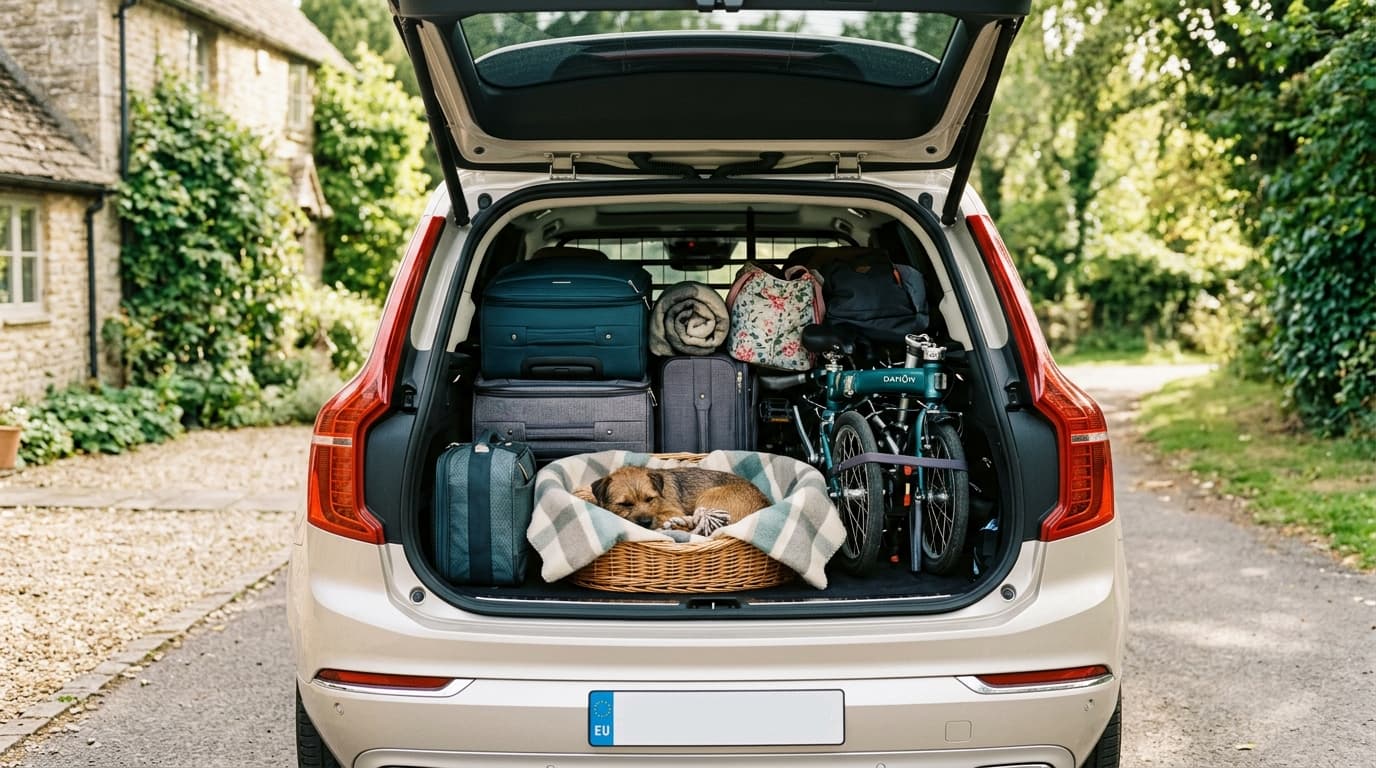
The family SUV with the biggest boot sold in Belgium is the Skoda Kodiaq, with 835 L in five-seat mode, bench up. But the rankings that advertise 2,000 L cheat: they measure seats folded. Here is the real ranking in litres, for a family that genuinely loads up.
Which family SUV has the biggest boot in Belgium?
The Skoda Kodiaq offers the biggest real boot in the segment, with 835 L in five-seat mode. The Peugeot 5008 follows with 780 L and the Kia Sorento with 705 L. These are the three biggest family-SUV boots sold in Belgium, measured bench up, the only setup useful day to day.
The real boot here means the VDA volume in five-seat mode, rear seats up, measured in litres to the parcel shelf. It is the figure that counts for a family: the one you fill every day with the pushchair, the school bags and the shopping, without folding anyone away.
The figure that counts: 835 L for the Kodiaq (VDA measure, Moniteur Automobile, 2026), meaning 130 L more than a Sorento and nearly twice the boot of a compact segment-C SUV. For Émilie and Damien, who go camping every summer from Flemish Brabant with three children and a Labrador, that gap decides everything: it is the difference between fitting it all in and driving with a roof box.
Why is the seats-folded volume misleading?
Because it measures the car emptied of its passengers. The 2,005 L quoted for a Kodiaq correspond to the bench fully folded, up to the roof. A family almost never drives like that: as soon as a child gets in, the bench comes up and the real volume drops back to 835 L.
In practice, for a family, only the five-seat boot tells the truth. A ranking that sorts SUVs by their maximum volume favours big empty boxes and hides those that actually seat five plus their luggage. That is why the generic lists headlining 2,000 L mislead: they compare setups nobody uses with the tribe aboard.
The awkward fact we own up to: between the seats-folded figure and the five-seat boot, the gap often exceeds 1,000 L. On the Belgian market, it is the most manipulated number on the spec sheet. Trust the five-seat volume, and demand it in VDA litres before comparing two models.
Family SUV boot comparison: the biggest volumes
Here are five family SUVs available everywhere in Belgium, ranked on the real five-seat boot and the seven-seat boot where a third row exists. Indicative catalogue prices incl. VAT recorded in July 2026, excluding options and incentives, to refine by engine and trim.
| Model | Boot 5-seat | Boot 7-seat | New from | Engine |
|---|---|---|---|---|
| Skoda Kodiaq | 835 L | 270 L | ~€40,000 | 1.5 mild-hybrid |
| Peugeot 5008 | 780 L | 166 L | €41,800 | hybrid 136 |
| Hyundai Santa Fe | 628 L | 314 L | ~€50,000 | full hybrid |
| Kia Sorento | 705 L | 175 L | ~€52,000 | hybrid / PHEV |
| Dacia Bigster | 667 L | 5 seats | €24,122 | mild-hybrid 140 |
835 L
Real five-seat boot of the Skoda Kodiaq, the biggest in the segment sold in Belgium in 2026
The reading is clear: the Kodiaq leads in five-seat mode, the 5008 follows closely, and the Dacia Bigster breaks the prices with 667 L for €24,122 incl. VAT (Dacia.be, 2026), half the price of a Sorento at almost comparable volume. The Santa Fe wins the battle that matters with seven aboard thanks to its boxy shape. Price rarely follows volume: budget and engine make the real difference.
Does a seven-seater really have a big boot with seven aboard?
Rarely. As soon as the third row is up, the boot collapses: 270 L for the Kodiaq, 175 L for the Sorento, 166 L for the Peugeot 5008, a cabin case and a bag. The Hyundai Santa Fe resists better with 314 L, the best of the group, because its boxy tail preserves volume behind the last row. For a family that often drives seven-up with luggage, that detail matters more than the maximum headline volume: always check the boot quoted with the third row up before signing.
Do you need a 5 or 7-seat SUV for a big boot?
For the biggest flat, regular boot, a five-seat SUV almost always wins. With no third row to house, the floor sits lower and the volume climbs: the five-seat Dacia Bigster offers 667 L, more than a seven-seat Sorento once its jump seats are folded into the floor.
In practice, the choice depends on how often you really drive seven-up. A family of five that travels loaded gains from a big five-seater: deep boot, single sill, no row to wrestle. A family of six or seven needs the seats, but must accept the tiny boot that comes with them, or target the Santa Fe and its 314 L with seven aboard.
The specific case that settles it: Émilie and Damien drive five-up day to day and never carry seven passengers. A five-seat Kodiaq gives them 835 L of nicely squared boot, where the seven-seat version nibbles away under-floor height for seats they would never use. Count your real seven-up trips before paying for a third row. Our comparison of seven-seat SUVs with a real third row helps you decide if doubt remains.
How to load a big family SUV for the holidays?
The rule: load the heavy and flat items at the bottom against the seatbacks, the fragile on top, and keep the dog behind a guard or in a boot separated from the rest. A big boot is useless if badly used, and an unrestrained Labrador becomes a projectile under braking.
In practice, for a family like Émilie and Damien's, the Kodiaq's 835 L swallow three suitcases, a camping bag and the dog basket without a roof box. Add the bikes and there are two options: a towbar with a bike rack (the Kodiaq tows up to 2,000 kg braked) or a roof box, which adds around 400 L but raises consumption by 1 to 2 L/100 km and increases motorway noise.
The Belgian detail we own up to: an SUV loaded to the brim sees its consumption climb and its range shrink, especially electric. On long runs to the coast or the Ardennes, a well-thought-out big boot beats a roof box that wrecks the aero. Check the payload on the certificate of conformity too: add up passengers, luggage and dog, and it is quickly reached.
How many Isofix seats in a big family SUV?
Two in almost all cases, at the outer rear seats, often a third on the front passenger seat. The centre rear seat is rarely Isofix-compatible and too narrow for a wide seat. On a seven-seater, the third row sometimes adds two anchors, useful for fitting three child seats without playing Tetris. Always check the number of accessible anchors and the bench width before buying, especially with three children still in seats.
Big boot: petrol, hybrid or electric in Belgium?
The non-plug-in hybrid (HEV) is the best compromise for a big family SUV in 2026. It combines a big boot, no charging constraint and a measured consumption around 6 L/100 km. Electric sometimes offers huge volumes, but rarely under €40,000, and its payload drops with battery weight.
In electric, the biggest family boots do exist: the Volkswagen ID. Buzz exceeds 1,100 L in five-seat mode and the Tesla Model Y adds a 117 L front boot. But these models start well above €45,000 in Belgium, excluding incentives now reduced across the three Regions. A big electric boot is expensive.
The tax trap we own up to: as a company car, the 2026 deductibility stays full only for 0 g CO₂ vehicles, meaning electric. A big hybrid SUV like the Kodiaq or 5008 makes most sense as a private purchase. And used, avoid the big Euro 5 diesel: it is already banned from the low-emission zone in Brussels, Antwerp and Ghent, and a valid Car-Pass stays mandatory to certify the mileage (Car-Pass.be).
The real question is therefore not which SUV shows the biggest volume on the brochure, but which fits your family and its gear without a roof box. Measure your real load, count your seven-up trips, then let the five-seat litres speak before the catalogue does.
Comparateur SUV familiaux & 7 places
Compare tous les suv familiaux & 7 places côte à côte.
Comparer maintenant →
Frequently asked questions
Audrey teste des familiales depuis 2015, maman de deux enfants, basée à Wavre. Elle installe vraiment les sièges Isofix avant de juger l’habitabilité et calcule le budget sur cinq ans, carburant et entretien compris. Sa boussole : peut-on y mettre deux sièges-auto et les courses sans jouer à Tetris ?