Five seats or seven? The right answer hangs on a single figure: how many times a year you really drive with seven on board. Below a handful of trips, five seats are enough, and the 7-seat option costs you twice — at purchase and every day. Figures in hand.
5 or 7 seats: what does the third row really change?
The third row doesn't add two "free" seats: it changes the car permanently. On the seven-seat version of a given model, the floor is raised to house the seats, the boot is shrunk and the weight is increased, whether the row is up or not. So you pay for that option 365 days a year, for a use that stays occasional.
The figure that counts: a Skoda Kodiaq offers 910 L of boot in five-seat form, but only 845 L in seven-seat form once the third row is folded. That's 65 L lost permanently, without even raising the seats, purely because you ticked the option (manufacturer data, July 2026). As soon as the row comes up, you drop to 340 L, less than a city car.
In practice, for a family, the real decision isn't "do I need two more seats", but "how many times a year". A car is chosen on its 360 ordinary days, not on its 5 exceptional ones.
Are five seats enough with two children?
Yes, in the vast majority of cases. Two children fit on two child seats in row two, with the middle seat still free for a third passenger now and then. The threshold that tips you towards seven seats is carrying a fifth and sixth occupant regularly, not occasionally.
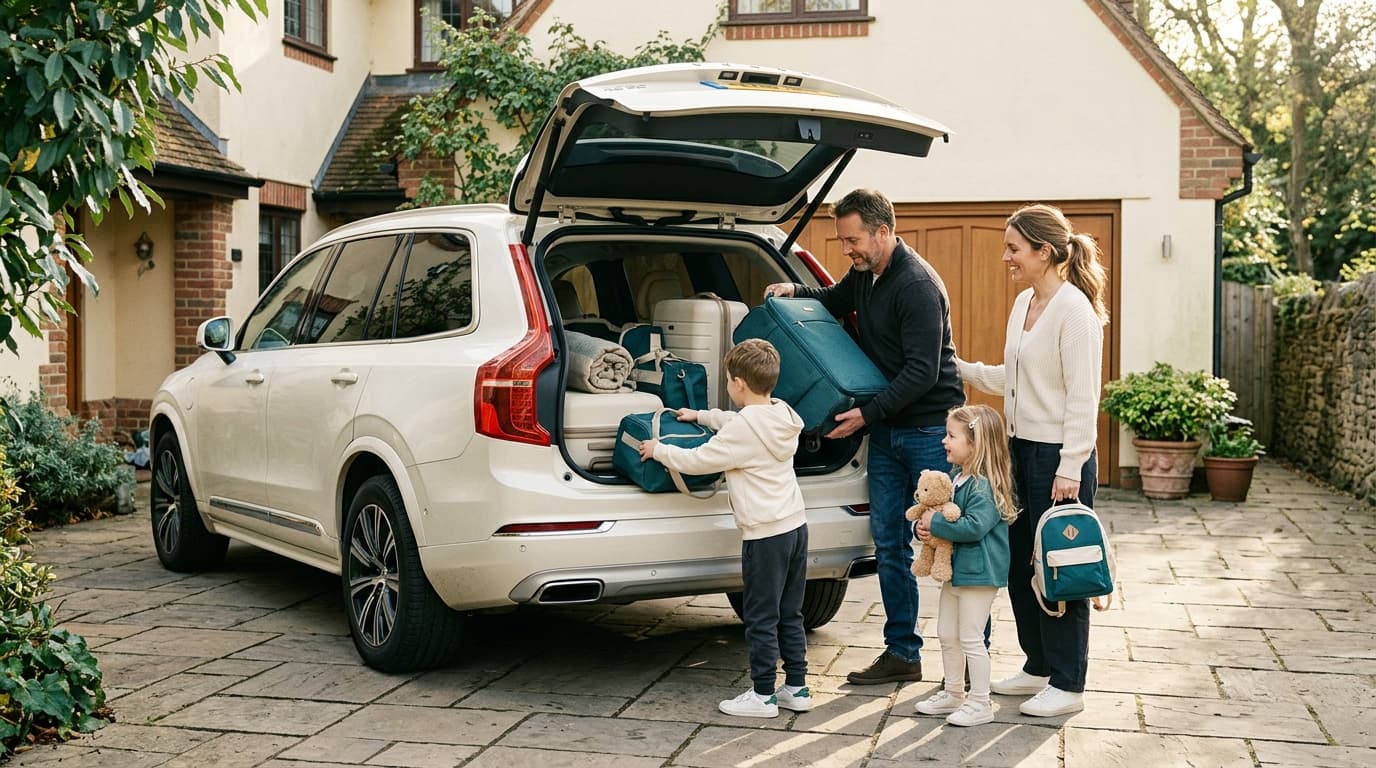
Take Ophélie and Renaud, late thirties, two children aged 4 and 7, a house in the Namur area, about 15,000 km a year. They hesitate over the seven-seat option for two reasons: the occasional car pool to the football club, and the grandparents they pick up two Sundays a month. Look at their year: those two uses add up to around fifteen trips where a sixth seat would help. The rest of the time, they drive with three or four aboard.
With two child seats in the back and a boot to fill every week, what serves them best day to day isn't a third row: it's a big five-seat boot. A Skoda Octavia Combi offers 640 L flat, a Dacia Jogger petrol 708 L. No seven-seat version comes close to those volumes once its seats are up.
How much does the 7-seat option really cost?
It costs you twice. At purchase first: €800 to €1,100 on average, more when the third row only comes on a high trim. A Dacia Jogger goes from €18,990 in five-seat form to €22,790 in seven-seat form (Extreme trim, offres.dacia.be, July 2026), nearly €3,800 apart. Then every day: raised floor, trimmed boot and 40 to 60 kg of extra seats, endured even when the row lies folded.
Here are the figures that count, taken from manufacturer data and road tests published in 2025 and 2026, with indicative prices on the Belgian market in July 2026, excluding options.
| Model | Seats | Boot, third row up | Boot, third row folded | Indicative BE price (Jul. 2026) |
|---|---|---|---|---|
| Skoda Octavia Combi | 5 | — | 640 L | from ~€30,000 |
| Dacia Jogger (petrol) | 5 | — | 708 L | from €18,990 |
| Dacia Jogger | 7 | 160 L | 565 L | from €22,790 |
| Peugeot 5008 | 7 | 259 L | 916 L | from ~€42,000 |
| Skoda Kodiaq | 7 | 340 L | 845 L | from ~€46,000 |
65 L
Boot a Skoda Kodiaq loses even with the third row folded, purely from choosing the seven-seat version (910 → 845 L)
The reading is telling. The cheapest Dacia Jogger, in five-seat form, offers the biggest boot in the table (708 L) for the lowest price. Switch to seven seats on the same model, and the everyday boot drops to 565 L even without using the row, then to 160 L when it's occupied — for €3,800 more. The ratio never flips in favour of seven seats on usable volume. That is exactly what our MPV or 7-seater SUV comparison already showed: the five-seat champion becomes the tightest at seven.
How often does the third row really get used?
This is the question that settles it, and no one asks it at the dealership. Do the count over a real year: how many times will you drive with six or seven on board? For most families with two children, the answer sits between ten and twenty trips — holidays, outings with cousins, a club car pool. The rest of the year, the two extra seats travel empty.
What we'd avoid: paying for an option and enduring a daily penalty for a need measured in days per year. For Ophélie and Renaud, the fifteen or so "six-up" trips of the year don't weigh much against 350 days spent hauling 65 L less boot and a few kilos of unused seats. On the Belgian market, two or three weekend rentals cost less, over five years, than the option paid at purchase and amortised on empty seats.
The maths flips as soon as the third row serves every week: a family of three children, an imposed regular car pool, shared custody with extra children. There, seven seats stop being a comfort option and become the baseline need.
Does a 7-seater use more fuel day to day?
A little, in two ways. The seven-seat version of a model adds 40 to 60 kg that weigh on consumption even when empty. Above all, the seven-seaters on sale are mostly large SUVs, taller and heavier than an estate or leisure van: the gap then comes from the size as much as from the row. Over 15,000 km a year, that adds up to a few hundred euros of extra fuel.
Can you rent a 7-seater for the holidays?
Yes, and it is often the most rational calculation when the need is seasonal. A week's rental of a large MPV or seven-seater runs around €400 to €700 in Belgium depending on the period. Two or three rentals over five years come to less than the seven-seat option, while letting you drive light the rest of the year. You fit the size to the need, rather than the other way round.
Which model to choose, in 5 or 7 seats, in Belgium?
If five seats are enough, target boot and budget: a Dacia Jogger petrol (708 L, from €18,990) or a Skoda Octavia Combi (640 L) serves you better day to day than any seven-seater with its third row up. If seven seats are a genuine weekly need, choose between the leisure van and the SUV.
The leisure van wins on price and volume. A seven-seat Dacia Jogger or a Citroën Berlingo offers a flat floor, three real seats in row two and a more accessible third row, for €15,000 to €20,000 less than a seven-seat SUV. The model-by-model prices are in our ranking of a cheap 7-seater MPV, and the leisure-van shootout in our Berlingo, Rifter and Combo comparison.
The 7-seat SUV, meanwhile, is justified mainly by the driving position, the trim and the image — not by a gain in usable seats. At equal family use, it costs more at purchase, at the pump and in boot space. The Peugeot 5008 remains the most versatile of the group thanks to its three real Isofix seats in row two, but its seven-seat boot (259 L) works no miracles.
Five seats, a big boot and the odd rental cover the life of most families with two children without paying for an option every day. Count your real seven-up trips, then decide with our family car comparator or our guide to the best family MPV.
Comparateur Monospaces & ludospaces
Compare tous les monospaces & ludospaces côte à côte.
Comparer maintenant →
Frequently asked questions
Audrey teste des familiales depuis 2015, maman de deux enfants, basée à Wavre. Elle installe vraiment les sièges Isofix avant de juger l’habitabilité et calcule le budget sur cinq ans, carburant et entretien compris. Sa boussole : peut-on y mettre deux sièges-auto et les courses sans jouer à Tetris ?