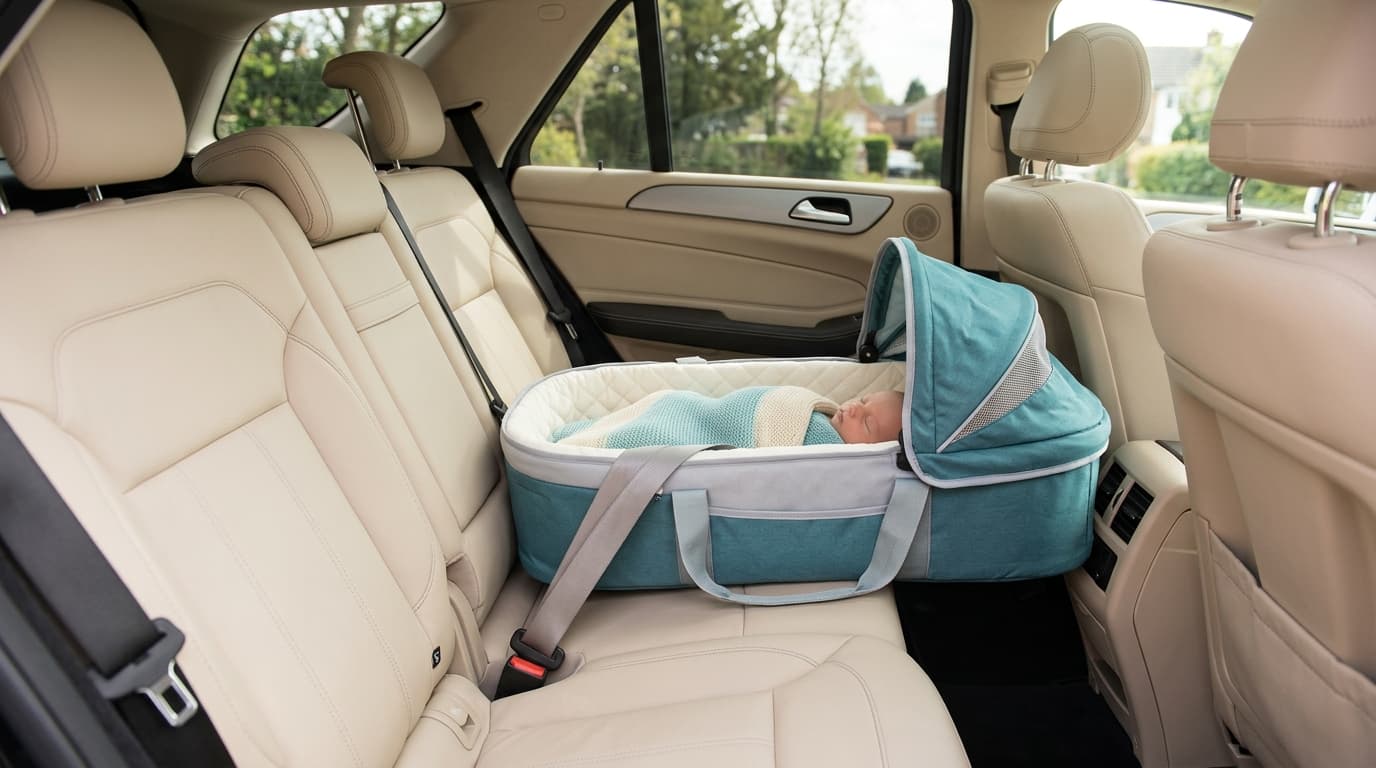
A carrycot for the long drives of the first few weeks, an infant carrier for everything else. The real arbiter is neither of them: it is your rear bench. An approved car carrycot measures 82.4 cm, lies across the seats and eats two of them. With an older child already strapped in beside it, the arithmetic decides before you do.
Infant car seat or carrycot: which one should you choose?
The infant carrier in the vast majority of cases. The carrycot when the journey runs beyond two or three hours in the first weeks, when a paediatrician has asked for one, and when the bench can physically take it.
Nursery websites frame this as a question of the baby's comfort. That is the wrong end of it. Both devices are approved, both protect, and the real decision turns on three numbers: how long the object is, how many seats it swallows, and how many months it stays usable.
| Criterion | i-Size infant carrier | R129 car carrycot |
|---|---|---|
| Baby's position | semi-reclined, around 45° | flat, 180° |
| Height range covered | 40 to 85 cm depending on model | 40 to 75 cm (Joie Calmi) |
| Footprint | one seat, facing the direction of travel | 82.4 cm, across the bench |
| Seats occupied | 1 | the equivalent of 2 |
| Fitting | Isofix base or belt, depending on approval | Isofix base only |
| ADAC score on record | 1.8 (Maxi-Cosi Pebble S + FamilyFix S, spring 2025) | 2.2 (Joie Calmi R129) |
| Belgian price checked 30/08/2026 | varies by model and base | €278.90 plus €129.00 for the base |
| Real service life | 15 to 18 months | 9 to 12 months |
A carrycot takes two seats, not one
A car carrycot does not sit like a seat. It lies across the bench, at right angles to the direction of travel, with the baby's head towards the middle of the car. That is exactly what makes it interesting in a side impact, and exactly what makes it bulky.
The Joie Calmi R129 measures 82.4 cm long by 44.8 cm wide, hood up or down, and weighs 3.6 kg. It fits only on an i-Base Encore or i-Base lx 2, never on a seatbelt, and Touring puts it plainly: an approved carrycot needs the equivalent of two seats on the rear bench.
The figure that counts: 82.4 cm on a bench that rarely offers more than 130 usable centimetres between the door trims. That leaves around forty centimetres for everything else. A group 1/2/3 seat, the one a four-year-old sister is sitting in, takes between 44 and 47 depending on the model. You can see the problem coming, and it does arrive, because the two objects cannot share three seats.
Then add the Belgian rules, which give no ground. Article 35 of the highway code requires an approved restraint for any child under 1.35 m, the on-the-spot fine is €174 per unprotected child, and Moniteur Automobile points out that the rule is federal: identical in Wallonia, Brussels and Flanders. There is no regional tolerance here, no exemption for a short trip, none for the drive home from the maternity ward.
Why does the flat position change anything?
Because a newborn held semi-reclined breathes less well, and it has been measured.
Research commissioned by the British charity the Lullaby Trust and carried out in Bristol placed infants, both term and preterm, in a seat inclined at 40 degrees for thirty minutes, with the vibration of a car journey. The result: heart rate and breathing rate up, oxygen saturation down, with desaturations judged clinically significant. The effect is sharper in preterm babies, but it shows up in term babies too. A cross-sectional study published in Archives of Disease in Childhood had already documented cardio-respiratory abnormalities in preterm infants placed in car seats.
That is where the two figures repeated everywhere without explanation come from: thirty minutes at a stretch under three months, two hours maximum afterwards. They are not laws. No Belgian roadside check will ever look at them.
They are physiological thresholds, and they do not say "buy a carrycot". They say "take the baby out of the shell and lay them flat again". A motorway services and ten minutes do what €407.90 of equipment does on your behalf.
Crash tests favour the infant carrier
ADAC, still the harshest child seat test bench in Europe, scores the Joie Calmi R129 at 2.2. In the spring 2025 round, the Maxi-Cosi Pebble S paired with its FamilyFix S base scores 1.8. On this scale, lower is better.
The gap is real but modest, and the two verdicts do not come from the same test session: this is not a head-to-head. The protocol detail is published by ADAC, which weights frontal impact protection heavily. That is precisely where the lying position loses ground, and where the semi-reclined shell, with its wrap-around headrest and five-point harness, absorbs better.
The other way round, a carrycot puts the baby's head in the middle of the cabin, well away from the door. In a side impact, that geometry works in its favour.
How much does an approved carrycot cost in Belgium?
€407.90 including the base, for nine months of use.
On 30 August 2026, the Joie Calmi car carrycot is listed at €278.90 at Babylux, in four colours. The i-Base LX 2, without which it does not attach to anything, appears at €129.00 on the same site. Total: €407.90. The carrycot covers 40 to 75 cm, which the manufacturer's spec sheet puts at birth to around twelve months, and considerably less in practice once the child starts sitting up.
Spread over nine months of real use, that is €45 a month for an object many families will fit three or four times. The infant carrier covers 40 to 85 cm, lasts fifteen to eighteen months, clips onto the pushchair, and sits on a single seat.
Before ordering, five things to check in your own car, tape measure in hand:
- The usable width of the bench, measured between the door trims at seat-cushion height, not up at window level.
- Two Isofix anchor points side by side, or a central Isofix position if your car has one.
- Whether the base is approved for your car: every maker publishes a vehicle list, and that list decides, not the salesperson.
- The room left for the older child's seat, if there is one, by measuring the width of the seat they use today.
- Headroom and door aperture, because an 82.4 cm carrycot is awkward to manoeuvre through a narrow opening.
Three weeks before the birth, Élise measured her bench
Élise and Rémi, both in their thirties, live near Tournai in Wallonie picarde (the western tip of French-speaking Belgium), cover 12,000 km a year in a compact MPV and are expecting their second child. Their daughter is four and already sits in a group 1/2/3 seat behind the passenger. The baby list mentioned a car carrycot, a gift from the family.
Rémi got out a tape measure one Sunday afternoon. Usable bench: 128 cm. The older girl's seat: 45 cm wide overall. That leaves 83 cm, within half a centimetre of the carrycot's length, before counting the clearance needed to clip the base in and close the door.
They dropped it, and swapped the line for an infant carrier. The drive home from the maternity ward takes twenty-two minutes. The question of time spent in the shell never even arose.
It nearly always ends this way, and nobody says so in the nursery aisles: the carrier-versus-carrycot debate is settled in the car, long before it is settled in the shop.
Does a newborn need an insert?
Only the one supplied with the seat, by the maker of that seat, for that exact model.
This is one of the most common questions new parents ask, and one of the worst served. A 2.8 kg baby visibly floats in a shell, the urge to add a cushion is hard to resist, and the market is full of universal inserts. None of them is approved with your seat. Anything slipped between the child and the harness changes how the straps sit and how the device behaves in a crash. The Calmi comes with its own removable head and body supports, and Maxi-Cosi, Cybex, Britax Römer and BeSafe do the same on their shells: those inserts, and no others. When in doubt, the seat's manual settles it.
And on the drive to the holidays?
A three-month-old between Tournai and the Ardèche means eight hours on the road and roughly ten stops. A carrycot does not change that arithmetic: it eases the constraint of the position, not the constraint of the journey. Plan to take the child out every ninety minutes, lay them flat on a mat, and set off again. We have put figures elsewhere on what a loaded family car really consumes on that kind of run south.
Get the tape measure out before the chequebook. To check bench width and the number of Isofix positions on your next family car, use our comparison tool, our guide to rear-facing car seats and our take on five seats or seven.
Comparateur Monospaces & ludospaces
Compare tous les monospaces & ludospaces côte à côte.
Comparer maintenant →
Frequently asked questions
Audrey teste des familiales depuis 2015, maman de deux enfants, basée à Wavre. Elle installe vraiment les sièges Isofix avant de juger l’habitabilité et calcule le budget sur cinq ans, carburant et entretien compris. Sa boussole : peut-on y mettre deux sièges-auto et les courses sans jouer à Tetris ?