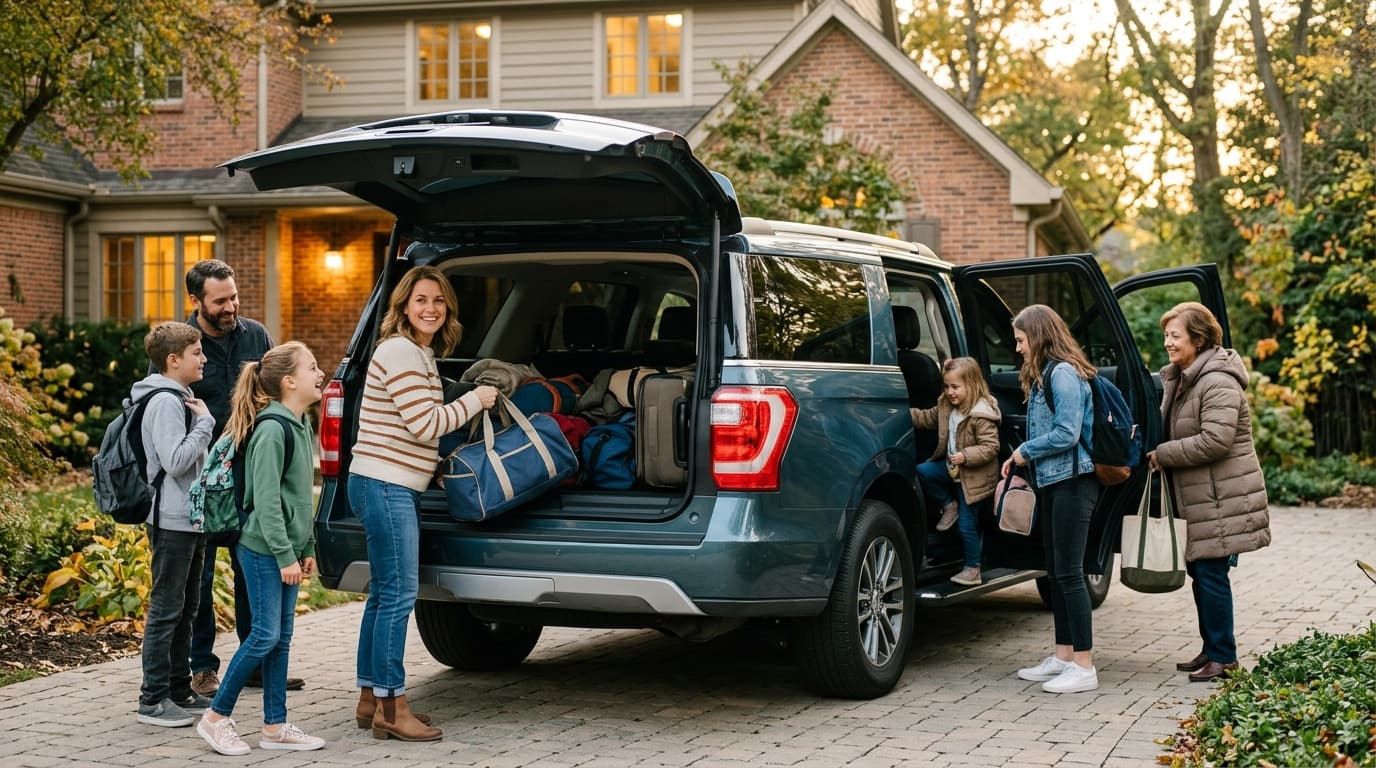
A cheap 7-seater family car in Belgium is almost always a trade-off between a new Dacia Jogger at 18,590 € and a roomier but older used car. The real trap isn't the purchase price, it's the boot that collapses once the third row is up. Figures in hand.
Which cheap 7-seater family car should you choose in Belgium?
To stay under 20,000 €, the Dacia Jogger ECO-G is the only genuinely affordable new seven-seater, from 18,590 €. Below that, you have to go used: the Dacia Lodgy, Volkswagen Touran or Peugeot 5008 offer more room for the same budget, provided you avoid the diesel banned from city centres.
A seven-seater is a vehicle with a third row of two seats, on top of the usual five. In practice, on the Belgian market, that third row comes in two forms: real MPV or leisure-van seats, usable by adults on short trips, or fold-out jump seats reserved for children. The distinction changes everything, and the price follows.
Take Sébastien and Aurélie, 42, a blended family near Namur: the equation is typical. Four children in all under shared custody, but rarely all together. They only need the seven seats two weekends a month. Before paying for a third row, the first question to settle is therefore the real number of seven-up trips.
Should you buy your 7-seater new or used?
Used is almost always more rational for a seven-seater, because this segment depreciates hard: 30 to 40 % over three years. New only holds up for the Dacia Jogger, already unbeatable at list price, and for the long warranty.
The reasoning lies in the very nature of these cars. MPVs and large family SUVs lose value fast because the used market is full of them and families move on as soon as the children grow up. A three-to-five-year-old Peugeot 5008 or Volkswagen Touran often trades around half its new price, for a proven drivetrain and full equipment.
The number that matters: a new Dacia Jogger starts at 18,590 € incl. VAT in seven-seat form (Dacia.be, July 2026), whereas a recent used 5008 runs between 18,000 and 24,000 €. So at equal budget, you choose between a new car that's tight on boot space and a roomier used one with mileage. What we'd avoid: paying the new price for a premium MPV that will shed several thousand euros in its first year.
Five cheap 7-seaters compared
Here are five seven-seaters available in Belgium, from the cheapest new to the roomiest used. Budgets are indicative ranges recorded in July 2026, excluding options and incentives, to refine by trim, engine and mileage.
| Model | 7-seat boot | Market | Engine | BE budget |
|---|---|---|---|---|
| Dacia Jogger ECO-G | 160 L | New | Petrol/LPG | from 18,590 € |
| Dacia Lodgy | 207 L | Used | Petrol/diesel | ~8,000-13,000 € |
| Volkswagen Touran | 137 L | Used | Petrol/diesel | ~14,000-20,000 € |
| Peugeot 5008 | 237 L | Used | Petrol/diesel | ~18,000-24,000 € |
| Citroën Berlingo (7 st.) | 322 L | New | Petrol/diesel | from ~30,000 € |
160 L
The boot left in a Dacia Jogger in seven-seat mode: barely a cabin suitcase, once the third row is up
The reading is clear. The Dacia Jogger dominates the cheap new market, but its 160 L boot in seven-seat mode calls for a roof rack or roof box to travel loaded with seven aboard. The Dacia Lodgy remains the true price floor on the used market, older but sturdy. The Volkswagen Touran and Peugeot 5008 offer the best space-reliability-equipment compromise for a used budget. The leisure van like the Berlingo is the most spacious, with 322 L even with seven aboard, but its new seven-seat price takes it out of the "cheap" category.
How much boot space is really left in a 7-seater?
Far less than the volume quoted in five-seat mode. With the third row up, most compact family cars drop to between 130 and 240 L, the size of one or two cabin suitcases. It's the first figure to check, before even the price.
The boot volume shown on spec sheets almost always refers to the five-seat configuration, rear seats folded or in place. The third row eats most of that volume: the Dacia Jogger goes from 708 L in five-seat mode to 160 L in seven, the Volkswagen Touran from 743 L to 137 L. For a family heading off on holiday with seven aboard, that means a roof box is compulsory.
In practice, for a blended family, the real question is how often you travel with seven. If full trips are rare, a very modular five-seater with a big boot is more useful day to day than a seven-seater whose third row stays folded eleven months out of twelve. The Dacia Jogger has the rare advantage of switching easily from 2 to 5 to 7 seats, with removable third-row seats.
Is there a cheap electric 7-seater in Belgium?
Not really in 2026. Large electric seven-seaters remain expensive to buy, and no regional incentive brings their price below that of a petrol Jogger. The purchase incentive for private buyers has in fact disappeared across all three Regions. An electric seven-seater only makes sense as a company car, where the full tax deductibility reserved for 0 g CO₂ in 2026 reshuffles the deck, or as a recent used car. For a cheap private purchase, the Jogger's LPG bi-fuel remains unbeatable per kilometre.
What traps should you avoid on a used 7-seater in Belgium?
Three traps dominate: the diesel banned from city centres, uncertified mileage, and the mechanical wear of overloaded MPVs. Each can turn an apparent bargain into a money pit.
The first is specifically Belgian. A Euro 5 diesel, common on cheap used 5008s and Tourans, is banned from the low-emission zones of Brussels, Antwerp and Ghent. Buying that kind of engine to drive in town means shutting yourself out of the centre of three of the country's major cities. On a used family car, aim instead for a petrol or a recent Euro 6d diesel, the only one still admitted in the LEZ.
Should you demand the Car-Pass on a used 7-seater?
Yes, every time. The Car-Pass is the official Belgian document that certifies the mileage history of a used vehicle. It is mandatory on resale between private parties and at a dealer, and handing it over is free. A seller reluctant to provide it almost always hides a tampered odometer or missing servicing. On an MPV that has covered a lot of loaded kilometres, also check the clutch, the gearbox and the running gear, whose repair quickly costs several thousand euros.
How many Isofix points in a 7-seater family car?
Usually two Isofix anchor points, on the outer seats of the second row. The third row is only rarely fitted, which limits the number of child seats you can install at once.
For a blended family with young children on both sides, this constraint is decisive. Two Isofix points are enough for two child seats on the second row, but fitting a third young child often means using a standard belt or an i-Size compatible seat elsewhere. The width of the centre seat then matters as much as the number of anchors.
With two child seats in the back, the Dacia Jogger and the Peugeot 5008 cope well thanks to wide, flat second rows. The Volkswagen Touran adds individually sliding rear seats, handy for slotting in a carrycot. Our comparison of cheap seven-seat MPVs breaks down the Isofix layouts model by model, and our guide to a reliable used family car under 15,000 € rounds out the topic for the tightest budgets.
So the real question isn't which seven-seater shows the lowest price, but which one matches how often you travel with seven and your maintenance budget. Measure the boot in full configuration, check the emissions standard, then let the figures speak before the catalogue.
Comparateur Pas chères & occasion
Compare tous les pas chères & occasion côte à côte.
Comparer maintenant →
Frequently asked questions
Audrey teste des familiales depuis 2015, maman de deux enfants, basée à Wavre. Elle installe vraiment les sièges Isofix avant de juger l’habitabilité et calcule le budget sur cinq ans, carburant et entretien compris. Sa boussole : peut-on y mettre deux sièges-auto et les courses sans jouer à Tetris ?