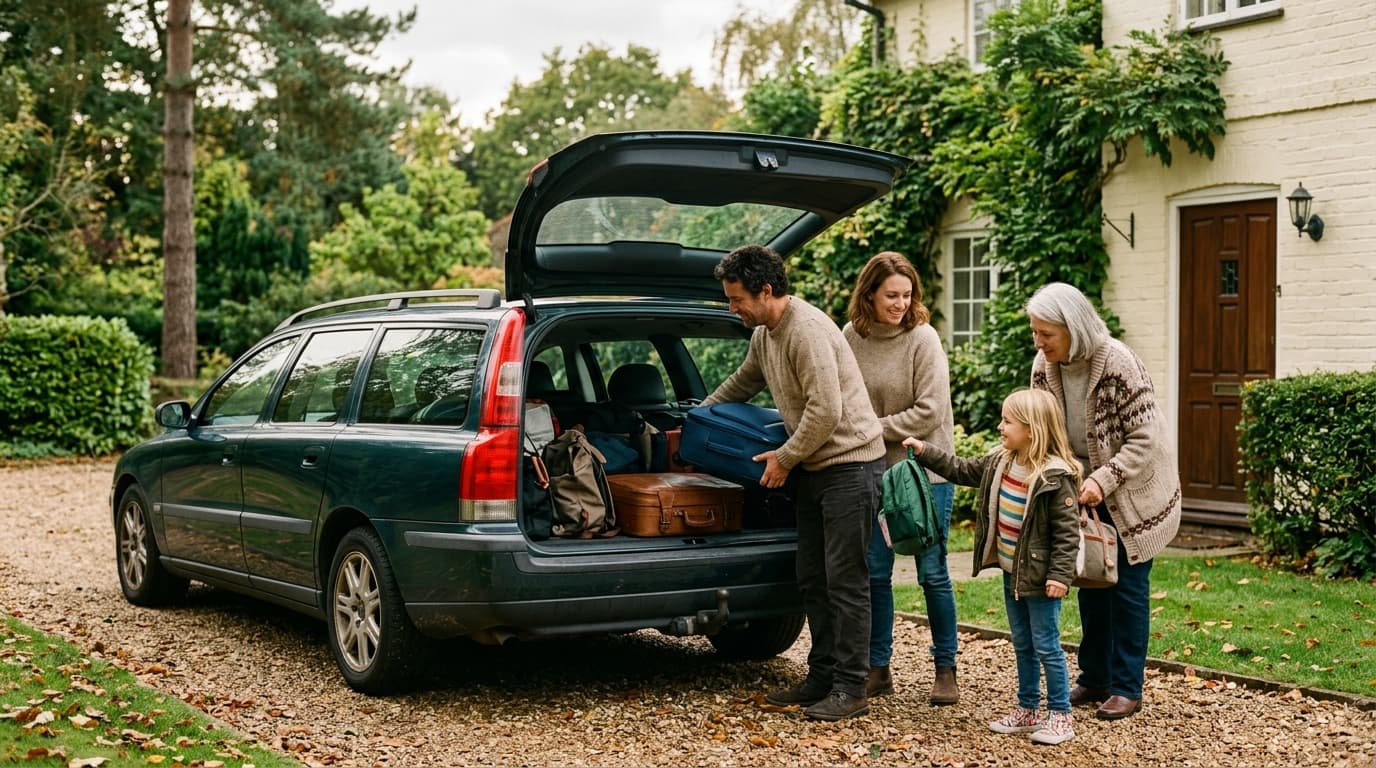
Under €15,000 in Belgium, a reliable large used family car exists, provided you target the right model and above all the right engine. A roomy estate can be found from €12,000, a genuine seven-seater from €7,500. Here are five safe bets, real boot space and mechanical pitfalls in hand.
Which large used family car to target under €15,000?
Under €15,000, three profiles stand out: the Skoda Octavia Combi estate for high mileage, the Dacia Lodgy MPV for seven seats at rock-bottom price, and the Toyota Verso for mechanical peace of mind. The real budget depends less on the model than on the year, mileage and service history.
A large used family car here means a vehicle at least 4.40 m long, five to seven seats, with a boot able to swallow a pushchair and the weekly shopping without playing Tetris. On the Belgian market, this size is found as an estate (Octavia Combi) or an MPV (Lodgy, Grand C4 Picasso, Touran, Verso), rarely as an SUV for this budget.
The figure that counts: on AutoScout24.be in June 2026, a seven-seat Dacia Lodgy starts at €7,500, whereas a clean, recent diesel Skoda Octavia Combi often nears €18,000. In other words, the same €15,000 ceiling buys either a well-equipped large family MPV or an older, higher-mileage estate. Before comparing models, set your priority: volume, seats or mechanical serenity.
Genuine seven-seater or big boot: which for a family of four?
For a family of four, a permanent big boot beats the third row. An estate or a five-seat MPV offers 500 to 640 L usable at all times, while a seven-seater drops below 200 L as soon as the last row is unfolded. The third row only makes sense with a regular fifth passenger.
This is the classic trap of the family segment. A Volkswagen Touran claims 834 L with five seats, but only 137 L once the seven seats are occupied, barely enough for a school bag and two sports bags. The Citroën Grand C4 Picasso drops to 170 L, the Toyota Verso to 178 L. By contrast, the Octavia Combi estate keeps its 610 L in all circumstances.
With two child seats in the back, the real question is the space behind the bench, not the theoretical seat count. For three children or school carpooling, the seven-seater is essential and you accept the reduced boot; for four, the estate stays the most rational choice. Our ranking of cheap family cars breaks down this trade-off budget by budget.
Five large used family cars under €15,000
Here are five models sold everywhere in Belgium, ranked from estate to MPV, with their real boot space and the engine to favour. Prices are ranges observed on Belgian platforms (AutoScout24.be, 2ememain.be) in June 2026, excluding options and depending on mileage.
| Model | Type | Boot | Seats | Engine to target | Belgian budget |
|---|---|---|---|---|---|
| Skoda Octavia Combi | Estate | 610 L | 5 | 2.0 TDI 150 (post-2017) | €12,000–15,000 |
| Dacia Lodgy | MPV | 827 / 207 L | 7 | 1.5 dCi 115 | €7,500–13,000 |
| Citroën Grand C4 Picasso | MPV | 645 / 170 L | 7 | 1.6 BlueHDi | €11,000–15,000 |
| Volkswagen Touran | MPV | 834 / 137 L | 7 | 2.0 TDI | €13,000–16,000 |
| Toyota Verso | MPV | 484 / 178 L | 7 | 1.8 petrol / 2.0 D-4D | €6,000–11,000 |
610 L
Permanent boot of the Skoda Octavia Combi, with no third row to manage
The second figure in the boot column is the volume left when the seven seats are occupied. The reading is clear: MPVs win on seats, the estate wins on everyday usable volume. The Volkswagen Touran, often listed around or above €15,000 for a clean example, partly falls outside the budget; you need to target a slightly older year to stay under the ceiling.
Which engines to target and which to avoid used?
The engine matters more than the model. Target proven diesel blocks (2.0 TDI Volkswagen-Skoda post-2017, 1.6 BlueHDi Citroën, 1.5 dCi Dacia, 2.0 D-4D Toyota) and avoid small wet-belt petrols and automatic gearboxes with no service history, sources of four-figure bills.
The weaknesses are documented and dated. According to user reports compiled by fiches-auto.fr, the pre-2017 Skoda 1.6 TDI suffers from a fragile water pump and rapid urban fouling, whereas the 2.0 TDI 150 that succeeds it fixes these flaws. The 1.2 PureTech petrol of the Grand C4 Picasso, meanwhile, is known for its "wet" timing belt that degrades prematurely. On the Toyota side, no major recurring fault is reported on the Verso, which explains its endurance.
What we would avoid: buying any of these vehicles without an up-to-date service book. A skipped timing belt or gearbox oil change turns a good deal into a money pit.
Should you avoid DSG gearboxes used?
Not always, but with caution. The DSG gearbox of Volkswagens and Skodas requires a strict oil change every 60,000 km, or the mechatronics can fail expensively. On the Touran, some early DSG7 units damaged the clutch as soon as 35,000 km. A DSG with proof of regular servicing stays reliable; without history, prefer a manual gearbox.
Is the 1.2 PureTech reliable?
No, not without reservation. This three-cylinder petrol equips many Citroën Grand C4 Picassos, but its timing belt runs in engine oil and breaks before its time, with a risk of engine failure. If you target a Grand C4 Picasso, clearly favour the 1.6 BlueHDi diesel, more rugged and better suited to heavy family use.
How much does a used family car really cost over five years?
The purchase price is not the budget. Over five years, servicing, fuel, insurance and depreciation often weigh as much as the initial outlay. A Dacia Lodgy and a Volkswagen Touran bought at the same price do not cost the same to maintain, the gap on parts reaching several hundred euros per item.
In practice, for a family, the Dacia Lodgy stays the most economical: cheap parts, simple mechanics, diesel consumption around 4.5 L/100 km. At the other end, the Touran offers better finish but markedly more expensive wear and timing parts. The Toyota Verso sits between the two, with reliability that limits nasty surprises. To compare volumes and new prices of seven-seaters, see our ranking of cheap seven-seat MPVs.
Do you still need a diesel for a large used family car?
Yes for a high-mileage driver, no for urban use. Beyond 15,000 km a year, a well-maintained diesel stays unbeatable on consumption and range, and these blocks routinely exceed 300,000 km. In town and at low mileage, a petrol Verso avoids particulate-filter issues and anticipates the low-emission zone restrictions of Brussels, Antwerp and Ghent.
How to avoid the pitfalls when buying in Belgium?
Three reflexes protect the Belgian buyer: demand the Car-Pass, read the service history and check the warranty. These documents are free and mandatory at a professional dealer; their absence is an immediate red flag.
The Car-Pass certifies the real mileage recorded at every workshop visit, and it is legally handed to every used-car buyer in Belgium. An odometer inconsistent with the Car-Pass betrays fraud. On the warranty side, buying from a professional grants a legal warranty of at least twelve months, where a private sale offers no comparable protection. Test-Achats (the Belgian consumer association) also recommends carefully checking the documents and the real condition of the vehicle before any payment.
The real question is therefore not which model to buy, but which one was properly maintained within your budget. First set your need in seats and boot, then let the documents speak before the seller does.
Comparateur Pas chères & occasion
Compare tous les pas chères & occasion côte à côte.
Comparer maintenant →
Frequently asked questions
Audrey teste des familiales depuis 2015, maman de deux enfants, basée à Wavre. Elle installe vraiment les sièges Isofix avant de juger l’habitabilité et calcule le budget sur cinq ans, carburant et entretien compris. Sa boussole : peut-on y mettre deux sièges-auto et les courses sans jouer à Tetris ?