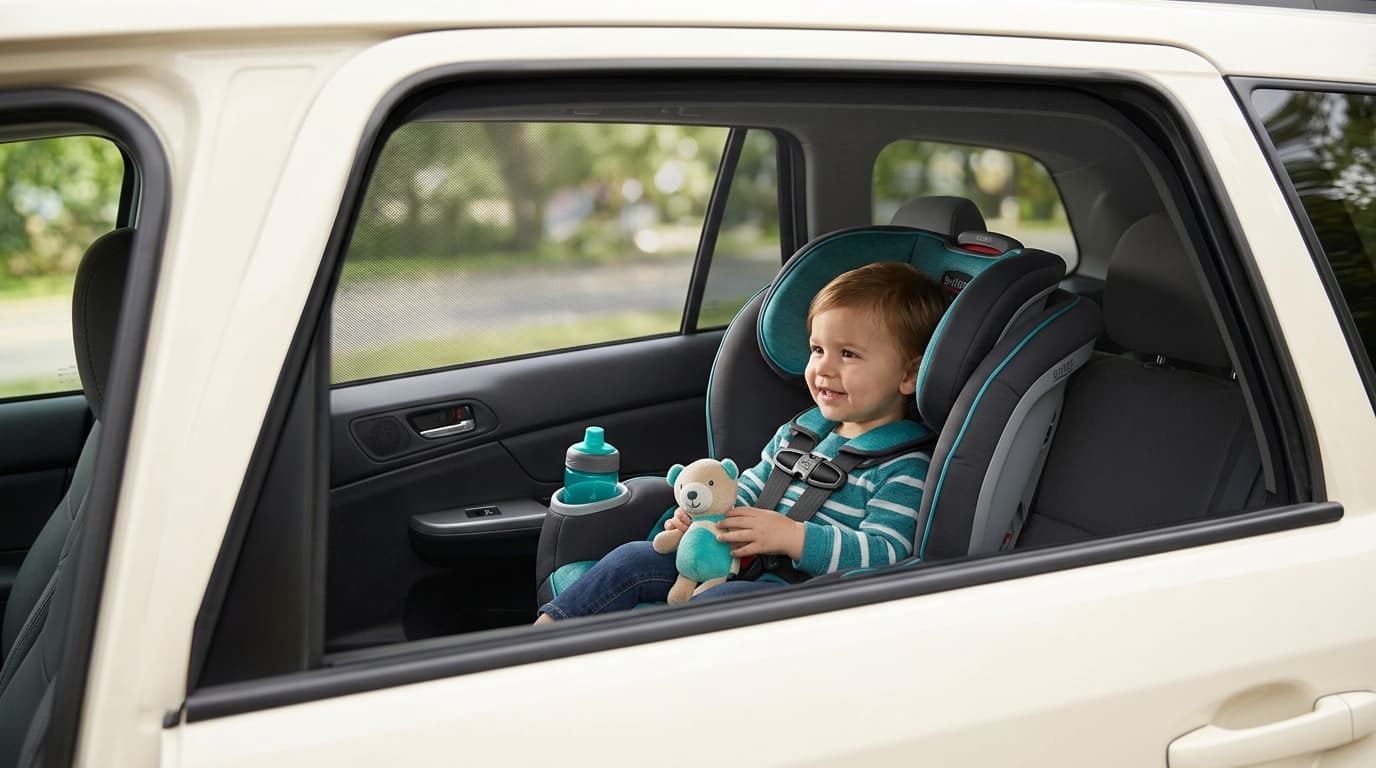
On a rear side window, a sun shade mostly works against direct sun and glare. For ultraviolet, the glass already stops the bulk of it, with wide differences from one car to the next. Three families of product share the shelf, from €4.90 to €24.95, and they are not equivalent.
The rear window lets through nine times more UVA than the windscreen
The number that matters is not the one printed on the packaging.
Across 34 vehicles measured and published in early 2025 in the Archives of Dermatological Research, the windscreen stops an average of 99.25% of UVA. The rear left side window, 93.18%. The gap between those two percentages looks tiny, and it is nothing of the sort: what lands on the child's skin is the transmitted radiation, 0.75% on one side against 6.82% on the other. Nine times more.
The reason sits in the glass, not in the car. A windscreen is laminated, two sheets of glass pressed onto a plastic interlayer that blocks almost all UVA. Rear windows are tempered glass, a single layer, very good at stopping UVB and much weaker on UVA. Touring, the Belgian motoring organisation, puts it another way in its file on tinted windows: rear windows are rarely laminated.
9 times
UVA transmitted by the rear left side window compared with the windscreen, calculated from the mean attenuation rates measured across 34 vehicles and published in 2025
In the twenty-SUV subset of the same survey the gap widens further: 99.12% at the windscreen, 91.84% at the rear left. One oddity the authors themselves cannot explain is that the rear right window does better than the left, 94.66%, which they cautiously put down to variations in glass thickness or tint.
You often read that rear windows filter only 30 to 40% of ultraviolet. The published measurements say something else, and something more troubling. In 2016, JAMA Ophthalmology measured 29 cars from 15 manufacturers: 96% of UVA stopped at the windscreen, 71% on average at the side windows, and a minimum of 44%. Between the best and the worst side window in that sample, transmitted radiation varied by a factor of twelve. No manufacturer publishes this figure model by model, no spec sheet mentions it, and you therefore cannot know your own car's number. That uncertainty, far more than the average, is what justifies a shade on the seat where the child spends the journey.
UVB, on the other hand, is stopped by every window
In the 2025 survey every window measured blocked 100% of UVB, with a single exception in the sample. A child does not get sunburnt behind a closed window. A sun shade is about UVA, direct heat and glare, not about burning.
Suction cup, sock or roller blind: which one stays put?
The sock. It is the only one of the three that depends neither on how clean the glass is, nor on heat, nor on the shape of the pillar.
| Criterion | Suction cup | Stretch sock | Roller blind |
|---|---|---|---|
| Mounting | 2 to 4 cups on the glass | fabric pulled over the whole door | clips or a clamp on the frame |
| Hold in a 30 °C car park | weak point, the cup peels off | no fixing to let go | good, if the clamp bites |
| Glazing covered | the product's own area, no more | whole window, pillar included | adjustable height, fixed width |
| Window still openable | yes | rarely | yes |
| Fitting and removing | one second | a minute, door open | a few seconds |
| Child's view outwards | kept around the product | filtered across the whole window | kept below the blind |
| Price recorded 18/09/2026 | €14.90 (Dreambaby Stretch) | €14.50 for two (Jané) | €13.99 (Ezimoov Ezi Sun Roller) |
Dreambaby's Stretch sun shade, reference G293, measures 68 × 45 cm and holds on suction cups. It folds down and stores away, which counts for more than it sounds. On the rear side window of a family SUV it covers the lower part and the middle, rarely the top of the glazing, and the top is exactly where the sun comes in late in the day.
The sock solves that by wrapping everything, pillar included. It creates another problem: on many cars the window no longer drops. Test it parked, door closed, before heading off on holiday with a system that rules out fresh air.
The roller blind is the compromise. Ezimoov sells its Ezi Sun Roller at €13.99 singly and €19.99 for two, and the principle holds up: you pull the blind down as far as you need, raise it when the sun moves round, and the window stays usable. The constraint comes from the door frame, whose shape decides whether the clamp grips.
The sun shade that goes on the child seat itself
A whole family of products goes not on the window but over the seat shell: canopies, drapes, sun covers. The rule is simple and it admits no exception.
Is a sun shade allowed on every window in Belgium?
On the rear windows, yes, with no opacity limit. On the windscreen and both front side windows, no.
Article 58 of the Royal Decree of 15 March 1968, the Belgian technical regulation for vehicles, governs transparent panels. At the front, no non-original treatment, film or coating is allowed, and opacity may not exceed 30%. At the rear, Touring sums up the rule: the rear screen and the rear side windows may go up to 95% opacity, provided the car has exterior mirrors on both sides. The rule is federal, so identical in Wallonia, Brussels and Flanders, and the roadworthiness test applies it the same way in Namur, in Anderlecht and in Hasselt.
A removable shade is not a film, and nobody will fine you for an accessory on a rear window. At the front the question does not even arise: that is where your side field of vision sits, and the children are behind you. The only tolerance on the windscreen is a sun strip, provided it does not reach lower than your interior visors when folded down.
An approved film costs €200 to €800, plus €4 to €8 at every roadworthiness test
Touring puts professional film fitting on the rear windows at €200 to €800, depending on the vehicle and the treatment. Film brings two things fabric does not: it never comes off, and it reinforces rear glazing that is almost never laminated. It also costs a roadworthiness supplement of €4 to €8, introduced in 2010 for modifications made after the vehicle was built.
Set that against the cheapest thing on the shelf, a two-pack of Jané shades at €4.90. The film comes to forty times the fabric in its cheapest form, and more than a hundred and fifty times in its dearest. For three summers of use with a child who will then outgrow it, the sum is quick.
From €4.90 to €24.95 on the same day, in the same aisle
A factor of five for two sun shades, from the same seller, at the same hour.
Recorded on 18 September 2026 on the Belgian sun shade page at L'Armoire de Bébé, a nursery retailer: Jané at €4.90 for two, Ezimoov Ezi Sun Stoppers electrostatic at €9.98 for two, Ezimoov Ezi Sun Roller at €13.99, Jané socks at €14.50 for two, Dreambaby Stretch at €14.90, Dreambaby socks at €17.99 for two, Ezimoov Ezi Sun Socks at €19.99 for two, BeSafe at €24.00 for two with a storage bag, Konges Sløjd at €24.95 for two.
The twenty euros between the extremes buy a denser fabric, a finish, a bag. They do not buy a certified UPF rating, which almost none of those sheets publishes, and which is the only figure that would let you compare two fabrics.
Five things to check before ordering, and none of them depends on budget:
- the real dimensions in centimetres, measured on your own window, rather than the word 'universal';
- the mounting method set against one precise use, a window you lower in summer;
- a stated UPF figure, not a plain 'anti-UV' label;
- whether the thing folds or rolls away, because otherwise it lives under the rear bench within a month;
- the stiffness of the frame, because a rigid object that does not store away becomes one more loose object in the cabin.
In a car park, a sun shade does not bring the temperature down
Here is the service it does not provide, and it is better known before you buy one.
Sarah and Nicolas live in Nivelles, in Walloon Brabant just south of Brussels, have two children of ten months and four years, a family SUV and 15,000 km a year. On Saturday mornings Nicolas stops at the bakery in the town centre with the little one asleep in the back. Five minutes, rear windows fitted with socks, car in the shade of a plane tree. He assumes the shades are doing part of the work.
They are doing none of it. The reference measurement remains the one published in July 2005 in Pediatrics by Catherine McLaren, Jan Null and James Quinn: sixteen sunny days, outside temperatures from 22 to 36 °C, and an average rise of 22 °C inside the cabin within one hour. Two thirds of that rise lands in the first twenty minutes, 80% in the first thirty. The researchers also tested windows cracked open by 4 cm: the effect is negligible.
80%
Share of the temperature rise that happens in the first 30 minutes inside a car parked in the sun, from the measurements published in Pediatrics in July 2005
A fabric shade deals with direct radiation on one side window. The greenhouse effect comes overwhelmingly through the windscreen, which stays uncovered, and through the bodywork. Nothing sold on a shelf changes that physics. A child is never left alone in a parked car, shade or no shade, sun or shadow, five minutes or one.
Do you need a shade if the rear windows are already privacy glass?
Less, but not none.
Factory privacy glass is tinted through the mass, type-approved, and can reach 95% opacity without troubling the roadworthiness test at all. Opacity is measured in visible light: it settles glare and privacy, not necessarily ultraviolet. The vehicles in the 2025 survey included factory-tinted glazing, and the rear average still sat at 8% of UVA transmitted on the SUVs. An athermic windscreen does filter infrared and ultraviolet properly, but that is a different product, and it sits at the front.
Measure the window before ordering, treat the seat handbook as the only reference for anything touching the shell, and put the shade away in autumn rather than letting it roll around under the bench. The rest of the kit is best planned with our comparison tool, keeping an eye on the child with our guide on the baby car mirror, and the choice of device itself with the one on infant carriers and carrycots.
Comparateur SUV familiaux & 7 places
Compare tous les suv familiaux & 7 places côte à côte.
Comparer maintenant →
Frequently asked questions
Audrey teste des familiales depuis 2015, maman de deux enfants, basée à Wavre. Elle installe vraiment les sièges Isofix avant de juger l’habitabilité et calcule le budget sur cinq ans, carburant et entretien compris. Sa boussole : peut-on y mettre deux sièges-auto et les courses sans jouer à Tetris ?