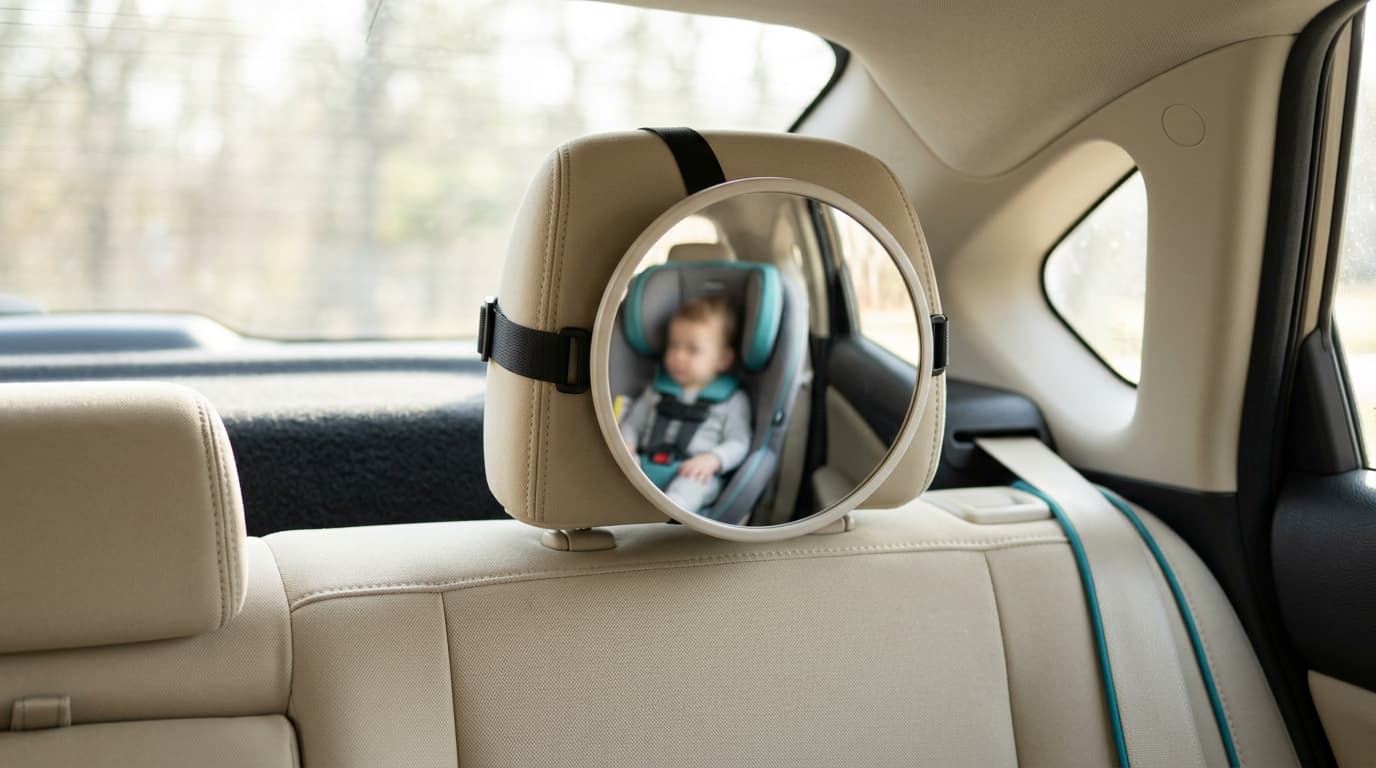
No European standard approves a baby car mirror. The child seat is type-approved; the mirror facing it is not. It is still useful, on one condition: strap it to the rear headrest without touching your interior rear-view mirror, which Belgian traffic law requires you to keep working.
No approval standard covers a baby mirror
There is no regulation for this object. No dedicated European standard, no compulsory marking, no body in charge of checking it.
The two texts parents know, R44 and R129 (i-Size), govern child restraint systems. The seat, its shell, its harness, its anchor points. A mirror strapped to a headrest falls into none of those categories: it restrains nothing, carries nothing, and European lawmakers have simply never dealt with it. It sits under the general product safety regime, the one that covers a desk lamp or a coat hook.
Diono nonetheless prints 'crash tested' on the official spec sheet of its Easy View. The wording is accurate in the sense that the maker put its product through a test. It points to no public protocol, no stated threshold, no third-party verification. Nobody can tell you at what speed, on which sled, against which pass mark. Compare that with a child seat, whose orange label carries an approval number, an issuing country and a verifiable height range: the gap in rigour is complete.
Is a baby car mirror dangerous in a crash?
Strapped to a headrest in the raised position, no. Propped, stuck or wedged, yes, and the figure is worth pausing on.
Heinz-Gerd Lehmann, an engineer at the ADAC (the German motoring organisation), puts the forces developed by a loose object inside a cabin during an impact at 30 to 50 times its own weight. The official Diono Easy View sheet gives 0.6 lb, that is 272 grams, for 19.1 × 19.1 × 5.6 cm. Do the multiplication: a mirror the size of a side plate represents 8 to 13.6 kg thrown towards the front of the car. Nothing anecdotal.
8 to 13.6 kg
Force developed by a badly fitted 272 g Diono Easy View mirror in a crash, applying the 30-to-50 factor the ADAC uses for loose objects inside the cabin
The good news is that strap mounting settles the question. Reer states for its BabyView LED that the fixing relies on adjustable tension straps, no tools needed, universal on any vehicle with headrests. Tighten them, push the mirror with a finger: if it pivots on its ball joint but does not travel, you are done. If it slides down the post, start again.
What if the headrest has been removed?
Many rear-facing seats require the rear headrest to come out so the seat can sit flat against the backrest. The seat handbook says so, and so does the car's. No strap-mounted mirror survives that configuration, and there is no acceptable workaround: not a cable tie around the post, not an improvised mount on the centre belt. The mirror then goes on the headrest of the neighbouring seat, at a poorer angle, or you do without. The seat installation rule always wins over the accessory, and the same logic applies to anything slipped between the child and the harness.
Your interior mirror pays the bill
Nobody writes this paragraph, and it is the one that decides whether the mirror is worth anything.
A baby mirror is never looked at directly. It sends the baby's image forward, and you pick that image up in your interior rear-view mirror. For the optical path to work, the two mirrors have to see each other. In a low saloon the alignment sometimes happens by itself. In a family SUV, where the rear cushion sits high and the headrest is far back, the angle almost never falls right, and the reflex is immediate: you tilt the interior mirror a few degrees down towards the back seat.
At that exact moment, your rearward view is gone.
Lore and Bram live near Ostend, on the Belgian coast, have a first baby of five months and drive the E40 to Brussels three times a month. They bought a mirror because the maternity ward had one on its list. Nobody told them they were buying an unregulated accessory. Nobody told them either that in their SUV the child seat headrest sits more than a metre and a half from the interior mirror, a distance at which the baby's image only lands properly once the central mirror has been tipped a few degrees downwards. Bram has driven like that for four months, convinced he did the right thing.
Article 8.3 of the Belgian highway code is explicit: the driver must have constant control of the vehicle, and neither their freedom of movement nor their field of vision may be reduced. An interior mirror aimed at a child seat no longer shows the rear screen. The blind spot this creates is the one the car overtaking you on the Ostend ring road arrives from. The offence, if it is recorded, is first degree: €58 on the spot, on the scale published by the federal police. Nobody will pull you over for it. An insurer, on the other hand, will look at where your mirrors point after a rear-end collision.
The real gain from the mirror is measured differently, and it is larger than people assume. Physically turning round to check an infant takes about three seconds: Vias (the Belgian road safety institute) measures that at 90 km/h those three seconds are 75 metres covered during which the driver cannot react, and notes that taking your eyes off the road for more than two seconds multiplies crash risk by seven (Distraction dossier). A glance at the mirror, timed like an ordinary mirror check, stays under one second. At 120 km/h on the E40, the gap between the two moves is worth 67 metres of road actually watched at every check. That is a lot, and it is exactly what you lose if the mirror is badly aimed and you end up turning round anyway.
The €7.99 mirror almost nobody buys
Reer sells a second mirror whose only job is to resolve that conflict: the ParentsView, €7.99 in the manufacturer's catalogue, sticks next to the original interior mirror. The optical path runs through it, and the central mirror stays set on the rear screen. The maker writes it out on its own BabyView LED page: pairing the two lets you avoid moving your rear-view mirror at all.
It is the cheapest item in the whole range. It is also the one nobody talks about, because it does not photograph well and shows nothing sweet on a shelf. Of the eight references I recorded, it is the only one whose product page discusses the driver's mirror rather than the baby's comfort, and it costs about the price of a pack of nappies.
From €11.50 to €79.95 for the same function
A factor of seven. That is the gap between the entry price and the top-end monitoring screen, checked on 3 September 2026 in the car mirror aisle at bol.com, a Belgian retailer.
| Product checked 03/09/2026 | Function | Price |
|---|---|---|
| Clear View Baby Safety Mirror | plain strap-on mirror | €11.50 |
| Baby Adjustable car mirror | adjustable mirror | €14.95 |
| Reer BabyView (maker's catalogue) | convex mirror, 29 × 20 cm | €19.99 |
| Reer BabyView LED (maker's catalogue) | convex mirror + LED + remote | €26.99 |
| Babyvoo with rechargeable light | mirror + rechargeable LED | €34.95 |
| Lucellia 4.3-inch monitor | camera + 1080p screen | €69.95 |
| ProRide Baby Auto Monitor 7-inch | camera + HD screen, night vision | €79.95 |
| Reer ParentsView (maker's catalogue) | secondary mirror by the rear-view mirror | €7.99 |
The three Reer lines are the manufacturer's catalogue prices; the other five are prices shown by the Belgian retailer on the same day.
The €68 between the two extremes buy not one gram of extra safety. They buy a light, a screen and a cable. The €11.50 mirror and the €34.95 one rest on the same optics, the same shatterproof plastic and the same strap.
Five criteria are enough to decide, and none of them is the brand:
- a convex surface at least 17 cm across its widest dimension, or you will only ever see part of a forehead;
- a ball joint rather than a simple hinge, because the angle has to be set in two planes and never in one;
- buckled tension straps that adjust to headrest posts of different diameters;
- an acrylic or stated shatterproof plastic surface, never glass;
- a sensible weight, and on that point the manufacturer's spec sheet is the only reliable document.
Should you get a camera instead of a mirror?
No, and the argument fits in one word: screen.
A camera wired to a 4.3-inch or 7-inch monitor on the dashboard gives a sharper picture than a convex mirror, especially at night. It also adds a permanently lit screen inside the driver's field of vision, and with it the long glances, the brightness adjustments and the trailing cables. Vias ranks the moves that force a driver to look away and operate a device among the most crash-prone of all.
The mirror has one property a screen does not: you consult it like a rear-view mirror, with an eye movement that is already automatic, without a harsh change of focus. A monitor demands accommodation, reading, interpretation. The extra time per glance is modest, and it repeats at every check on a run to the coast.
One case still argues for the camera: two rear-facing children in a large family car, an older one behind the driver and an infant in the centre, a layout no single mirror frames. There the screen is a rational answer rather than a gadget.
Does the mirror still help once the child faces forward?
Barely. A forward-facing child is visible in the interior mirror with no accessory at all, and most families take the mirror out within a month of turning the seat round. Given that safety bodies recommend keeping rear-facing until around 105 cm, the useful life of a mirror runs well beyond the few months of an infant carrier, which makes the purchase easier to defend than it looks. The same reasoning applies when choosing between an infant carrier and a carrycot: the constraint always comes from the car, not from the baby.
Three situations where the mirror is useless
A child sitting forward-facing. A headrest removed on the handbook's orders. A trip with an adult in the back, which remains the best supervision ever invented.
In those three cases the mirror clutters without adding anything. And if the baby cries, no mirror replaces a stop at a service area: you do not comfort an infant while driving, and the object only ever helps you decide whether the stop is needed.
A properly strapped mirror and an untouched rear-view mirror beat an €80 screen. Check where your headrest sits before ordering, tighten the straps until the mirror resists a finger, and keep your central mirror on the rear screen. The rest of the kit is best planned with our comparison tool, and the seat installation itself with our guide on the support leg.
Comparateur SUV familiaux & 7 places
Compare tous les suv familiaux & 7 places côte à côte.
Comparer maintenant →
Frequently asked questions
Audrey teste des familiales depuis 2015, maman de deux enfants, basée à Wavre. Elle installe vraiment les sièges Isofix avant de juger l’habitabilité et calcule le budget sur cinq ans, carburant et entretien compris. Sa boussole : peut-on y mettre deux sièges-auto et les courses sans jouer à Tetris ?