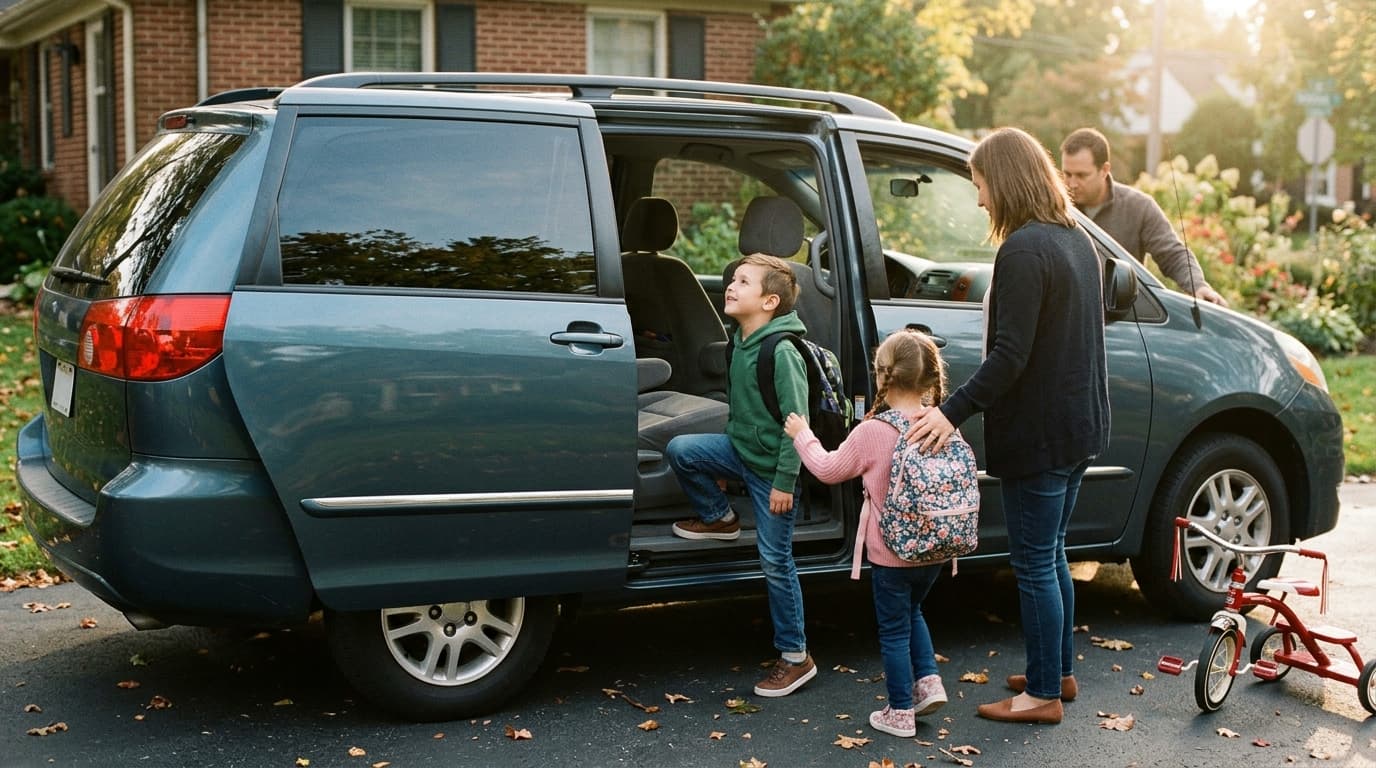
The Ford Tourneo Connect and the Volkswagen Multivan make the same promise — seven seats, two sliding doors, a real boot — at prices that run from single to double in Belgium. Here is what that €29,000 actually buys, and the industrial detail that changes how the question should be asked.
Multivan or Tourneo Connect: which one for a family?
The Grand Tourneo Connect if you want seven seats and two sliding doors at the best price. The Multivan if you regularly carry seven people and their luggage, or if sliding individual seats on rails genuinely earn their keep. Between them, nearly €29,000 on the Belgian price list.
Take Fanny and Antoine, late thirties, three children aged 5, 9 and 12, a house near Waremme in the Hesbaye and 22,000 km a year. At weekends they drive two neighbourhood kids to hockey on top of their own, sticks and kit bags included. Their budget runs from €30,000 to €55,000, which lands them squarely between the two vans. Their real question isn't "which is better" but "what am I paying extra for, and how often does it serve me".
| Criterion | Ford Grand Tourneo Connect | Volkswagen Multivan |
|---|---|---|
| BE list price (August 2026) | from €27,010 | from ~€56,000 |
| Boot, seven seats in use | 322 L | 469 L (short) / 763 L (long) |
| Maximum boot, seats removed | ~3,100 L (2 seats) | 3,672 L (short) / 4,005 L (long) |
| Sliding side doors | 2 | 2 |
| Quoted electric range (plug-in hybrid) | 119 km | 95 km |
| Euro NCAP | 5 stars (2022 protocol) | 4 stars (2025 protocol) |
€28,990
List-price gap between a Ford Tourneo Connect (from €27,010) and a Volkswagen Multivan (from ~€56,000), Belgium, August 2026
Why is the Ford Tourneo Connect a Volkswagen?
Because it is one, literally. The current Tourneo Connect is a Volkswagen Caddy re-dressed by Ford: same MQB platform, same running gear, same engines, and the same Volkswagen plant in Poznań, Poland.
This is neither a secret nor a workshop rumour: Ford said so itself in 2022, presenting the model as the first fruit of the Ford-Volkswagen commercial vehicle alliance signed in 2019. Ford brings the grille, the bonnet, the lights, the bumpers, the dealer network and the warranty. Volkswagen brings everything else.
That industrial detail changes the question you ask in the showroom. Fanny and Antoine aren't choosing between a Ford and a Volkswagen: they're choosing between two Volkswagens, one sold under a Ford badge at around €27,000, the other under its own badge from €56,000. The comparison is no longer about one brand's reliability against another's, but about what the van that costs twice as much does better day to day. That question is far easier to settle, figures in hand.
How much boot space is left once all seven seats are in use?
322 L in a Grand Tourneo Connect, 469 L in a short Multivan, 763 L in a long one — measured loaded to roof height. That's the number that decides, and the one configurators are least keen to show.
322 L is a compact saloon's boot. For a family of five heading off for a weekend, it works. For seven people with sports bags and a pushchair, it doesn't: you fold a seat down and you're back to six. The Grand Tourneo Connect claws it back as soon as you start folding: around 2,620 L with the five rear seats flat, and close to 3.1 m³ in two-seat configuration. It's an occasional removal van as much as a family car.
The Multivan plays in another league on this specific point. Its 469 L in short-wheelbase form already cover seven people and their weekend bags, and the long version offers 763 L, more than double the Ford. With the seats out it climbs to 4,005 L. The price is length: the long Multivan passes 5.17 m, which you feel in a Brussels underground car park and in angled supermarket bays.
322 L
Boot left in a Ford Grand Tourneo Connect with all seven seats in use — the equivalent of a compact saloon
Should you take the long-wheelbase Tourneo Connect?
If you want seven seats, you have no choice. The third row exists only on the long-wheelbase Grand Tourneo Connect, and it is still charged as an option at around €300. Three hundred euros for two seats is one of the best-priced options on the Belgian market — the seven-seat option on a family SUV costs three times as much. The real trade-off lies elsewhere: the long body imposes its footprint every day of the year, including the 340 days you travel five-up. On pure cabin practicality, the three individual second-row seats take child seats on the two outer positions via their Isofix anchorages, which remains the usual set-up for a family of three children.
Do sliding doors really change daily life?
Yes, and it's the one point where the two vans agree: both have two, as standard, and that is what separates them from every seven-seat SUV on the market.
A sliding door doesn't swing outwards, so it never hits the car alongside or the garage wall. A five-year-old can open and close it alone without a gust of wind slamming it. In a sports club car park on a Saturday morning, the difference against hinged doors is measured in minutes and in scratches avoided. The low loading lip, inherited from the two vans' commercial origins, completes the picture: you roll a pushchair in instead of lifting it over an SUV's boot sill.
Where the Multivan takes the lead is inside. Its rear seats are individual, mounted on two longitudinal rails, movable fore and aft, reversible to face forward or into the cabin, and removable one by one. You go from a seven-seat van to a five-seat lounge with a central table in about fifteen minutes. The Tourneo Connect offers classic leisure-van modularity: seats that fold and lift out, without rails. It's the first thing that €29,000 buys, and the only one nothing else replaces.
How do these two vans score in Euro NCAP crash tests?
Five stars for the Tourneo Connect, four for the Multivan. The ranking is counter-intuitive, and it needs careful reading before you draw a conclusion.
The Multivan did earn five stars at launch in 2022, with 90% for adult occupant protection, 89% for child occupant protection and 87% for safety assist. Put back on the bench in 2025, under Euro NCAP's tougher protocol, it drops to four stars. Two reasons appear in the report: its child presence detection system is indirect, and Euro NCAP no longer rewards indirect systems; and pedestrian protection is rated poor on the windscreen pillars and the base of the screen. The structure holds up: a stable compartment in the frontal offset test, and good or adequate protection across all critical body regions in the full-width test.
The Tourneo Connect shows five stars earned in 2022, with a maximum score in the side barrier crash test, on the basis of the Caddy tested in 2021 (Ford Media Center). But those five stars were awarded under the old scale — the very one the Multivan failed to hold three years later. Comparing a 2022 score with a 2025 score is like comparing two exams when one has toughened its marking: the Tourneo Connect isn't demonstrably safer than the Multivan, it simply hasn't sat the newer paper.
Where does the Citroën SpaceTourer fit in?
It fills the space left between the two, and it deserves a test drive if you need eight or nine seats. The medium-size SpaceTourer starts around €41,450 in 2.2 BlueHDi 180 hp EAT8 Plus trim and climbs to €50,550 in Plus Max, while the electric ë-SpaceTourer 50 kWh opens at €48,970. Its modularity runs on sliding benches rather than individual seats on rails: less refined than the Multivan's, more generous in seat count than the Tourneo Connect's. Our family-car comparison tool lets you line them up against your own criteria.
What does an extra €29,000 actually buy?
Individual seats on rails, 441 L more boot with seven aboard in the long version, sound insulation from another level and a firmer residual value. Not more seats, not a better Euro NCAP score, and not more electric range.
That last point is worth pausing on, because it inverts the intuition. Ford Belgium quotes 119 km of pure electric range for the plug-in hybrid Tourneo Connect, against 95 km for the 245 hp Multivan eHybrid. For a family charging in its own garage and stringing together short runs — school, shopping, training — the cheaper van is the one that will more often move without burning a drop of petrol. The Multivan's advantage shows elsewhere: on a loaded motorway run, with seven aboard and the luggage, a wider chassis and a stronger engine make themselves felt.
For Fanny and Antoine, the decision comes down to two measurable questions. How many times a month are they genuinely seven-up with luggage? And how often do they move the seats? If the answers are "Saturday mornings, no suitcases" and "never", the Grand Tourneo Connect does the job and the €29,000 funds something else. If the answers are "every holiday departure" and "every other week", the Multivan defends itself. Our guide to 5 or 7 seats: how to choose puts numbers on that frequency trade-off.
Which one works better as a company car in Belgium?
The Multivan, for tax and network reasons more than technical ones. Deductibility for combustion and hybrid powertrains shrinks year after year in Belgium, which pushes fleet managers towards versions calibrated for renting, with established residual values — home ground for Volkswagen, and exactly where the Multivan eHybrid has been positioned. The Tourneo Connect sells mainly to private buyers and small trade fleets, with more modest residuals. For an outright private purchase, the reasoning flips completely.
Three children, 22,000 km a year, a budget between €30,000 and €55,000: the right answer sits in a figure only you know, the number of seven-up trips with luggage you make in a year. Count it, then decide with our comparison tool or our comparison of the Berlingo, Rifter and Combo family leisure vans.
Comparateur Monospaces & ludospaces
Compare tous les monospaces & ludospaces côte à côte.
Comparer maintenant →
Frequently asked questions
Audrey teste des familiales depuis 2015, maman de deux enfants, basée à Wavre. Elle installe vraiment les sièges Isofix avant de juger l’habitabilité et calcule le budget sur cinq ans, carburant et entretien compris. Sa boussole : peut-on y mettre deux sièges-auto et les courses sans jouer à Tetris ?