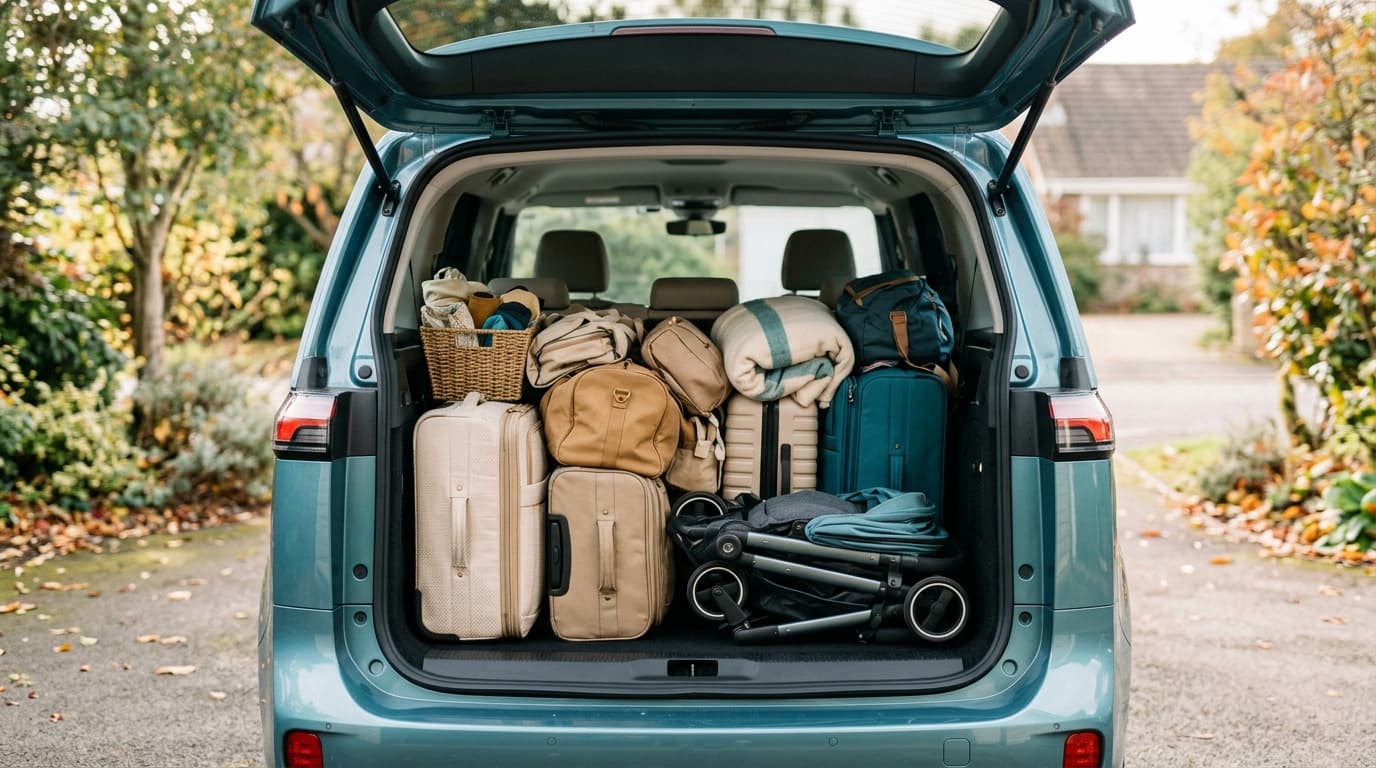
Looking for the family car with the biggest boot in Belgium — without blowing your budget? This ranking crosses real VDA volumes in litres with Belgian list prices and Isofix counts, by price bracket. No hollow superlatives, just numbers.
What does "big boot" actually measure?
A manufacturer advertises 800 litres; you load the pushchair and two suitcases — and it doesn't close. The problem? Gross volume includes unusable corners, space above the parcel shelf and inaccessible depths. The VDA standard measures with standardised blocks: that's the only figure that makes models comparable.
Two other common traps: the loading sill height (the higher it is, the harder it is with a newborn or a heavy car seat) and the floor shape once the rear bench is folded. A flat floor means the pushchair slides in flat — a stepped floor means the pushchair tips over.
Definition signal: in this article, all volumes are in VDA litres, bench in place and measured to the parcel shelf, unless otherwise stated. Sources: manufacturer specs verified on automobiledimension.com and moniteurautomobile.be, June 2026.
Under €20,000: what big boot can you get on a tight budget?
The blunt truth first: under €20,000 new in Belgium, the Dacia Jogger is the only family model that exceeds 700 litres. Full stop.
In 5-seat configuration (third row removed or absent), it reaches 708 litres with a low loading sill and a near-flat floor. From ~€17,900 INCL. VAT for the Eco-G 100 petrol/natural-gas version in Belgium (Dacia.be, May 2026), it offers the best volume-to-euro ratio on the Belgian market. Warning: in the 7-seat version with third row deployed, the boot drops to 160 litres. If boot space is your priority, order the 5-seat or remove the bench.
The Jogger has 3 Isofix anchor points (2 outer rear seats + 1 centre seat on some trim levels): enough for two children in car seats side by side.
708 L
Dacia Jogger 5-seat boot, VDA standard, third row removed — automobiledimension.com June 2026
€20,000–€30,000: does the people-carrier beat the estate?
Yes, and by a wide margin. The Citroën Berlingo XL (or its twin the Peugeot Rifter XL) delivers 775 litres — an absolute record in this price bracket, across all body styles. Available from ~€24,000 INCL. VAT in Belgium for the PureTech 110 engine (Citroën.be, June 2026), it offers a fully flat floor, a wide low-sill tailgate and 4 Isofix anchor points — extremely rare under €30,000.
For a family with two children in car seats and a twin pushchair, this is the most rational choice on the Belgian market in 2026. The Berlingo XL is one of the only models at this price to allow 3 child seats across the rear, thanks to its full 3-seat bench and 4 Isofix anchors. Real downside: low ground clearance — forest tracks and steep speed bumps are not its terrain.
For comparison: the Peugeot 308 SW delivers 548 litres at a similar price (~€26,500), which is 227 litres less than the Berlingo XL. Elegant and dynamic, but not bought for the boot.
| Model | Boot (L VDA) | Isofix | BE price from (INCL. VAT) |
|---|---|---|---|
| Citroën Berlingo XL / Rifter XL | 775 | 4 | ~€24,000 |
| Dacia Jogger (5-seat) | 708 | 3 | ~€17,900 |
| Peugeot 308 SW | 548 | 2 | ~€26,500 |
| Toyota Yaris Cross | 397 | 2 | ~€27,000 |
€30,000–€45,000: Octavia Combi or something else?
The Skoda Octavia Combi stands out here with 640 litres from ~€31,000 INCL. VAT. Not the biggest boot in the table, but the most reliable and lowest-maintenance estate in the segment: proven 1.5 TSI engine, dense Skoda dealer network in Belgium, moderate depreciation. For a family covering 20,000 km/year or more, the 5-year maintenance budget stays among the lowest in the category, per Test-Achats BE data (December 2025).
In the same price range, the Toyota RAV4 Hybrid arrives with 580 litres (~€39,000) and a self-charging hybrid that measurably cuts fuel use in typical Belgian urban conditions (Brussels, Liège, Antwerp): 5.5–6.5 L/100 km vs 7–8 L/100 km for a comparable diesel in mixed driving.
Is a 640-litre boot enough for a family of four and their luggage?
Yes, for most families of four. 640 litres fit two compact pushchairs or two folding bikes plus four cabin bags. The Octavia Combi's flat floor — even in the petrol TSI version — helps slide in long items (ski bags, dismantled surfboard). Only for heavy-duty departures with maximum gear do the 690 L of the Superb Combi make a real difference.
Above €45,000: Superb Combi or Passat Variant?
These two estates share the same declared volume: 690 litres in 5-seat configuration. That's where the details matter.
The Skoda Superb Combi petrol/diesel (from ~€42,000 INCL. VAT) offers the flattest floor in the segment with 1,920 litres rear bench folded, and a slightly more compact footprint than the Passat (4.90 m vs 4.92 m) — easier to park in Brussels. The VW Passat Variant (from ~€44,000) prioritises superior long-distance comfort, remarkable sound insulation and latest-generation IQ.DRIVE driver aids.
Both models offer 2 Isofix anchors at the rear as standard and exist as plug-in hybrids. And that's where the PHEV trap hits hardest — see next section.
Why does a PHEV family car's boot always shrink?
The high-voltage battery of a PHEV always sits under the boot floor, where engineers have the most room. The inevitable result: you lose 80 to 200 litres depending on the model — with no exception on the Belgian market in 2026.
- Skoda Superb Combi iV (PHEV): 510 L → 180 litres less than the petrol/diesel version (690 L). Source: Skoda.be spec sheet, June 2026.
- Peugeot 308 SW PHEV: 467 L → 81 litres less (548 L in petrol).
- VW Passat Variant eHybrid: ~592 L → ~98 litres less than the TDI version.
If you need the biggest possible boot and a clean powertrain for Belgian company car tax in 2026, the only coherent option is full electric: battery between the axles under the floor, boot intact — or even with a flatter floor than the equivalent petrol. The Citroën ë-Berlingo electric (775 L, ~€36,500) and the ID. Buzz LWB (1,121 L, ~€65,000) are the clearest examples.
Which big-boot family car matches your Isofix needs?
The number of Isofix points determines real safety, not just seat count. Two Isofix anchors at the rear are enough for two children; if you have or plan three children, target 3 or 4 anchors.
| Model | Boot (L VDA) | Isofix (no.) | BE price from (INCL. VAT) |
|---|---|---|---|
| Citroën Berlingo XL / Rifter XL | 775 | 4 | ~€24,000 |
| Dacia Jogger (5-seat) | 708 | 3 | ~€17,900 |
| Skoda Superb Combi (petrol/diesel) | 690 | 2 | ~€42,000 |
| VW Passat Variant | 690 | 2 | ~€44,000 |
| Skoda Octavia Combi | 640 | 2 | ~€31,000 |
| Peugeot 308 SW | 548 | 2 | ~€26,500 |
The picture is clear: the Berlingo XL leads on both criteria under €30,000. The Jogger offers the best volume under €20,000 with one extra anchor over the competition. Above €40,000, premium estates (Superb, Passat) match on boot but offer only 2 Isofix.
What total budget should you plan for a big-boot family car in Belgium over 5 years?
Beyond the list price, factor in fuel (basis 15,000 km/year in Belgium), insurance (average RC class for a new family car in Brabant Wallon, ~€900/year in 2026) and manufacturer servicing. Over 5 years, the Dacia Jogger comes to approximately €38,000–€42,000 all-in in natural gas; the Berlingo XL petrol to €47,000–€52,000; the Skoda Superb Combi to €68,000–€76,000. Estimates based on the Test-Achats BE TCO simulator (December 2025 edition).
Big boot or 7 real seats: which should you choose?
This is a false dilemma in most cases. A Dacia Jogger 7-seater with third row deployed has only 160 litres of boot behind it — that's no longer a big boot, it's a parcel shelf. A Berlingo XL 7-seater also loses volume. If boot space is your priority, stick to 5-seat configuration and use the spare seats for extra luggage.
Sources: Dacia.be (prices May 2026), Citroën.be (prices June 2026), Volkswagen.be, Skoda.be, automobiledimension.com (VDA volumes verified June 2026), Test-Achats BE TCO simulator (December 2025), AutoScout24.be (boot comparison 2025).
Comparateur Monospaces & ludospaces
Compare tous les monospaces & ludospaces côte à côte.
Comparer maintenant →
Frequently asked questions
Audrey teste des familiales depuis 2015, maman de deux enfants, basée à Wavre. Elle installe vraiment les sièges Isofix avant de juger l’habitabilité et calcule le budget sur cinq ans, carburant et entretien compris. Sa boussole : peut-on y mettre deux sièges-auto et les courses sans jouer à Tetris ?