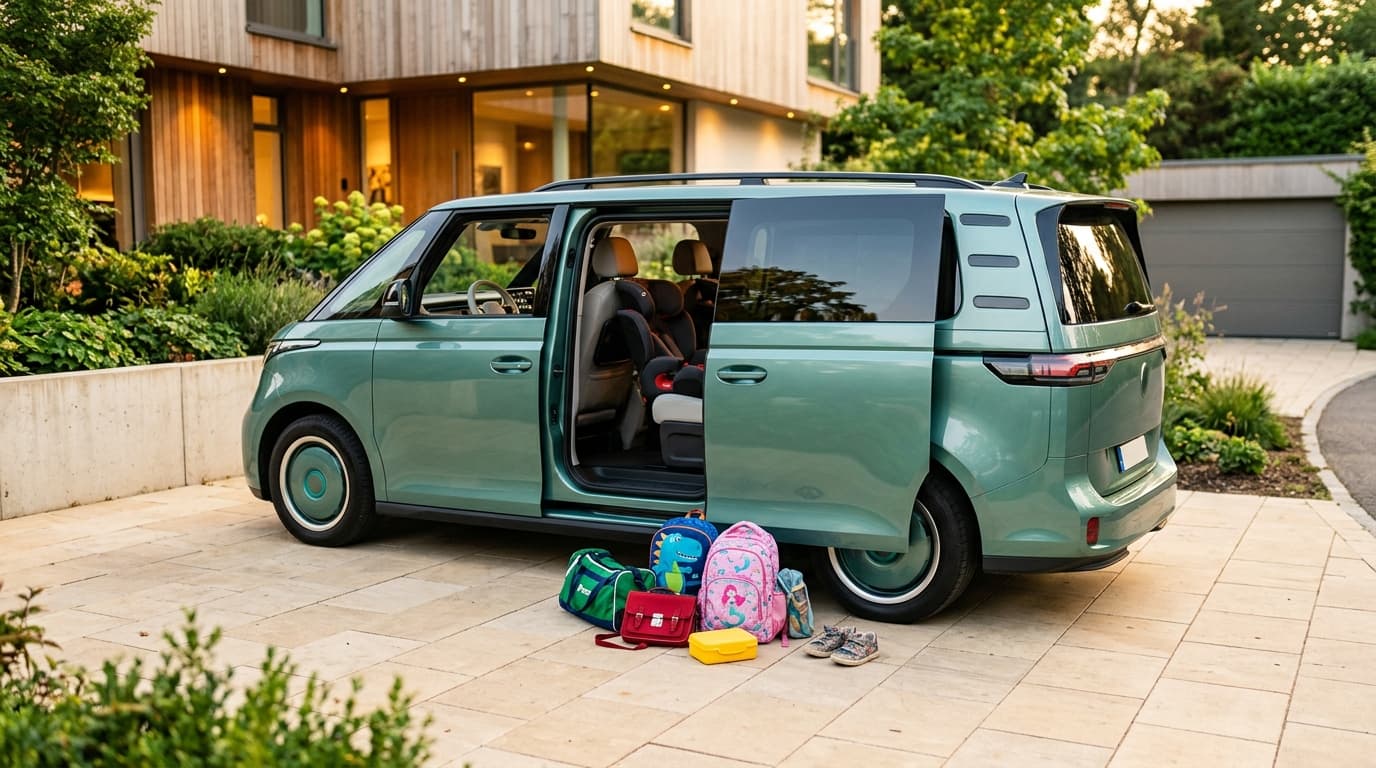
An electric family MPV is a sliding-door van seating 7 to 9, not a rebadged SUV. In Belgium in 2026, five models hold up: the VW ID. Buzz, Mercedes EQV, Citroën ë-SpaceTourer, Peugeot e-Traveller and Ford e-Tourneo Custom. What remains is the range, often modest, and the real boot once every seat is taken. Figures in hand.
What is an electric family MPV?
An electric family MPV is a large, flat-floored vehicle with sliding doors, fully electric, able to seat 7 to 9 people across three rows. Concretely, it is a passenger van, distinct from a 7-seat SUV: it prioritises cabin volume and modularity over ground clearance and looks.
The confusion is everywhere. Most "7-seat electric car" rankings mix raised SUVs, such as the Kia EV9 or Peugeot e-5008, with genuine sliding-door MPVs. For a large family, the difference is concrete: in an SUV the third row is often a stopgap 5+2 where an adult does not fit; in a van, all three rows are designed to be used every day.
Take Nadia and Xavier, in their forties, four children, a house with a garage and a wall box near Charleroi. At the weekend they also carry two friends from the football club: they need eight real seats, not a convertible boot. On the Belgian market, only electric vans truly answer that need. The Citroën ë-SpaceTourer goes up to nine seats depending on configuration, according to Citroën Belgium, where no electric SUV exceeds seven.
Which electric family MPVs are really available in Belgium?
Five electric family vans share the Belgian market in 2026: the VW ID. Buzz LWB, Mercedes EQV, Citroën ë-SpaceTourer, Peugeot e-Traveller and Ford e-Tourneo Custom. All offer at least seven seats across three rows, but their range and price vary twofold.
Here are those five electric MPVs compared on seat count, WLTP range, estimated real winter motorway range (WLTP × 0.60), battery capacity and list price. Manufacturer ranges, winter estimate from the rule of thumb, indicative list prices including VAT (TVAC), recorded in July 2026, excluding options and discounts.
| Model | Seats | WLTP range | Real winter | Battery | Belgian price |
|---|---|---|---|---|---|
| VW ID. Buzz LWB | 7 | 476 km | ~285 km | 86 kWh | from ~€65,000 |
| Mercedes EQV 300 | 8 | 353 km | ~210 km | 90 kWh | from ~€75,000 |
| Citroën ë-SpaceTourer M | 9 | 330 km | ~200 km | 75 kWh | from ~€56,000 |
| Peugeot e-Traveller | 9 | 330 km | ~200 km | 75 kWh | from ~€58,000 |
| Ford e-Tourneo Custom | 8 | ~325 km | ~195 km | 64 kWh | from ~€62,000 |
306 L
Boot of the VW ID. Buzz once its 7 seats are occupied: a giant van with a city-car boot
The reading is clear: the VW ID. Buzz dominates on range and modernity, but its boot collapses to 306 litres when the seven seats are in place, against 2,469 litres with the benches folded, according to Moniteur Automobile. The Citroën ë-SpaceTourer and Peugeot e-Traveller, technical twins from the same Stellantis platform, stay the only ones under €60,000 to offer up to nine seats, but top out at 330 km WLTP. The Mercedes EQV aims upmarket at about €75,000 incl. VAT (€61,990 excl. VAT), a price above that of a 7-seat electric SUV that is often better finished. Our comparison of an electric family car's real range rounds out this table if you are still weighing up an SUV.
What real range for a loaded electric MPV?
Count on the WLTP range times 0.60 on the motorway in winter. An electric van rated 330 km therefore covers only about 200 real km on a January morning at 120 km/h, loaded and heating on. That is the format's main drawback: a brick shape and a high weight heavily penalise range.
An electric MPV commonly weighs 2.5 tonnes empty and presents a huge frontal area. As a result, its consumption climbs fast: Mercedes quotes 28.3 kWh/100 km on average for the EQV, against 16 to 18 kWh for an electric saloon. On the motorway in cold weather, a van can exceed 30 kWh/100 km, and real range falls far more than on a sleek SUV.
For Nadia and Xavier, the sum is direct. A loaded Charleroi–Belgian coast run is about 230 km one way. With an ë-SpaceTourer at 200 real km in winter, that means a charging stop before even reaching Ostend. The VW ID. Buzz, at 285 real km, just about makes it. The signal to keep: on an electric van, you buy the margin and aim for a WLTP range well above your real everyday need.
How many real seats and Isofix anchors can you fit?
An electric MPV lets you fit up to three child seats side by side in the second row, something few SUVs allow. The Citroën ë-SpaceTourer, Peugeot e-Traveller and Mercedes EQV offer three individual seats or a wide, flat bench, with at least two accessible Isofix anchors.
The advantage comes from the flat floor and the sliding doors. In a narrow Belgian supermarket parking space, a sliding door opens fully without risking the neighbouring car, and you clip in a child seat without contorting. The VW ID. Buzz LWB offers a sliding bench in row two and two separate seats in row three, with access eased by 16.5 cm of extra foot space at the back, according to Moniteur Automobile.
What we would avoid: relying on the third row for three tall teenagers on a long trip. Even in a van, rear legroom stays tight, and shoulder width limits comfort to two adults. For three child seats every day, an ë-SpaceTourer's second row stays the benchmark, better than a 7-seat SUV with a stopgap third row.
Are sliding doors worth the extra cost?
For a large family, yes, without hesitation. Sliding doors, often powered on higher trims, transform daily life: children board safely on the pavement side, you reach the centre seat without removing a seat, and you never scratch the car next door. It is the argument that tips many families from the SUV to the van, beyond even the seat count.
Can you tow a trailer or fit a roof box?
Yes, but be careful with range. Most of these vans accept a braked trailer of 750 to 1,000 kg, and a roof box stays possible. Beware, though: towing or loading the roof raises consumption by 20 to 40%, which can drop an ë-SpaceTourer below 150 real km of range in winter. For loaded holidays, better to plan the charging stops accordingly.
What budget and what company-car tax in 2026?
In 2026, no Belgian region still grants a purchase incentive for an electric vehicle to private buyers. The real financial lever of an electric MPV runs through the company: a zero-emission vehicle stays 100% deductible until 31 December 2026, then 95% in 2027 and 90% in 2028 for new orders.
Concretely, list prices run from €56,000 for an ë-SpaceTourer M to nearly €75,000 for a well-equipped EQV. Add charging, far cheaper at home: about €5 to €7 per 100 km on a night tariff, against €20 to €35 on public rapid charging for these heavy consumers. Over 20,000 km a year, the gap quickly tops €2,000, which weighs on the five-year total cost.
For a family like Nadia and Xavier's, who run a small company, registering the van as a professional vehicle changes everything: 100% deductibility in 2026 and recoverable VAT pro rata to professional use. A private buyer pays full price and counts only on the fuel saving. The tax treatment of a plug-in hybrid company car offers a useful benchmark if full electric feels too tight on range.
Is a used electric MPV a good deal in 2026?
Often yes, because depreciation has been severe on this segment. A 2022-2023 ë-SpaceTourer or EQV sometimes trades 30 to 40% below its new price, bringing a large family van into a reasonable budget. The non-negotiable point stays battery state of health (SoH), to aim above 90% and have confirmed. The Belgian Car-Pass secures the mileage history, and a still-active battery warranty, often 8 years or 160,000 km, protects the purchase.
Which electric family MPV to choose for your family?
The right choice depends first on the seats needed and the budget. For versatile family use with a real concern for range and style, the VW ID. Buzz stands out despite its reduced boot at seven seats. For nine seats at the best price, the Citroën ë-SpaceTourer and Peugeot e-Traveller stay unbeatable. For the premium end, the Mercedes EQV dominates, no surprise.
For a large family that drives a lot and loads heavy, these vans' limited range stays the real brake: better to have a home wall box and short daily trips. If your weekends mean long loaded distances, a comparison of the best family hybrids is worth a look before settling on full electric.
The real question is therefore not which electric MPV shows the biggest spec sheet, but which one carries your whole tribe without forcing a charge every 200 kilometres. Count your real seats, measure your motorway share, then let the five-year charging budget speak before you sign.
Comparateur Hybrides & électriques
Compare tous les hybrides & électriques côte à côte.
Comparer maintenant →
Frequently asked questions
Audrey teste des familiales depuis 2015, maman de deux enfants, basée à Wavre. Elle installe vraiment les sièges Isofix avant de juger l’habitabilité et calcule le budget sur cinq ans, carburant et entretien compris. Sa boussole : peut-on y mettre deux sièges-auto et les courses sans jouer à Tetris ?