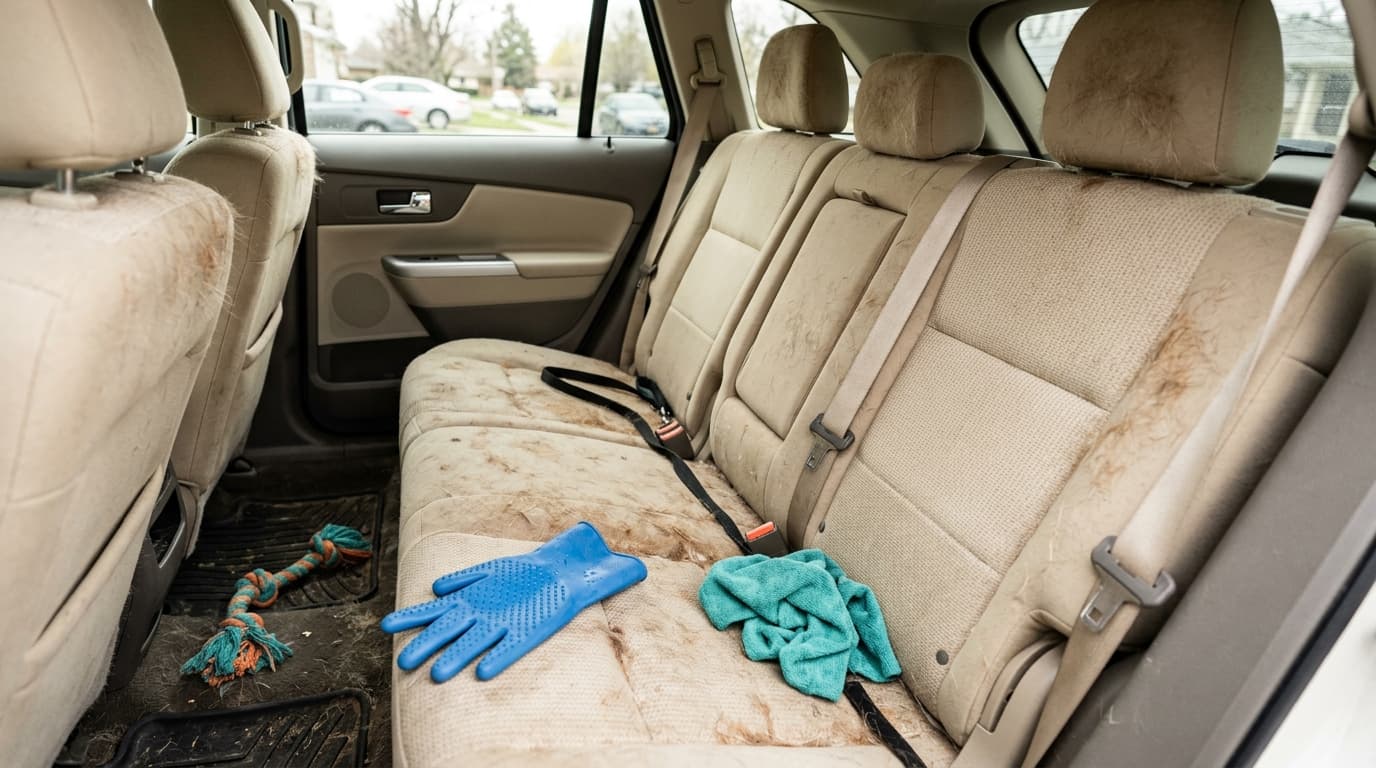
A damp rubber household glove lifts more hair than a €269 vacuum cleaner. Friction does the work; suction only finishes it. What remains is knowing which method suits which surface, and the one place where nothing goes at all: the straps of a child seat harness.
What actually removes dog hair from a car?
A damp rubber glove on fabric, a squeegee on carpet, the vacuum last. In that order, never the reverse. Three euros of kit settles most of the problem.
Dog hair does not behave like dust. Its cuticle is covered in overlapping scales, it picks up a charge at the slightest friction, and it ends up planted in upholstery like a needle in knitwear. A vacuum creates a pressure drop: it carries off what is lying loose and passes straight over what is anchored. Rubber brings an opposite static charge and a mechanical grip. It tears the hair out rather than sucking at it, and that is the whole difference.
Delphine and Cédric live in Marche-en-Famenne, in the Ardennes foothills of southern Belgium, have two children aged 8 and 11, a Bernese mountain dog and a family estate that covers 19,000 km a year. Every spring the moult turns their boot into a rug. They bought a vacuum, then a special nozzle, then a second cordless vacuum. The answer was in the kitchen drawer.
under €3
Price of a pair of rubber household gloves, the tool that lifts the most hair off an upholstered car seat
Why is a vacuum alone never enough?
Because it collects without releasing. A €269 machine and a forecourt vacuum hit the same wall: power changes nothing about how the hair is anchored in the fibre.
This is the part advice pages tend to skip, often because they are selling a vacuum. On the short-pile carpet of a boot, suction alone already does three quarters of the job. On a woven or velour seat it barely does a fifth, and the rest is still visible in raking light three passes later.
The machine keeps its role all the same: collecting what the rubber has rolled into sausages, and clearing the seat rails where hair, sand and crumbs form a compacted felt. A two-centimetre flat nozzle helps more there than another hundred watts.
Which method for which surface?
Every material has its answer, and the wrong one costs you either time or the material itself.
| Surface | What works | What to avoid |
|---|---|---|
| Tight-weave seat fabric | Damp rubber glove, short strokes towards you | The vacuum alone, which glides over the top |
| Velour and looped fabric | Rubber squeegee, then vacuum | Lint roller, which leaves with the fibres |
| Removable floor mats | Out of the car, shaken and brushed outside | Vacuuming them in place |
| Fixed floor and boot carpet | Squeegee then flat nozzle | Dampening before you have lifted the hair |
| Seat rails, seams and hinges | Fine nozzle, compressed air | Any manual method |
| Leather and faux leather | Barely damp microfibre cloth | The squeegee, which marks the surface |
| Child seat cover and harness straps | Hand, or vacuum on low power | Lint roller, pins, household cleaner |
The five mistakes that double the work: dampening the fabric before the hair has been lifted, which glues it down instead of freeing it; leaving the mats in place and vacuuming around them; running a lint roller over velour; starting with the boot when everything falls downwards; and putting the dog back on a seat that is still damp.
Is cat hair any different?
Yes, and it is harder. Cat hair is finer, shorter and far more static: it sits deeper in the fibre and resists a squeegee. The rubber glove is still the right answer, but count two passes instead of one, on fabric that has been very lightly misted rather than left dry. Some will still show in raking light, and no kitchen trick changes that.
Fabric softener leaves a film that catches dust
The trick is everywhere: a few drops of fabric softener in a water spray, mist the fabric, the hair clumps together. It works. The trouble comes afterwards.
Fabric softener is a cationic surfactant designed to cling to the fibre, which is precisely what makes laundry feel soft. Deposited on car upholstery, that greasy film traps dust and darkens a light seat within weeks. Plain misted water gets nearly the same anti-static effect without the deposit.
What should you spend in Belgium?
Three euros. Or nothing at all, if you already own washing-up gloves and a shower squeegee.
Prices checked on 31 August 2026 at GAMMA give the scale of the aisle: the Kärcher WD 3 V-15/4/20 at €84.99, the WD3 V-17/4/20 at €80.99, the WD3 S V-17/4/20 at €109, the WD 4 S V-20/5/22 at €149, the WD5 S V-25/5/22 at €209 and the WD6 P S V-30/6 at €269. Between the first and the last sit €184 and fifteen extra litres of tank. Not one extra hair lifted.
The family arithmetic fits on one line. A glove, a squeegee and twenty minutes a month beat a three-figure machine brought out twice a year. A wet and dry vacuum earns its place for mud, holiday sand and spilled liquids, which we cover in our full method for cleaning a family car interior.
Is a cordless vacuum enough?
For monthly upkeep, yes, and its fifteen to twenty minutes of runtime matches the real length of a pass fairly well. For a spring moult on an estate with a large dog, no: the battery dies before the boot, and the small canister fills up after two seats. A cable running to a garage socket stays more comfortable than a second battery.
What does Belgian law say about dogs in cars?
The animal counts as a load. Article 8.3 of the Code de la route, the Belgian highway code, requires the driver to "keep control of the vehicle or the animals at all times". No crate is legally compulsory in Belgium, but the obligation of result exists and it is federal: the same rule applies in Wallonia, Brussels and Flanders, as Moniteur Automobile, the Belgian motoring magazine, set out in its dossier of 10 May 2026.
The less familiar part comes from Switzerland. The Touring Club Suisse put 19 dog transport systems, among them six harnesses, two mesh cages, four plastic or fabric boxes and seven metal crates, through an avoidance manoeuvre at 70 km/h and a frontal impact at 50 km/h with a 19 kg canine dummy. Not one harness held the animal; only the metal crates were judged worth recommending.
The link with hair is direct. A dog travelling in a crate or behind a boot guard sheds ten times less on the bench, which is to say exactly where the children sit. Safety and the Saturday morning chore share an answer here, and that is rare enough to be worth saying.
How do you stop the hair coming back?
By stopping it arriving. A washable bench cover or a boot liner reduces the chore to a machine wash.
Trixie and the other pet accessory brands distributed in Belgium sell full covers, hammock styles and coated nylon boot liners. The principle matters more than the brand: what goes in the washing machine never has to be scraped with a glove, and a cover costs less than a tired bench does when you sell a used family car.
Two free habits complete the picture: brush the dog outside before letting him in, which removes most of the dead hair, and give him the boot rather than the bench on a large-boot family estate. Delphine and Cédric did both. Their Bernese gained a washable mat, the children got a clean bench back, and Saturday morning went back to fifteen minutes instead of two hours.
The best hair removal is the one you never have to do: a washable cover, a brush outside, the boot instead of the bench. To pick a family car whose boot swallows a dog, a pushchair and the shopping without a painful trade-off, start with our comparison tool.
Comparateur Pas chères & occasion
Compare tous les pas chères & occasion côte à côte.
Comparer maintenant →
Frequently asked questions
Audrey teste des familiales depuis 2015, maman de deux enfants, basée à Wavre. Elle installe vraiment les sièges Isofix avant de juger l’habitabilité et calcule le budget sur cinq ans, carburant et entretien compris. Sa boussole : peut-on y mettre deux sièges-auto et les courses sans jouer à Tetris ?