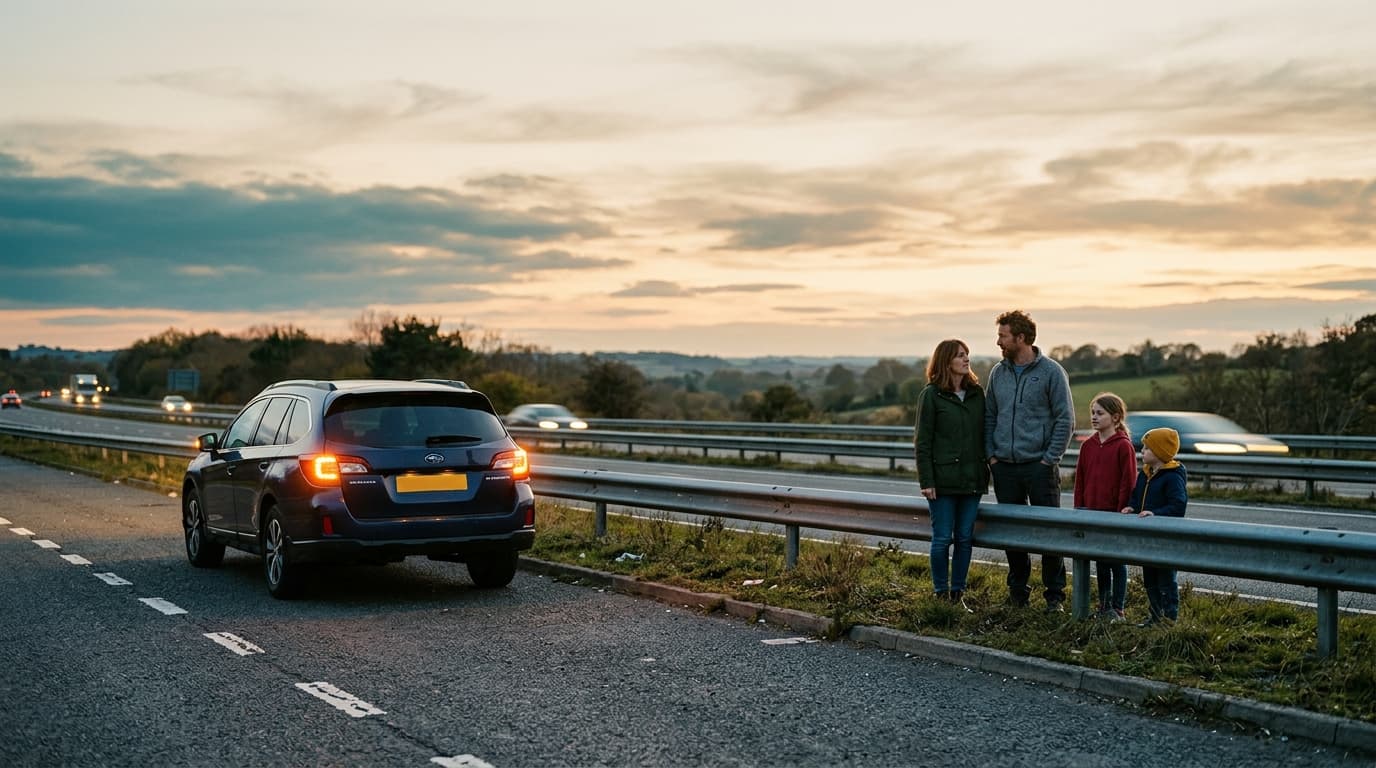
A breakdown with children on board is handled in two steps: get everyone behind the safety barrier, then call the right number for the region you are in. On a Walloon motorway, that means 112 and a fixed €196 bill. And the child seats leave the car with you.
What should you do in the first five minutes?
Get to safety, in this order: hazard lights, vests, out through the right-hand side, family behind the barrier. The phone call comes afterwards. The sequence goes against every parental instinct, which says to leave the little ones strapped into their seats while you hunt for your phone.
That is the most serious mistake on the list. A car stopped on the hard shoulder occupies statistically the most dangerous spot on the motorway, and Vias, the Belgian road safety institute, points out how poorly other drivers respect it. A child seat protects against a crash in normal traffic, not against a lorry at 90 km/h.
Six actions, in order.
- Switch on the hazard lights the moment the car falters. If it is still rolling, push on to a rest area or a refuge lay-by.
- Put your high-visibility vest on before you open the door. The federal police stress that piece of chronology: a vest put on outside protects nobody during the ten seconds you spend standing in the dark at the edge of three lanes.
- Unbuckle the children and get them out on the right-hand side. All of them. Including the baby, including if they are asleep.
- Take everyone behind the safety barrier, well back from the vehicle, never in front of it. One vest each, children included.
- Place the warning triangle at least 100 metres back on a motorway, and only if you can do it without walking on the carriageway. Moniteur Automobile reports that it will disappear from the highway code on 1 June 2027, precisely because setting it down is judged too dangerous.
- Call, and know where you are. Exit number, kilometre marker, direction of travel.
Sofie and Michaël, both in their late thirties, with three children aged 2, 6 and 9, broke down on the E17 on a Friday in late July, twenty kilometres from Kortrijk. For four minutes they did the opposite: hunting for the assistance number with the children still strapped in the back, on the hard shoulder. Nobody had ever told them otherwise.
20 min
Time limit imposed on the F.A.S.T. rapid intervention service to reach the scene after the call, on motorways and ring roads in Flanders
Who do you call: 112, 101, or your provider?
The answer changes with the location, and this is one of the rare Belgian rules that genuinely differs from one region to the next.
In Wallonia, a breakdown on a motorway, ring road or major regional road means calling 112 first: the control room identifies your policy from the number plate and sends an approved recovery operator. In Flanders it is 101 or 112, and the F.A.S.T. service run by the Agentschap Wegen en Verkeer, the Flemish roads agency, attends, secures the scene and clears the vehicle. On an ordinary road the logic reverses: calling 112 for a breakdown is not allowed there.
| Where you are | Who to call | What follows |
|---|---|---|
| Motorway, ring road or major regional road in Wallonia | 112 | Approved recovery operator dispatched by the control room, fixed regional rate |
| Motorway or ring road in Flanders | 101 or 112 | F.A.S.T. truck on site within 20 minutes, tow to the nearest safe place |
| Brussels ring road (R0) | 101 or 112 | The R0 runs through Flemish territory for almost its whole length, so F.A.S.T. attends |
| Tunnel in the Brussels-Capital Region | Emergency call point, then 112 | Tunnel services secure the scene before any recovery |
| Ordinary road, simple breakdown | Your assistance provider directly | 112 is reserved for accidents |
One sentence is worth learning by heart, because it is expensive and it is decided in thirty seconds: insist on being towed to the nearest safe place only, the next exit or a rest area. Touring spells this out for Flanders, where letting F.A.S.T. take you all the way to your garage exposes you to a disproportionate bill.
How much does a motorway breakdown cost in Belgium?
In Wallonia the intervention is charged at a fixed rate, whoever your insurer is: €196 Monday to Friday between 7am and 7pm, €294 at night and on public holidays (rates published by Touring, page updated 1 April 2026, checked on 29 August 2026).
The figure that matters: a breakdown on a Sunday afternoon in Hainaut, towed two kilometres to the nearest exit, costs €294 before the actual repair has even started. The tow to the garage comes afterwards, billed separately. Most Touring policies contribute up to €450 towards a motorway recovery carried out by a third party, which absorbs the regional rate. One explicit exception: the Touring Go policy does not include it by default, you have to add the extended towing option.
€294
Fixed rate for a motorway recovery in Wallonia at night and on public holidays, against €196 during weekday daytime hours
Child seats leave the car with the children
Your car leaves on a flatbed; your children do not. They will continue in a recovery truck, a taxi, a relative's car or a replacement vehicle, and Belgian law grants no favours at that moment.
Article 35 of the highway code requires a suitable restraint for every child under 18 measuring less than 1.35 m. An exception exists for occasional transport, over short distances, in a vehicle with a maximum of eight seats: children aged 3 and over may then travel on the seat belt alone. It is doubly bounded. It never covers children under 3, taxis included, and it does not apply to the children of the person driving.
In practice, for a family: as soon as a child under three is on board, their seat has to come out of the broken-down car and into the next vehicle. Plan for it physically. An infant carrier and a 40-105 cm seat are not carried one-handed along a hard shoulder.
Can five people ride in the recovery truck cab?
No. A cab has two or three approved seats, and the operator is under no obligation to transport the occupants. A family of five with two child seats fits no configuration at all. It is arithmetic, and it is still the most common discovery at the roadside. The fix is contractual: a guarantee covering transport of the occupants, or a replacement vehicle delivered to the scene.
Does your policy carry the whole family?
Get your policy conditions out tonight, not on the day it happens. Belgian contracts almost all cover the car; how many people they move varies enormously.
The points to check, in this order:
- The number of occupants covered for transport or accommodation.
- Assistance from 0 kilometres, outside your own front door. Several Belgian providers offer it, while several motor insurance policies refuse it below a minimum distance.
- The replacement vehicle: duration, conditions, and above all the number of seats. VAB includes one in its extended policies, Touring too, never in the entry-level offer.
- Whether that replacement vehicle has Isofix points, a question to ask on the phone before accepting the car.
- The contribution towards a motorway recovery imposed by the region, the one you did not choose.
- The waiting period after subscribing: taking out cover the night before you leave does nothing for the extended guarantees.
Does assistance cover a breakdown outside your own home?
That depends on the distance excess. VAB, Europ Assistance and Allianz Assistance advertise assistance from your doorstep; the cover bundled into a motor insurance policy often starts beyond a minimum distance. For a family, breaking down outside the school on a Monday morning is more likely than breaking down on the holiday motorway.
And if it happens in France or Germany?
Geographical cover is checked before departure, not at the toll booth. Touring covers Belgium and 100 kilometres beyond our borders in its national policies, and the whole of Europe in the others. Repatriating the vehicle and getting the occupants home are two separate guarantees.
The breakdown bag fits in a boot pocket
A breakdown lasts anywhere from twenty minutes to three hours. With three children behind a safety barrier, the difference comes down to what is in the boot.
| On board | How many | Why it matters on the day |
|---|---|---|
| High-visibility vest | One per occupant, children included | Only one is legally required on board, a family of five needs five |
| Warning triangle | 1 | Required on board, to be placed at least 100 m back on a motorway |
| Head torch | 1 | Reading a policy number without using your hands |
| Charged power bank | 1 | The phone is your only link to the control room |
| Blanket or emergency blanket | One per child | Twenty minutes standing still, even in summer |
| Water and dry biscuits | Enough for an hour | Three children with nothing to do |
Sofie and Michaël waited fifty minutes and carried two child seats three hundred metres. Their policy now covers transport of the occupants. To check the Isofix positions and boot space of your next family car, use our comparison tool, our verdict on rear-facing until what age, our reading of value for money in a family car or our comparison of towbar or boot-mounted bike racks.
Comparateur Pas chères & occasion
Compare tous les pas chères & occasion côte à côte.
Comparer maintenant →
Frequently asked questions
Audrey teste des familiales depuis 2015, maman de deux enfants, basée à Wavre. Elle installe vraiment les sièges Isofix avant de juger l’habitabilité et calcule le budget sur cinq ans, carburant et entretien compris. Sa boussole : peut-on y mettre deux sièges-auto et les courses sans jouer à Tetris ?